The 30-Year Yield Hit 5.26% and US Debt Passed $40 Trillion. Crypto Is Trading Inside That.
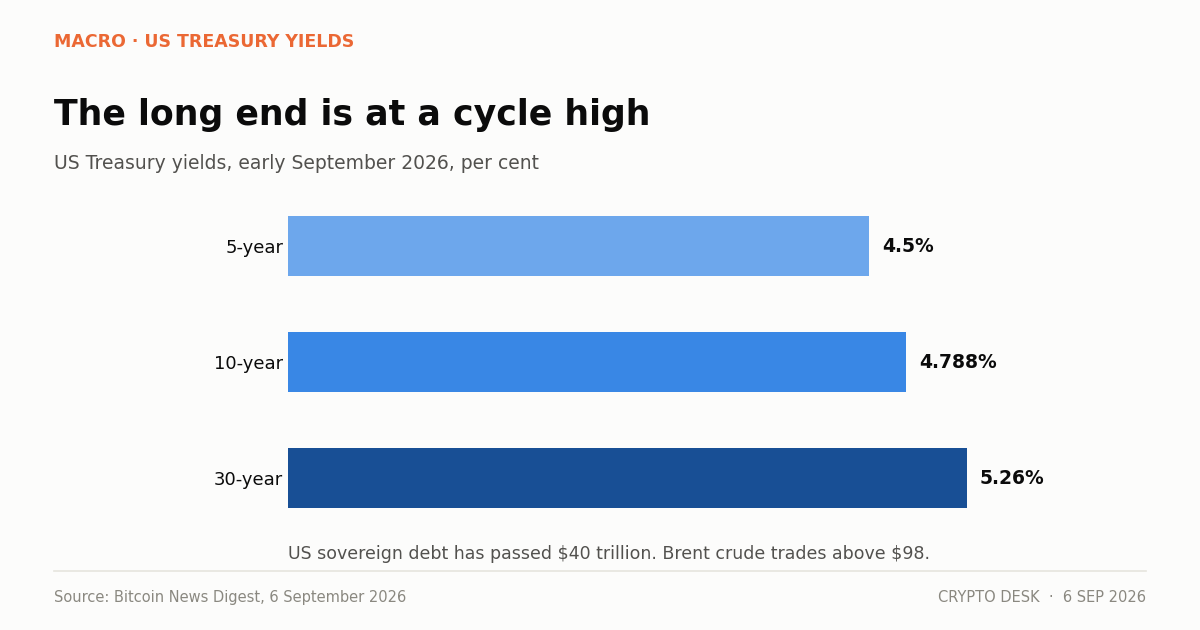
Treasury yields crypto exposure is now inseparable: the 30-year reached a cycle high of 5.26% as US sovereign debt passed $40 trillion and Brent crude held above $98.
On this page
- Treasury yields and crypto: why the long end matters most
- The arithmetic for non-yielding assets
- The debasement trade
- The oil channel
- What the buyers are actually trading
- The mid-August precedent
- What to watch
- The auction nobody watches
- The uncomfortable version
The US 30-year Treasury yield reached 5.26%, a cycle high. The 10-year sits at 4.788% and the five-year at 4.5%. Federal debt has passed $40 trillion. Brent crude trades above $98.
Bitcoin closed the week at $77,024, below its 50-week moving average of $80,300.
Those five numbers are the market. Everything else this week — the ETF flows, the treasury purchases, the correlation shifts — happened inside the frame they set.
Treasury yields and crypto: why the long end matters most
The 30-year yield is the number to watch, and it is not the one that gets the most coverage.
Short-term yields reflect what the Federal Reserve is expected to do over the next year or two. They move on employment data and Fed commentary, and they moved twice this week — down on Governor Christopher Waller's dovish remarks, then back up when August payrolls printed 162,000 against a consensus near 55,000.
The 30-year reflects something different: what investors require to lend to the US government for three decades. It embeds expectations about inflation over that horizon, about the government's fiscal path, and about the risk premium demanded for holding duration. It is much less responsive to any single meeting and much more responsive to the debt trajectory.
A 30-year at a cycle high while debt passes $40 trillion is the bond market attaching a rising cost to a rising debt stock. That is the frame.
The arithmetic for non-yielding assets
Bitcoin has no cash flow. Its value is entirely a claim on future price, discounted to the present.
Raise the long-term discount rate and that present value falls, mechanically, with nothing to cushion it. An equity has earnings to fall back on; a bond has coupons. Bitcoin has neither, which is why it is one of the longest-duration assets in existence and why the 30-year yield matters to it more than the fed funds rate does.
Yet bitcoin rallied roughly 40% from June lows in the high $50,000s while long yields climbed. That apparent contradiction has an explanation, and it is the more interesting part of the current setup.
The debasement trade
The same fiscal picture that raises yields also drives demand for assets held against currency debasement.
Rising debt with rising financing costs is the classic setup for that trade. Gold is the incumbent. Bitcoin has claimed the position for a decade.
The evidence that the trade is live comes from correlation data. Bitcoin's 90-day correlation with gold has risen above 0.50, a six-year high, according to Bitwise analysis of Bloomberg data via the Kobeissi Letter and separately reported by Grayscale's Zach Pandl. Its Nasdaq 100 correlation has fallen from over 60% to around 33%. The bitcoin-to-gold ratio sits at 18 ounces, the highest since January.
So bitcoin is currently caught between two mechanisms that the same fiscal news pushes in opposite directions. Higher long yields lower the present value of a non-yielding asset. Higher debasement risk raises demand for a scarce one. Which dominates on any given day appears to depend on whether the market is focused on the discount rate or the currency.
The oil channel
Brent above $98 adds a third mechanism, and it is unambiguously negative in the near term.
Energy costs feed headline inflation with a lag of roughly one to three months. Higher inflation prints reduce the Fed's room to cut and increase the case to hike, which lifts the front end and pressures long-duration assets.
The live test came on 2 September. US strikes on Iranian targets pushed Brent to a three-month high — a textbook inflation and geopolitical shock, exactly the scenario a debasement hedge should handle. Bitcoin fell to $76,229.
That single data point does more to characterise bitcoin's current behaviour than the correlation table does. The correlation says gold. The behaviour under a real shock said risk asset.
What the buyers are actually trading
US spot bitcoin ETFs hold $103 billion in assets after $3.8 billion of net inflows over three weeks, with August contributing roughly $3.5 billion — the strongest month since October 2025.
The largest single day was $731 million on 3 September, of which about $454 million went to BlackRock's IBIT. The catalyst was Waller's comments on rate policy.
That is the tell. The marginal institutional buyer moved on a Fed governor's remarks about the near-term path, not on the debt stock or the long end. Whatever the gold correlation suggests about the asset's character, the people putting the largest tickets in are trading rates.
The mid-August precedent
One episode illustrates how quickly this can turn.
The US Treasury announced a doubling of liquidity-support buybacks from $2 billion to $4 billion. Yields eased, the dollar softened, and bitcoin ran from under $65,000 to over $80,000 within days.
The effects faded quickly. Which raises the question that hangs over the whole setup: whether the summer advance was a repricing on fundamentals or a liquidity response to a temporary technical operation.
What to watch
The 30-year, not the fed funds rate. A move through 5.5% would be a materially more hostile environment for long-duration assets than another quarter-point at the front end.
Auction demand. Bid-to-cover ratios and indirect bidder participation at long-dated auctions show whether the debt is being absorbed comfortably. Weak auctions move yields faster than data does.
The 16 September dot plot. More informative than the decision, because it shows the committee's own view of the path.
Whether bitcoin holds its gold correlation through the next shock. The 2 September test failed. The next one is the retest.
The auction nobody watches
There is one recurring event that would tell a crypto investor more about the fiscal picture than most of what gets covered, and it happens on a published schedule: long-dated Treasury auctions.
Two numbers matter. The bid-to-cover ratio shows how much demand turned up relative to the size offered. The indirect bidder share approximates foreign and institutional participation as distinct from primary dealers absorbing what nobody else wanted.
A weak long-dated auction — low bid-to-cover, dealers taking an unusually large share — moves the 30-year yield faster than any data release, because it is direct evidence about the willingness to fund $40 trillion of debt at current prices.
For an asset whose valuation is a claim on the distant future discounted at the long rate, that is the most relevant recurring event in the calendar. It is also the one least covered by crypto media, which tends to watch the Fed's short-rate decisions instead.
The uncomfortable version
If the debasement thesis is right, bitcoin should have risen when Brent went above $98 on a geopolitical shock. It fell to $76,229.
If the risk-asset framing is right, bitcoin should have fallen when the 30-year hit a cycle high of 5.26%. It has risen roughly 40% from June lows.
Both frameworks have a live counterexample from the past quarter. Neither framework explains the asset's behaviour completely right now, and anyone claiming otherwise is selecting the episodes that fit.
About this report. Yield levels, debt figures, commodity prices, ETF assets and bitcoin's weekly close are from the Bitcoin News Digest of 6 September 2026. Correlation figures are Bitwise analysis via the Kobeissi Letter and Grayscale research as reported by CryptoPotato. Employment data is from the BLS August release via CNBC.
Not investment advice. Macroeconomic relationships are unstable and this article does not forecast rates.
Related reading
- Fed Hike Odds Pass 60% and Bitcoin Holds $78,900
- Bitcoin $82,000 Resistance: Three Rejections in Two Weeks
- Bitcoin Dominance at 56.9% Leaves Altcoins 32% of the Market
- Crypto Fear and Greed Index Falls to 66 on a Flat Tape
Sources
- Bitcoin News Digest, September 6, 2026 — Mike Richardson
- Bitcoin's Link to Gold Hits a 6-Year High as Tech Correlation Fades — CryptoPotato
- September, Not October, May Test Crypto's Big 2026 Rally — DailyCoin
- U.S. payrolls rose 162,000 in August — CNBC
Read next
- The Fed Chair Says Financial Conditions Are Not Restrictive. Crypto Should Read That Twice. Chairman Kevin Warsh called inflation the Fed's predominant focus with PCE at 3.7%, and said he would be hard…
- Crypto Spent Monday Waiting. Next Week's CPI Print Decides Whether the Fed Hikes. Bitcoin held near $79,350 on 7 September as traders waited on the August CPI report, which economists say cou…
- Three Events in Four Days: Why 15 to 18 September Is the Densest Risk Window of the Quarter The Senate CLARITY Act cloture vote on 15 September, the Fed decision and dot plot on the 16th, and quadruple…