Crypto Spent Monday Waiting. Next Week's CPI Print Decides Whether the Fed Hikes.
The August CPI report crypto reaction is now the whole trade: bitcoin held near $79,350 on Monday while traders waited on a print economists say could swing the Fed between a hike and a hold.
On this page
- Where prices actually stand
- Why the August CPI report matters more than any crypto event
- Why inflation data moves bitcoin more than most assets
- The complication nobody has priced
- What is already priced
- The week's own calendar
- What to watch
- The summary
- What a quiet Monday is actually worth
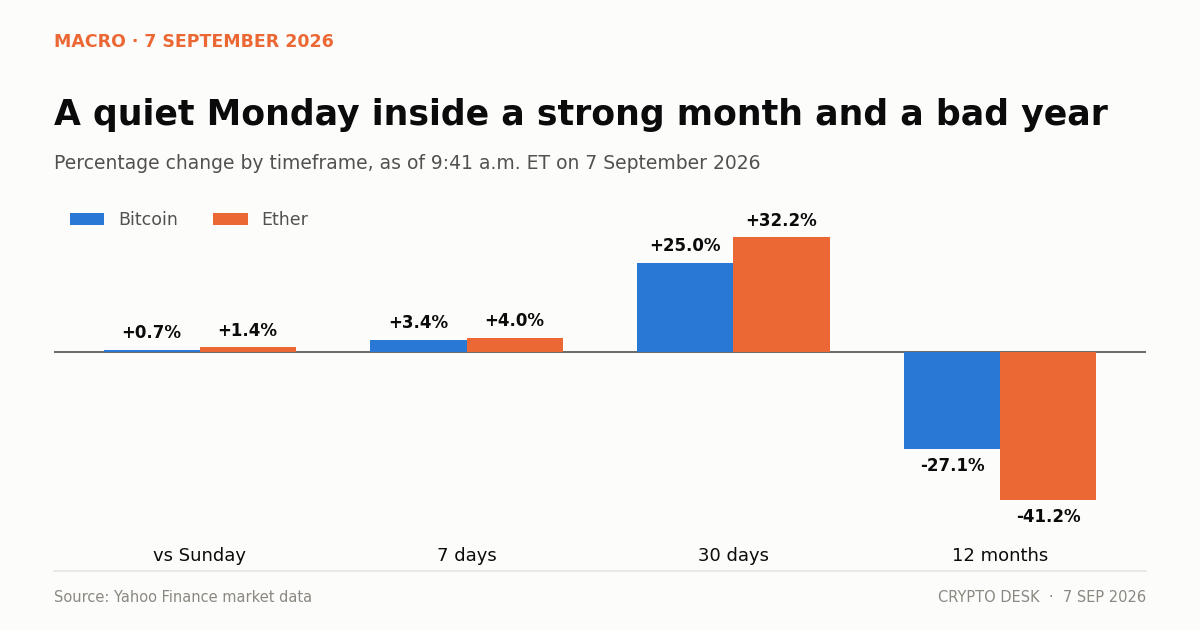
Bitcoin opened Monday 7 September at $80,351.40 and was trading at $79,349.91 by 9:41 a.m. Eastern. Ether opened at $2,514.80 and sat at $2,497.60. Both were higher against Sunday — bitcoin 0.7%, ether 1.4% — and both drifted lower through the morning.
Nothing happened. That is the story.
Where prices actually stand
| Timeframe | Bitcoin | Ether |
|---|---|---|
| Price, 9:41 a.m. ET | $79,349.91 | $2,497.60 |
| 7 days | +3.4% | +4.0% |
| 30 days | +25.0% | +32.2% |
| 12 months | -27.1% | -41.2% |
| All-time high | $126,198.07 (6 Oct 2025) | $4,953.73 (24 Aug 2025) |
The monthly and annual columns are the ones to hold in view. Both assets have had a strong five weeks. Both remain deep in a twelve-month drawdown — bitcoin 37% below its record, ether about 50% below its own.
The global crypto market capitalisation sits near $2.77 trillion, down 0.3% on the day, on $70.8 billion of volume. The Fear and Greed Index reads 71, inside Greed territory.
Why the August CPI report matters more than any crypto event
Friday's employment report is what set this up. Payrolls came in at 162,000 against a consensus near 55,000 — the strongest month since March — with unemployment steady at 4.1% and average hourly earnings up 3.1% over the year.
Bill Adams, chief economist at Fifth Third Commercial Bank, put the consequence plainly: "For the Fed, the jobs report squarely focuses attention on inflation at the next meeting."
That is why the August CPI and PPI releases next week matter more than any crypto-specific event on the calendar. Economists describe those two prints as capable of swinging the decision between a hike and a hold.
Why inflation data moves bitcoin more than most assets
Bitcoin produces no cash flow. Its entire value is a claim on future price, discounted back to the present at whatever rate the market applies.
An equity has earnings underneath it and a bond has coupons. Both fall when the discount rate rises, but both have a floor set by what they actually produce. Bitcoin has no such floor, which is why a change in expected policy passes through to its price with almost no dampening.
That mechanism has held all year, and it explains the past fortnight without reference to anything crypto-specific. US strikes on Iran pushed oil higher and bitcoin fell. Fed Governor Christopher Waller signalled support for a hold and bitcoin rose 5% in a session. The jobs report reversed part of it. Every large move traced to a rates input.
The complication nobody has priced
There are two opposing forces in the current inflation picture, and the CPI print will show which is winning.
Brent crude has been above $98 since the Iran escalation. Energy costs feed headline inflation with a lag of roughly one to three months, so the August print may only partly capture it and the September print will capture more.
Against that, core inflation excludes energy directly, and the Fed watches core. A headline print inflated by oil with a soft core reading is a genuinely ambiguous outcome — and ambiguity, with a committee already split, produces more volatility than a clean number in either direction.
What is already priced
Market-implied odds of a quarter-point hike moved to roughly 59% after the jobs report, up from 52%.
At those levels the market is close to a coin flip with a hawkish lean, which is the most uncomfortable place to be positioned. Any incremental data point moves a near-even probability meaningfully, and that is precisely what produces the pattern of the last two weeks — large daily moves in both directions netting to very little.
What is clearly priced is a single quarter-point move or the absence of one. What is not priced is a sequence. Markets are trading one meeting, not a path.
The week's own calendar
Three scheduled events land between 15 and 18 September and they compound each other.
The Senate votes on cloture for the CLARITY Act at 2:15 p.m. Eastern on 15 September, requiring sixty votes. The Federal Reserve decision and updated dot plot arrive on 16 September. Quadruple witching follows on 18 September.
CPI and PPI land before all of that. By the time the Fed meets, the market will have already repriced on the inflation data, and the dot plot will either confirm or contradict it.
What to watch
Core CPI, not headline. Headline will carry the oil effect. Core is what the committee acts on.
The gap between CPI and PPI. Producer prices lead consumer prices. A hot PPI with a soft CPI signals pass-through still to come.
Whether ETF flows hold through the wait. US spot bitcoin and ether ETFs took in a combined $1.2 billion in the week to 4 September — $986.85 million into bitcoin funds, $218.41 million into ether. Allocators buying into an uncertain data week is a different signal from allocators waiting it out.
The dot plot's 2027 column. More informative than the 2026 one, because it shows whether the committee treats the current level as a peak or a waypoint.
The summary
Bitcoin at $79,350 is up 3.4% on the week and down 27.1% on the year, holding a five-week recovery while the market waits for two data releases that will decide the Fed's September meeting.
Monday produced no news and very little movement. That is what a market looks like when everyone is waiting for the same number.
What a quiet Monday is actually worth
There is a temptation to skip days like this. Nothing moved, so there is nothing to report.
But a market that holds a 25% monthly gain through a hawkish repricing, without giving it back, is telling you something. After the jobs report pushed hike odds to 59%, bitcoin did not break down. It drifted a percentage point and stopped.
That is either genuine underlying demand — the ETF complex took in $1.2 billion in the week to 4 September — or it is a market that has not yet finished processing what it heard.
The CPI print resolves it. A hot number tests whether that demand holds against a hike; a soft one tests whether the recovery has more in it than a relief rally. Either way the answer arrives next week, and Monday's job was simply to get there.
About this report. Prices and timeframe performance are from Yahoo Finance market data at 9:41 a.m. ET on 7 September 2026; other trackers showed bitcoin near $79,794 at different timestamps. Market capitalisation, volume and sentiment figures are from CoinGabbar's 7 September summary. Employment data is from the BLS August release via CNBC. ETF flow figures are from KuCoin's weekly summary.
Not investment advice. Macroeconomic data releases have unpredictable outcomes and market reactions.
Frequently asked questions
When is the August CPI report released?
Next week, alongside the August PPI. Economists describe the pair as capable of swinging the Federal Reserve between a hike and a hold at its 16 September meeting, which is why crypto traded sideways on 7 September.
What is bitcoin's price today?
Bitcoin opened Monday 7 September at $80,351.40 and traded at $79,349.91 by 9:41 a.m. ET — up 3.4% on the week and 25% on the month, but down 27.1% over twelve months.
Why does inflation data move bitcoin so much?
Bitcoin produces no cash flow, so its value is entirely a claim on future price discounted at whatever rate the market applies. Unlike equities with earnings or bonds with coupons, there is no floor to dampen a change in the discount rate.
Related reading
- Fed Hike Odds Pass 60% and Bitcoin Holds $78,900
- Bitcoin $82,000 Resistance: Three Rejections in Two Weeks
- Bitcoin Dominance at 56.9% Leaves Altcoins 32% of the Market
- Crypto Fear and Greed Index Falls to 66 on a Flat Tape
Sources
- Bitcoin and ethereum prices today, Monday, September 7, 2026 — Yahoo Finance
- Crypto News September 7: BTC Falls, ORBIO Gains 160% — CoinGabbar
- U.S. Bitcoin and Ethereum ETFs Attract $1.2 Billion in Weekly Inflows — KuCoin
- U.S. payrolls rose 162,000 in August — CNBC
Read next
- The Fed Chair Says Financial Conditions Are Not Restrictive. Crypto Should Read That Twice. Chairman Kevin Warsh called inflation the Fed's predominant focus with PCE at 3.7%, and said he would be hard…
- The 30-Year Yield Hit 5.26% and US Debt Passed $40 Trillion. Crypto Is Trading Inside That. The 30-year Treasury yield reached a cycle high of 5.26% and US sovereign debt passed $40 trillion, with Bren…
- Three Events in Four Days: Why 15 to 18 September Is the Densest Risk Window of the Quarter The Senate CLARITY Act cloture vote on 15 September, the Fed decision and dot plot on the 16th, and quadruple…