The CLARITY Act Gets One Vote on 15 September. Sixty Senators Decide Its Year.
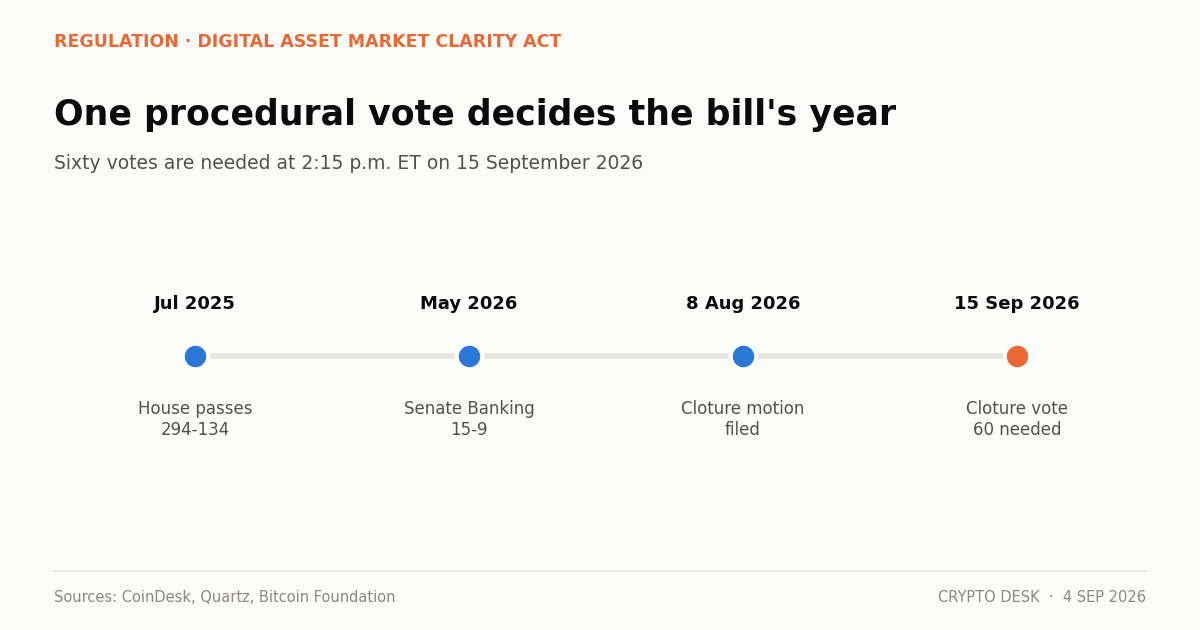
The CLARITY Act vote is a single cloture motion at 2:15 p.m. ET on 15 September 2026, and sixty senators decide whether the crypto market structure bill survives the year.
On this page
- How the bill got here
- What sixty votes actually requires
- The four fights that could sink it
- If cloture fails
- If cloture passes
- What to watch before Monday
- The context nobody in Washington mentions
- The bottom line
- What a failed cloture vote historically means
At 2:15 p.m. Eastern on Monday 15 September, the Senate will vote on a motion to proceed to the Digital Asset Market Clarity Act. It needs sixty votes. If it gets them, the bill moves to floor debate and amendments. If it does not, the crypto industry's most expensive legislative campaign in a decade probably ends for the year.
That is the entire situation, stripped of the noise around it.
How the bill got here
The CLARITY Act has been moving for over a year, and it has cleared harder tests than the one it now faces.
The House passed it in July 2025 by 294 to 134. That margin included 78 Democratic votes, which is not a partisan-line result by any reading. The Senate Banking Committee approved its version in May 2026 by 15 to 9. Majority Leader John Thune filed the cloture motion on 8 August, which set the 15 September clock running.
Senator Cynthia Lummis, one of the bill's principal architects, has said the Senate text absorbed hundreds of pages of Democratic priorities and more than a hundred separate compromises. Whether those concessions bought enough votes is the open question, and the fact that a cloture vote was scheduled six weeks out instead of held immediately suggests the answer was not yet clear in August.
What sixty votes actually requires
Cloture on a motion to proceed is a procedural threshold, not final passage. It only determines whether the Senate will begin debating the bill at all.
That distinction cuts both ways. Some senators will vote for cloture while reserving judgment on the final text, on the argument that a bill deserves debate. Others treat cloture on a motion to proceed as a proxy vote and withhold it precisely to avoid the debate. Vote counting on procedural motions is unreliable for exactly this reason.
The arithmetic still demands a meaningful number of Democratic votes. Republicans do not hold sixty seats. The 78 House Democrats who backed the bill last year established that bipartisan support exists in principle; the Senate has fewer members and a narrower set of persuadable votes.
The four fights that could sink it
Four issues have consistently produced friction, and none of them is really about market structure in a technical sense.
Ethics restrictions on officials with crypto holdings. Several Democratic senators want the bill to include restrictions on federal officials holding or promoting digital assets. Republicans have generally resisted attaching those provisions to a market structure bill. This is the most politically charged item on the list and the least amenable to technical compromise.
Anti-money-laundering provisions. The scope of AML obligations, particularly as applied to non-custodial software, has been contested throughout. The gap is between senators who want parity with bank obligations and those who argue that parity is technically impossible for software that never holds customer assets.
DeFi limitations. Where the line sits between a regulated intermediary and a protocol nobody controls remains unsettled. The bill draws a line. Neither side is fully satisfied with where.
Stablecoin yield and rewards. Whether stablecoin issuers or their distribution partners may pass returns to holders has become a proxy fight between the banking lobby, which sees deposit flight, and crypto firms, which see a competitive product. The GENIUS Act left the question partly open, and it has resurfaced here.
If cloture fails
The consequence is not that crypto goes unregulated. It is that crypto keeps getting regulated by agencies, not by statute.
The SEC has already proposed Regulation Crypto Assets, its offering framework, on 18 August. Banking regulators are working through GENIUS Act implementation, with final stablecoin rules due and enforcement scheduled to begin in January 2027. The CFTC continues to develop its own approach through its advisory committees, where Ripple's Brad Garlinghouse has participated in innovation committee discussions.
All of that continues regardless. What the country would lack is a statute that assigns jurisdiction. Agency rules can be rewritten by the next administration in a way that a statute cannot. Firms making ten-year infrastructure decisions notice that difference, and it is the strongest argument the bill's supporters have.
Prediction markets have been marking down the odds of 2026 enactment through August. That is a signal about expectations rather than a forecast, but the direction has been consistent.
If cloture passes
Passage of cloture would open floor debate and an amendment process, and that is where the real risk shifts. An amendment process on a bill this contested can attach provisions that cost more votes than they gain. A bill that clears cloture at 60 or 61 has very little room to absorb a controversial floor amendment and still pass.
There is also the calendar. Appropriations and the year-end legislative crush consume September through December. Floor time is the scarcest resource in the Senate, and a bill that needs a week of it competes against everything else on the leadership's list.
What to watch before Monday
Three signals will tell you more than any headline.
Whether the vote gets rescheduled. Cloture votes get pulled when the count is not there. A postponement announced in the days before 15 September would be the clearest possible tell.
Statements from undecided Democratic senators. Public positions in the week before a cloture vote are usually negotiated positions, not spontaneous ones.
Whether a manager's amendment appears. A substitute text released before the vote would signal that a deal was struck on at least one of the four contested issues.
The context nobody in Washington mentions
Prices are not helping the industry's case. Bitcoin trades around $76,600, down roughly 29% over twelve months. Ether is down about 44%. August's ETF inflows were strong, but the twelve-month picture is a bear market.
Legislators respond to salience. A bill that felt urgent in the autumn of 2025, with bitcoin above $120,000 and a wave of new products launching, competes for attention differently in a year when the sector's headline assets have lost a quarter to nearly half their value. That is not a reason to write or reject legislation, but it is a reason floor time is harder to get.
The bottom line
One procedural vote, sixty votes needed, 2:15 p.m. Eastern on 15 September. The bill has already cleared a 294-134 House vote and a 15-9 committee vote. It has absorbed over a hundred compromises. Whether that was enough will be known within about ten days.
What a failed cloture vote historically means
Cloture failing on a motion to proceed is not always fatal. Bills have been brought back in the same session after an initial failure, usually following a renegotiation that produces a substitute text.
What makes 2026 harder than the typical case is the calendar. A renegotiation takes weeks. Weeks from mid-September runs into the appropriations period, and appropriations consume floor time through the autumn. After that, the political calendar begins reshaping every legislative calculation, and members grow reluctant to cast votes on contested subjects.
There is also the question of whether the industry's coalition holds. The bill's supporters have spent eighteen months keeping a diverse group aligned — exchanges, banks entering custody, stablecoin issuers, DeFi developers — whose interests conflict on several of the four contested issues. A failed vote followed by a renegotiation is exactly the circumstance in which such a coalition fragments, because each member is asked to give up something different.
About this report. Procedural details, vote counts and dates come from CoinDesk's Senate coverage, Quartz, and the Bitcoin Foundation's 31 August status report. Where sources did not provide senator-by-senator counts, this article does not estimate them.
Not legal or investment advice. Legislative outcomes are uncertain and this article does not predict one.
Frequently asked questions
What is the CLARITY Act vote on 15 September?
It is a cloture vote on the motion to proceed, filed by Majority Leader John Thune on 8 August. Sixty votes are required to open floor debate. It is a procedural threshold, not final passage of the bill.
What happens if the CLARITY Act fails cloture?
Crypto continues to be regulated by agencies instead of by statute. The SEC's Regulation Crypto Assets proposal proceeds, GENIUS Act stablecoin rules move toward January 2027 enforcement, but the US keeps no statutory allocation of SEC and CFTC jurisdiction.
Which issues are holding the bill up?
Four: ethics restrictions on federal officials holding crypto, the scope of anti-money-laundering obligations, where regulation stops for decentralised finance, and whether stablecoin issuers may pass yield to holders.
Related reading
- Asia Stablecoin Regulation: Japan, Hong Kong and Korea Move
- Crypto Exchange Bank Charters: Three Very Different Routes
- ESMA MiCA to MiFID II: Europe's Dual Licensing Pathway
- CLARITY Act Vote on 15 September Is Barely Priced
Sources
- CLARITY Act Hits a September 15 Deadline — Bitcoin Foundation
- U.S. Senate opens first stage of crypto Clarity Act voting — CoinDesk
- Senate won't vote on crypto Clarity Act before its summer break — CoinDesk
- Senate delays Digital Asset Market Clarity Act vote to September — Quartz
- Crypto enters September with legislative policy gamble hanging by a thread — CNBC
Read next
- The CLARITY Act Vote Lands on 15 September, and the Rate Market Is Louder Than the Senate The CLARITY Act vote on 15 September needs sixty Senate votes, but crypto is trading Fed hike odds above 60% …
- The SEC Asked 27 Questions About Crypto ETFs. The Answers Decide Whether Staking Funds Can Exist. The SEC's crypto ETF rules review closed to comment on 31 August. Release 33-11426 asks 27 questions on Rule …
- Japan's Banks Can Issue Stablecoins, Hong Kong Is Licensing, and Korea Will Tax Tokenized Stocks Asia stablecoin regulation is accelerating: Japan''s Payment Services Act lets banks issue, Hong Kong is lice…