Japan's Banks Can Issue Stablecoins, Hong Kong Is Licensing, and Korea Will Tax Tokenized Stocks
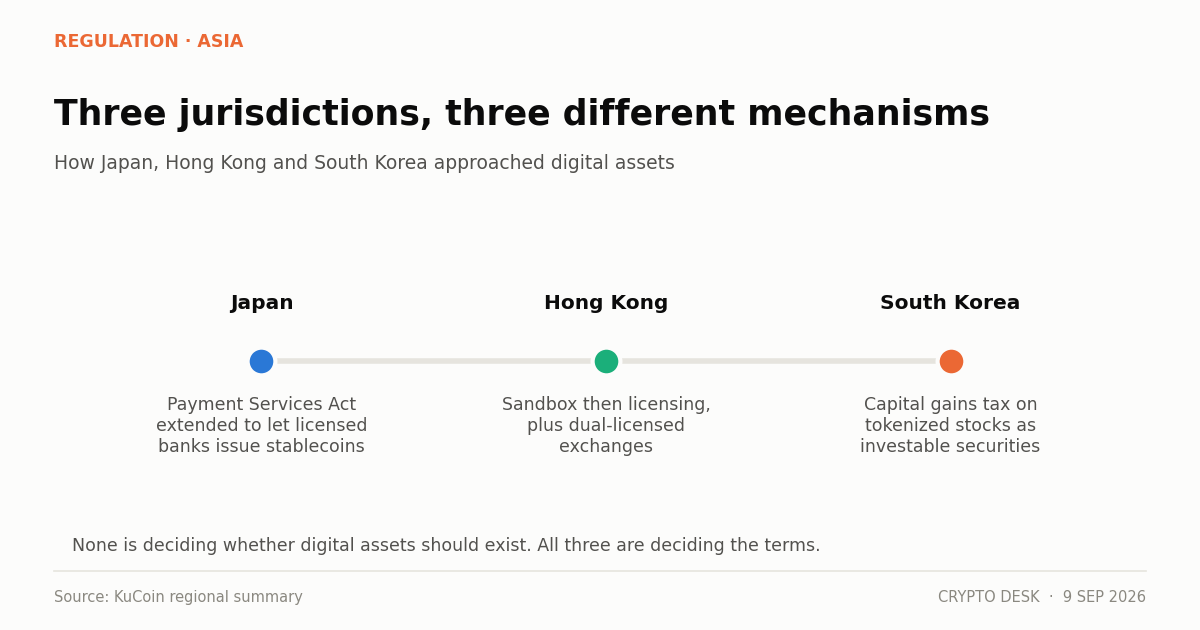
Asia stablecoin regulation moved on three fronts at once: Japan's Payment Services Act now permits bank issuance, Hong Kong is building a licensing regime, and South Korea will tax tokenized stocks.
On this page
- Japan: issuance through the banking system
- Hong Kong: a licensing regime after a sandbox
- South Korea: taxing the product, not the technology
- What the three have in common
- What is not yet public
- What to watch
- What Asia is not doing
Three Asian jurisdictions moved on digital assets in the same window, and each solved a different problem. Together they describe a region approaching the same question from three directions while the United States argues about jurisdiction.
Japan: issuance through the banking system
Japan amended its Payment Services Act to allow stablecoin issuance, with eligibility restricted to licensed banks, trust companies and registered money transfer agents. Both yen and dollar denominations are contemplated, and banks are actively preparing to issue.
The design choice is the interesting part. Japan did not create a new licence category for stablecoin issuers. It extended an existing one, which means every issuer arrives already supervised, already examined and already inside the deposit and AML framework.
That is the opposite of the American approach, where the GENIUS Act built a bespoke regime and then had to classify issuers as financial institutions under the Bank Secrecy Act to bring them into supervision. Japan started from the supervised entity and added the product.
It is slower to open and far harder to arbitrage.
Hong Kong: a licensing regime after a sandbox
Hong Kong ran a sandbox for stablecoin issuers earlier in the year and has been targeting a regulated regime, with the Monetary Authority operating the framework for issuers.
Hong Kong's broader strategy is visible in its exchange licensing. OKX holds a Type 1 securities dealer licence alongside a Virtual Asset Service Provider licence — the first exchange globally to hold crypto and securities dealer licences simultaneously in one jurisdiction. HashKey Exchange operates under a VASP licence with co-custody infrastructure provided by HSBC and Standard Chartered.
That combination — a stablecoin regime plus dual-licensed exchanges plus bank custody — is a deliberate attempt to make Hong Kong the venue where tokenized securities and crypto trade in the same regulated place.
South Korea: taxing the product, not the technology
South Korea will apply capital gains tax to tokenized stocks, treating tokenized equities as investable securities.
That sounds administrative and is not. Tax treatment is the clearest statement a government makes about what something is. By taxing tokenized equities the same way it taxes equities, Korea has settled the classification question that the United States is still litigating through SEC rulemaking and a stalled market structure bill.
It also removes a specific arbitrage. If a tokenized share is taxed differently from the share it represents, capital moves to the cheaper wrapper for reasons unrelated to the underlying investment. Korea has closed that gap before the market opened.
What the three have in common
None of them is trying to decide whether digital assets should exist. All three are deciding the terms.
That is a different posture from the American debate, where the CLARITY Act faces a Senate cloture vote on 15 September needing sixty votes, and where failure would leave the country without a statute allocating jurisdiction between the SEC and CFTC.
The competitive consequence is straightforward. A firm choosing where to build a stablecoin or a tokenized securities venue in 2027 can get a licence in Hong Kong, issue through a bank in Japan, and know its tax treatment in Korea. In the United States it can read a proposed rule and wait.
What is not yet public
The reporting on all three carries the same limitation, and it is worth stating instead of glossing.
No specific Japanese institution has been named with a launch date. Hong Kong's licence numbers and approved issuers have not been published. Korea's tax rate for tokenized equities and its effective date were not specified.
These are framework announcements. The implementation detail — which determines whether any of it works — is still to come.
What to watch
The first named Japanese bank issuer. Framework to product is where these things stall.
Hong Kong's first published licence list. It will show whether the regime is open or effectively closed to incumbents.
Korea's rate and effective date. A punitive rate would defeat the purpose of classifying tokenized equities as securities.
Whether Western consortia route through Asia. Twenty-one banks including Goldman Sachs and Citi are building a stablecoin joint venture for the first half of 2027, and Qivalis has 37 European institutions behind a euro token. Where they seek licences first will say a great deal about which regime is actually workable.
What Asia is not doing
The absence is as informative as the activity.
None of these jurisdictions is trying to determine whether a token is a security through case-by-case adjudication. Japan extended an existing licence category. Hong Kong issues dual licences. Korea settled the question through tax treatment.
The American approach — establishing classification through enforcement actions and then, belatedly, through rulemaking — produced nine years of uncertainty and is still unresolved, with the CLARITY Act facing a vote it may not survive.
The Asian regimes are not obviously better designed. They are more decided. For a firm choosing where to build, decided beats well-designed, because a decided regime can be complied with and an undecided one cannot.
That is the competitive dynamic, and it does not require anyone to think Hong Kong's rules are superior.
About this report. Framework details for Japan, Hong Kong, South Korea and Malaysia are from KuCoin's summary of Asian stablecoin developments. Exchange licence details for OKX and HashKey are from Yellow's research on exchange bank-charter pivots. The reporting does not specify institution names, licence numbers, tax rates or effective dates, and this article does not supply them.
Not legal or investment advice. Regulatory frameworks change and implementation detail is pending in all three jurisdictions.
Frequently asked questions
Can Japanese banks issue stablecoins?
Yes. Japan amended its Payment Services Act to allow stablecoin issuance by licensed banks, trust companies and registered money transfer agents, in yen or dollar denominations. Banks are actively preparing, though no specific institution has been named with a launch date.
What is Hong Kong doing on stablecoins?
It ran a sandbox for issuers earlier in the year and has been targeting a regulated regime under its Monetary Authority. Alongside that, OKX holds a Type 1 securities dealer licence with a VASP licence, and HashKey operates with co-custody from HSBC and Standard Chartered.
How will South Korea tax tokenized stocks?
It will apply capital gains tax, treating tokenized equities as investable securities. The rate and effective date were not specified in the reporting. Taxing them identically to the underlying shares closes an arbitrage before the market opens.
How does this compare to the United States?
Asia is deciding terms instead of deciding whether. The US CLARITY Act faces a Senate cloture vote on 15 September needing sixty votes, and failure would leave the country without a statute allocating jurisdiction between the SEC and CFTC.
Related reading
- Crypto Exchange Bank Charters: Three Very Different Routes
- ESMA MiCA to MiFID II: Europe's Dual Licensing Pathway
- CLARITY Act Vote on 15 September Is Barely Priced
- Tokenized Equities: The Custody Problem Banks Are Solving
Sources
- Asia's Stablecoin Acceleration: Japan Banks, Hong Kong Rules, and South Korea Tax Tokenized Assets — KuCoin
- Binance, Coinbase, And Kraken Are Becoming Full Banks — Yellow
- Stablecoins in 2026: Regulatory Landscapes in Singapore, Japan, Taiwan, South Korea, Europe — XREX
- Regulatory Regime for Stablecoin Issuers — Hong Kong Monetary Authority
Read next
- The CLARITY Act Vote Lands on 15 September, and the Rate Market Is Louder Than the Senate The CLARITY Act vote on 15 September needs sixty Senate votes, but crypto is trading Fed hike odds above 60% …
- The SEC Asked 27 Questions About Crypto ETFs. The Answers Decide Whether Staking Funds Can Exist. The SEC's crypto ETF rules review closed to comment on 31 August. Release 33-11426 asks 27 questions on Rule …
- Russia's Crypto Law Took Effect on 1 September. Its Largest Bank Will Lend Against Bitcoin. Russia's digital-asset framework took effect 1 September 2026. Sberbank plans bitcoin-backed loans, with ETH …