Russia's Crypto Law Took Effect on 1 September. Its Largest Bank Will Lend Against Bitcoin.
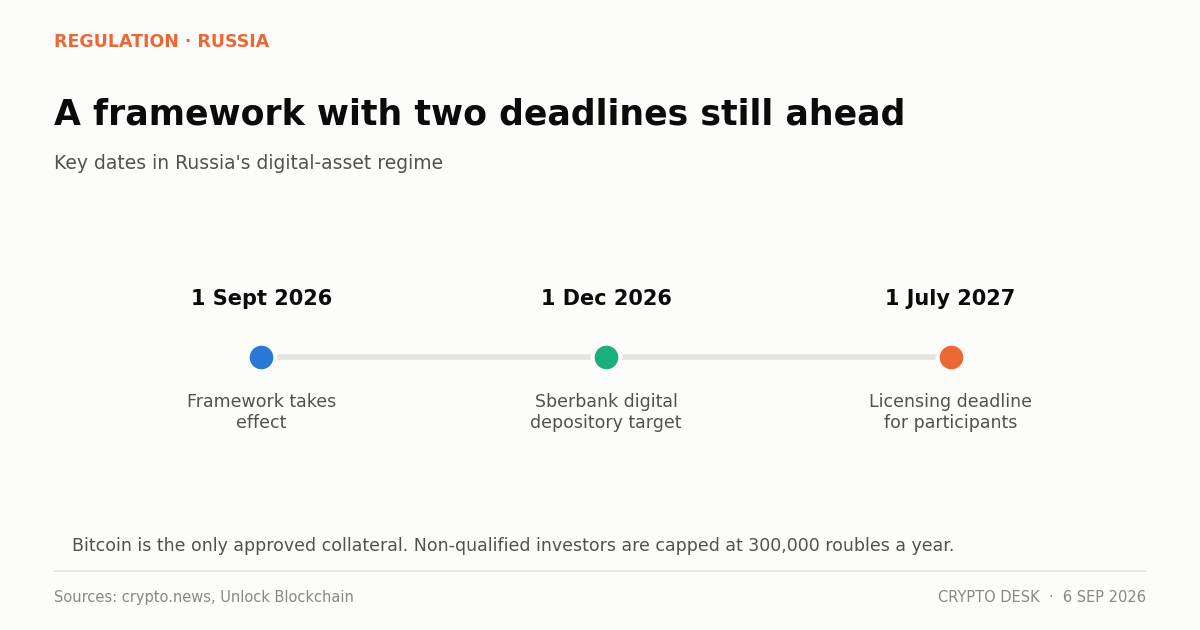
Sberbank bitcoin collateral lending becomes possible under Russia's digital-asset framework, which took effect on 1 September 2026 under Bank of Russia supervision.
What the framework actually does
The law builds an infrastructure layer, not simply permitting or banning activity. It brings banks, brokers, asset managers, exchanges and digital depositories into a supervised structure under the Bank of Russia.
The investor rules are the distinctive part:
Non-qualified investors must pass a mandatory knowledge assessment and may purchase up to 300,000 roubles of eligible cryptocurrency per year through each intermediary.
Qualified investors face fewer restrictions but still require testing.
Payments remain prohibited. Cryptocurrency cannot be used domestically for goods and services. Cross-border settlement is permitted.
That last provision explains much of the framework's design. A system that permits cross-border settlement while prohibiting domestic payments is one built with trade and sanctions circumvention in mind rather than retail commerce.
Sberbank's position
Deputy Chairman Anatoly Popov set out the sequencing plainly: the bank would add ether and USDT as collateral "after the Central Bank, of course, allows them for public circulation."
Bitcoin is currently the only approved asset. Sberbank completed a pilot in December 2025 with Russian mining company Intelion Data, using mined cryptocurrency as collateral — which is a sensible first case, since a miner's holdings have a documented provenance that an arbitrary customer's do not.
The bank targets 1 December 2026 for launching a digital depository to manage customer ownership, wallets and settlement. Market participants have until 1 July 2027 to obtain the necessary licences.
Loan terms, fees, withdrawal limits and eligible customer segments have not been disclosed.
The pattern this fits
Crypto-backed lending by regulated banks is not a Russian phenomenon. It is a global one, and it has accelerated through 2026.
In the US, the Federal Housing Finance Agency has directed Fannie Mae and Freddie Mac to count cryptocurrency held on regulated exchanges toward single-family mortgage reserves without conversion to dollars, with bitcoin and USDC eligible at launch. Lenders have begun building products on it.
The common structure is instructive. In both cases the asset is not being used as money. It is being used as a balance-sheet item that a lender will underwrite against — collateral, or evidence of reserves. That is a far more conservative role than "currency," and it is the role banks understand.
It is also the role that produces the deepest institutional integration over time. An asset a bank will lend against is an asset with custody arrangements, valuation methodology, haircut policy and liquidation procedures. Those are the pipes that matter.
The obvious caveats
Three, and they should be stated instead of glossed.
Russia is under extensive sanctions. A framework permitting cross-border crypto settlement while prohibiting domestic payments invites the reading that it is designed partly to facilitate trade outside the dollar system. Whether that succeeds is a separate question from whether it is intended.
Announcements are not products. Sberbank has described plans and completed one pilot. The depository launches in December, licensing runs to July 2027, and no terms have been published. There is considerable distance between a deputy chairman's remarks and a loan a customer can take out.
Central bank approval gates most of it. Ether and USDT are not permitted. The Bank of Russia has been consistently more restrictive than the banks it supervises, and the framework gives it the deciding vote.
Why it matters anyway
Because the direction of travel across jurisdictions is now unmistakable.
The US has a stablecoin statute in implementation, an SEC offering framework out for comment, a market structure bill facing a Senate vote on 15 September, and mortgage guidance counting bitcoin as reserves. Europe's MiCA is in enforcement. Asian jurisdictions have moved to licensing regimes through 2026. Hong Kong has stablecoin beta testing under way. Russia now has a supervised framework with its largest bank building on it.
These regimes differ substantially in design and in intent. What they share is the assumption that digital assets are a permanent category requiring regulation, not a phenomenon to be suppressed. That assumption was contested as recently as 2023.
For an asset class whose central regulatory question was existential for a decade, the shift from "will this be allowed" to "under what terms" is the larger story, and it is happening in places that do not agree with each other about anything else.
What to watch
Whether the December depository launches on time. Infrastructure deadlines in new frameworks slip routinely.
Whether the Bank of Russia approves ether and USDT. The scope of eligible collateral determines the framework's practical reach.
Published loan terms. Loan-to-value ratios and liquidation thresholds are where the actual risk appetite shows.
Whether other large banks follow. One state-linked bank is a policy pilot. Several is a market.
The comparison worth drawing
Set Russia's framework beside the US one and the difference is instructive, because they solve opposite problems.
The US framework is built around investor protection and market integrity. Its central questions are which agency has jurisdiction, what disclosure an issuer owes, and how a fund may custody assets. The CLARITY Act, the SEC's offering proposal and the GENIUS Act stablecoin rules all address versions of that question.
Russia's framework is built around channel control. Its central questions are who may participate, through which supervised intermediaries, up to what limits, and for which purposes — with domestic payments prohibited and cross-border settlement permitted. The 300,000-rouble annual cap for non-qualified investors is a control on retail exposure, not a disclosure regime.
Both are regulation. They are regulating different things for different reasons, and an asset that satisfies one has done nothing to satisfy the other.
That is the practical reality of a globally traded asset entering national regulatory systems: compliance is not portable, and the frameworks are diverging rather than converging.
Why the licensing deadline matters
Market participants have until 1 July 2027 to obtain licences. That date, rather than the 1 September effective date, is when the framework's real shape becomes visible.
Frameworks are judged by who ends up licensed. If a handful of state-linked institutions hold the licences and independent exchanges do not, the regime is a channel-control mechanism. If a genuinely diverse set of intermediaries qualifies, it is a market. Nothing published so far settles which it will be.
About this report. Framework details, investor limits, timelines and Sberbank's plans are from crypto.news reporting and the accompanying coverage of Anatoly Popov's remarks. The FHFA comparison is from the agency's directive as reported by Fox Business. The effective date and the Sberbank collateral plan are also noted in the Bitcoin News Digest of 6 September 2026.
Not legal or investment advice. Cross-border regulatory frameworks carry sanctions and compliance implications that are jurisdiction-specific.
Frequently asked questions
When did Russia's crypto law take effect?
1 September 2026. It creates a regulated ecosystem supervised by the Bank of Russia covering banks, brokers, asset managers, exchanges and digital depositories. Sberbank targets 1 December 2026 for its digital depository.
Which assets can Sberbank accept as collateral?
Bitcoin only at present. Deputy Chairman Anatoly Popov said ether and USDT would be added 'after the Central Bank, of course, allows them for public circulation'. A December 2025 pilot used mined crypto from Intelion Data.
Related reading
- Asia Stablecoin Regulation: Japan, Hong Kong and Korea Move
- Crypto Exchange Bank Charters: Three Very Different Routes
- ESMA MiCA to MiFID II: Europe's Dual Licensing Pathway
- CLARITY Act Vote on 15 September Is Barely Priced
Sources
- Sberbank plans BTC, ETH and USDT-backed loans — crypto.news
- Crypto-Backed Lending Spreads to Russia as Sberbank Joins Global Bank Push — Unlock Blockchain
- The Largest Bank in Russia Plans Crypto-Backed Loans Ahead of Regulation — BitKE
- Bitcoin News Digest, September 6, 2026 — Mike Richardson
Read next
- The CLARITY Act Vote Lands on 15 September, and the Rate Market Is Louder Than the Senate The CLARITY Act vote on 15 September needs sixty Senate votes, but crypto is trading Fed hike odds above 60% …
- The SEC Asked 27 Questions About Crypto ETFs. The Answers Decide Whether Staking Funds Can Exist. The SEC's crypto ETF rules review closed to comment on 31 August. Release 33-11426 asks 27 questions on Rule …
- Japan's Banks Can Issue Stablecoins, Hong Kong Is Licensing, and Korea Will Tax Tokenized Stocks Asia stablecoin regulation is accelerating: Japan''s Payment Services Act lets banks issue, Hong Kong is lice…