Your Bitcoin Can Now Count Toward a Mortgage — Without Selling It. Here Is How That Actually Works.
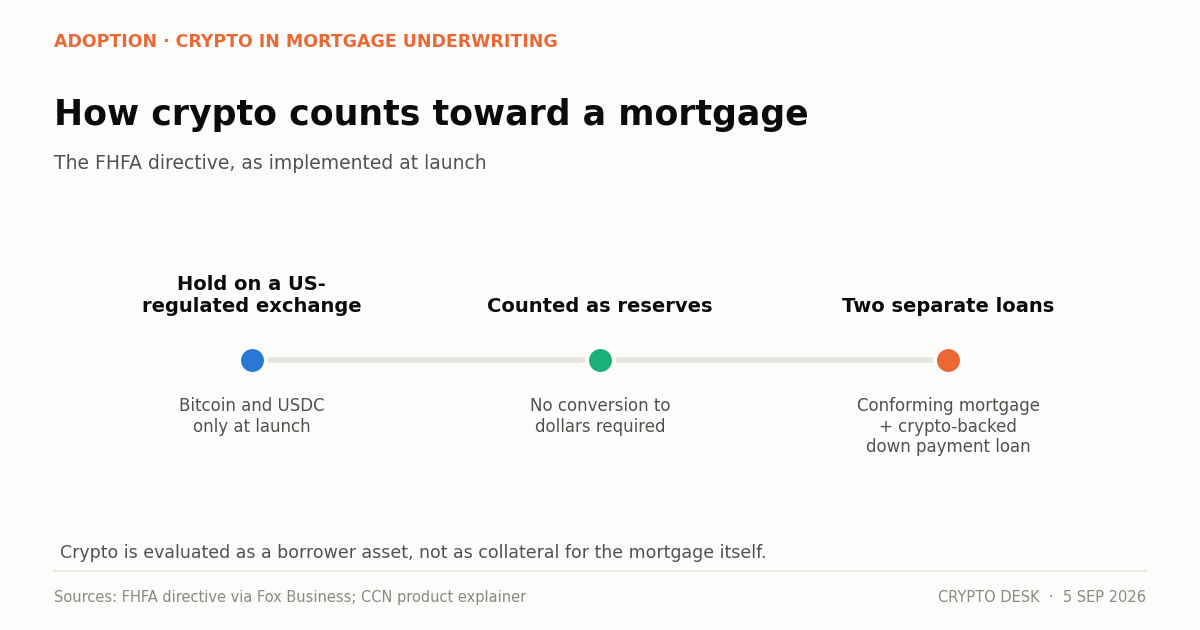
A crypto mortgage is now possible without selling the asset: the FHFA directed Fannie Mae and Freddie Mac to count cryptocurrency as mortgage reserves without converting it to US dollars.
On this page
- What the directive says
- The misunderstanding worth correcting
- How a crypto mortgage works in practice
- Why the asset selection tells you the thinking
- What is still unresolved
- What to watch
- Who this actually helps
The Federal Housing Finance Agency directed Fannie Mae and Freddie Mac to prepare for counting cryptocurrency as an asset in single-family mortgage risk assessments — and, critically, to do it without requiring conversion into US dollars.
The directive resurfaced in market coverage this week as implementation moved from proposal to product. It is worth understanding precisely, because almost every summary of it has been wrong in the same way.
What the directive says
FHFA Director William Pulte instructed each enterprise to "prepare a proposal for consideration of cryptocurrency as an asset for reserves in their respective single-family mortgage loan risk assessments, without converting it into U.S. dollars."
Three conditions are attached:
Only US-regulated exchanges count. Assets must be "evidenced and stored on a U.S.-regulated centralized exchange, subject to all applicable laws." Self-custodied holdings in a hardware wallet do not qualify. Neither do assets on an offshore venue.
No conversion required. This is the substantive change. Previously, a borrower wanting crypto to count toward their reserves had to sell it, season the proceeds in a bank account, and document the source. That triggers a taxable event and removes the exposure. Under the directive the asset stays as it is.
Reserves, not collateral. Crypto is evaluated as a borrower asset during risk assessment — evidence of the capacity to keep paying after closing. It does not secure the loan.
Pulte framed the move as aligned with "President Trump's vision to make the United States the crypto capital of the world."
The misunderstanding worth correcting
Coverage has widely described this as "buying a house with bitcoin" or "bitcoin as mortgage collateral." It is neither.
Mortgage underwriting looks at three things: income, credit, and reserves. Reserves are the assets a borrower holds after closing — the cushion that determines whether a job loss becomes a missed payment or an inconvenience. Lenders count them in months of housing expense covered.
What the directive changes is that crypto held on a regulated US exchange can appear in that reserves calculation without being liquidated first. A borrower with a strong income, good credit and $200,000 of bitcoin at Coinbase is now a stronger applicant than the same borrower with no reserves, where before they were treated identically unless they sold.
That is a real change with real consequences for a specific group of people. It is not a crypto-denominated mortgage.
How a crypto mortgage works in practice
The first product built on this framework came from a partnership between Better and Coinbase, announced 26 March 2026 with a rollout over the following months.
At launch, eligible assets are bitcoin and USDC only. Not ether, not solana, not the long tail.
The structure uses two separate loans:
- A standard conforming mortgage, eligible for sale to Fannie Mae.
- A separate crypto-backed loan for the down payment.
The borrower pledges crypto against the second loan instead of selling it. They must still have strong income and credit, they carry two concurrent obligations, and the pledged assets are exposed to liquidation if payments default.
That last point is not a footnote. A borrower who pledges bitcoin against a down payment loan during a drawdown faces the possibility of losing the position and the house in the same sequence. Bitcoin is down 27.3% over twelve months and 35.6% from its October 2025 record of $126,198.07. Anyone modelling this structure should model it at those levels, not at the highs.
Why the asset selection tells you the thinking
Bitcoin and USDC is a revealing pair.
USDC is a dollar-pegged stablecoin issued by a US company under the GENIUS Act framework, with attested reserves. Counting it toward mortgage reserves is barely a policy change — it is a dollar balance held somewhere unusual.
Bitcoin is the volatile one, and its inclusion is the actual decision. What it signals is that the enterprises are treating bitcoin as an asset with a liquid, observable, dollar-denominated market on regulated US venues — the same test they would apply to any security counted in reserves.
The absence of everything else is equally informative. Ether, with $15.6 billion in US spot ETF assets, did not make the launch list. Neither did solana or XRP despite each now having roughly $1.5 billion in ETF products. The enterprises are starting with the single asset that has the longest price history and the deepest US market, which is a conservative choice and a sensible one.
What is still unresolved
Haircuts. The published guidance does not specify what discount is applied to crypto valuations for reserve purposes. Traditional reserve assets carry haircuts — stocks are typically counted at 70% of value, retirement accounts at 60% net of penalties. Bitcoin's volatility argues for a steeper discount, and the number that gets chosen will determine how much this policy actually matters.
Verification. Proving ownership of an exchange-held balance is straightforward. Proving it will still be there next month is not. Whether lenders will require attestation at closing only, or ongoing monitoring, is undecided.
Scale. Fannie Mae and Freddie Mac together guarantee more than half of US mortgages. Both have operated under conservatorship since 2008. A policy applied at that scale has systemic implications that a pilot product with one lender does not, and the enterprises are moving deliberately for that reason.
What to watch
The published haircut. The single number that determines whether this is meaningful or symbolic.
Whether the asset list expands. Adding ether would roughly double the addressable holder base.
Default experience. The first cohort of these loans through a drawdown will produce the data that decides whether the policy expands or narrows.
Other lenders. One partnership is a pilot. Half a dozen is a market.
Who this actually helps
The eligible population is narrower than the coverage suggests, and it is worth being specific.
This helps a borrower who holds a substantial crypto position on a US-regulated exchange, has income and credit strong enough to qualify on their own, and would otherwise have had to sell — realising capital gains tax and giving up the position — to show reserves.
It does not help a borrower whose income does not support the payment. Reserves are the third leg of underwriting, not a substitute for the first two. Someone with $500,000 of bitcoin and insufficient documented income still does not qualify.
It does not help a self-custodian. The directive is explicit that assets must be evidenced and stored on a US-regulated centralised exchange. A borrower holding keys in a hardware wallet must move the position to an exchange to have it counted, which is precisely the opposite of what long-term holders are generally advised to do.
And it does not help anyone holding an asset outside the launch list. Bitcoin and USDC only.
The intersection of those conditions is a real group of people. It is a much smaller group than "crypto holders."
About this report. The FHFA directive text, conditions and quotes are from the agency's June 2025 order as reported by Fox Business and analysed by Consumer Finance Monitor and Sheppard Mullin. Product details for the Better and Coinbase partnership, including eligible assets and loan structure, are from CCN's explainer. Bitcoin price context is from Yahoo Finance for 4 September 2026.
Not financial or legal advice. Mortgage qualification is fact-specific. Talk to a licensed lender.
Frequently asked questions
Can I buy a house with bitcoin?
Not directly. Crypto is counted as a borrower asset in the reserves calculation, not as collateral for the mortgage. The Better and Coinbase product uses two loans: a standard conforming mortgage plus a separate crypto-backed down payment loan.
Which crypto assets qualify for mortgage reserves?
Bitcoin and USDC only at launch, and they must be evidenced and stored on a US-regulated centralised exchange. Self-custodied holdings in a hardware wallet do not qualify.
Related reading
- Asia Stablecoin Regulation: Japan, Hong Kong and Korea Move
- Crypto Exchange Bank Charters: Three Very Different Routes
- ESMA MiCA to MiFID II: Europe's Dual Licensing Pathway
- CLARITY Act Vote on 15 September Is Barely Priced
Sources
- FHFA tells Fannie Mae, Freddie Mac to consider crypto as mortgage asset — Fox Business
- How to Turn Your Bitcoin into a House Without Selling Sats — CCN
- FHFA directs Fannie Mae, Freddie Mac to develop plans to use cryptocurrency as assets without conversion to dollars — Consumer Finance Monitor
- FHFA Orders Fannie Mae and Freddie Mac to Consider Cryptocurrency Reserves in Mortgage Risk Assessments — Sheppard Mullin
Read next
- 93% of Last Week's Crypto Venture Money Went to Companies That Move Regulated Dollars Crypto VC funding reached $292.35m across ten deals in the week to 5 September, with 93% going to payments an…
- Sentiment Has Fallen for Three Sessions While Price Did Nothing. That Is the Momentum Draining Out. The crypto Fear and Greed Index slipped to 66 from 69 and 71 across three sessions while bitcoin barely moved…
- Hashprice Rose 22% and Miners Added No Machines. Transaction Fees Were 0.43% of Revenue. Bitcoin hashprice rose 22% to $39.63 per PH/s per day as difficulty hit 127.45T, but hashrate stalled at 934 …