93% of Last Week's Crypto Venture Money Went to Companies That Move Regulated Dollars
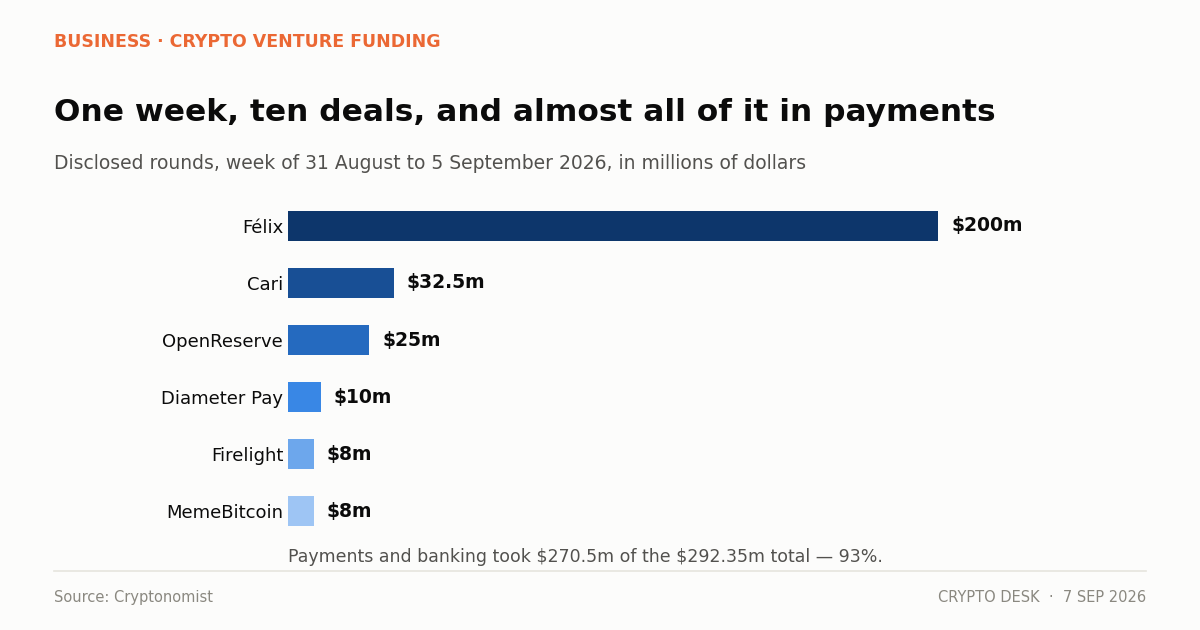
Crypto VC funding reached $292.35 million across ten disclosed deals in the week to 5 September, and 93% of it went to payments and banking infrastructure instead of to tokens.
The rounds
| Company | Amount | What it does |
|---|---|---|
| Félix | $200m | Stablecoin remittances over WhatsApp |
| Cari | $32.5m | Tokenised bank deposits |
| OpenReserve | $25m | Regulated banking infrastructure |
| Diameter Pay | $10m | Payment rails and stablecoin services |
| Firelight | $8m | DeFi risk management |
| MemeBitcoin | $8m | Strategic expansion |
Two details in the funding structures are worth more than the headline totals.
Félix's $200 million is not one round. Andreessen Horowitz led an $87 million equity round; General Catalyst provided a $113 million credit facility. A credit facility is not venture capital in the ordinary sense — it is working capital for a business that moves money and needs float. Lenders extend it against receivables and volume, not against a pitch deck. That is a company with revenue, not a company with a thesis.
Cari's $32.5 million came entirely from seven US banks. First Horizon, Huntington, KeyBank, M&T, Old National, SouthState and Glacier. No crypto fund participated. Banks funding a tokenised deposit company directly, with no venture intermediary, is a different signal from a16z writing a cheque — it is incumbents buying into infrastructure they intend to use.
What changed in crypto VC funding
For most of the last cycle, crypto venture funding went to protocols, Layer 1 chains, NFT platforms and token launches. The product was a token and the business model was the token appreciating.
The current allocation inverts that. Nine of every ten dollars went to companies whose product is moving regulated money faster and cheaper than the existing system does, and whose revenue comes from fees, not from an asset going up.
Félix is the clearest example. It moves remittances over WhatsApp using stablecoins as settlement rails. The user does not know or care that a stablecoin is involved; they know the money arrives faster and costs less than a wire. That is a payments business with a crypto backend, not a crypto business.
Why the money is going there now
Three things converged.
The regulation exists. The GENIUS Act was signed in July 2025 with enforcement beginning January 2027. A stablecoin payments company can now be built against a known rulebook rather than a hope. Investors underwrite regulatory certainty at very different multiples from regulatory risk.
The incumbents validated it. Twenty-one banks including Goldman Sachs, Citi, Bank of America and UBS are forming a joint venture to issue a stablecoin, targeting the first half of 2027. When the institutions being disrupted start building the same thing, the category stops being speculative.
The token model underperformed. Bitcoin is down 27.1% over twelve months and ether 41.2%. Funds whose returns depended on token appreciation have had a difficult two years, and allocators have noticed which parts of the sector produce revenue regardless of price.
The part that should give pause
A concentration this extreme is itself a signal, and not entirely a comforting one.
When 93% of capital in a week goes to one category, it usually means that category is either genuinely where the value is, or it is where consensus has arrived — and consensus arrives late. Payments and banking infrastructure has been the recommended crypto thesis in nearly every institutional outlook published this year.
The corollary is that everything else is starved. DeFi risk management took $8 million. Protocol development, Layer 2 scaling, developer tooling and consumer applications took essentially nothing in this sample. A sector that funds only the regulated-payments layer for several consecutive years produces excellent payment companies and very little else.
One week is a small sample and these figures cover disclosed deals only. But the direction has been consistent through 2026.
What it means for the assets
Almost nothing directly, and that is the point.
A stablecoin remittance company scaling on WhatsApp does not create demand for bitcoin. It creates demand for USDC or USDT as a settlement instrument, and stablecoin demand is a function of payment volume instead of of anyone's view on crypto.
This is the bifurcation that has been developing for two years. The infrastructure layer is growing on fundamentals — transaction volume, fee revenue, regulated distribution. The asset layer trades on interest rate expectations, with bitcoin moving 5% on a Fed governor's remarks and giving it back on a jobs report.
They are increasingly two different businesses that share a technology stack.
What to watch
Whether Cari's bank syndicate expands. Seven regional banks funding a tokenised deposit company is a pilot. Thirty would be an industry position.
Félix's volume disclosures. A $113 million credit facility implies a lender's view of receivables. Actual remittance volume would confirm or undercut it.
Whether the concentration persists. Four consecutive quarters at these ratios would confirm a structural shift, not a rotation.
Token-side funding. If protocol and application funding stays near zero into 2027, the pipeline of new consumer crypto products thins out considerably — and that shows up two or three years later.
The counterargument to the concentration worry
There is a reading of this data that is less pessimistic than the starvation-of-everything-else framing.
Payments and banking infrastructure is where crypto's original promise actually cashes out for ordinary people. A remittance that costs 1% instead of 7% and arrives in minutes instead of days is a material improvement in someone's life, and it is available to people who will never open an exchange account or hold a private key.
Two years of capital concentrated there might produce the first crypto products with mainstream distribution — which the protocol and application layers, funded generously through 2021, largely failed to deliver.
The risk is real and so is the opportunity. Which one this turns out to be depends on whether the payments companies being funded now reach scale, and that will not be visible for another eighteen months.
About this report. Funding totals, company names, amounts, investors and the 93% sector figure are from Cryptonomist's summary of the week of 31 August to 5 September 2026, covering disclosed deals only. Price performance is from Yahoo Finance for 7 September 2026. The bank consortium detail is from DailyCoin's reporting.
Not investment advice. Private funding rounds are disclosed selectively and one week is a small sample.
Frequently asked questions
How much crypto VC funding was raised last week?
$292.35 million across ten disclosed deals in the week of 31 August to 5 September 2026. Payments and banking infrastructure took $270.5 million of it, or 93%.
What was the largest round?
Félix, a WhatsApp-based stablecoin remittance platform, raised $200 million — an $87 million equity round led by Andreessen Horowitz plus a $113 million credit facility from General Catalyst.
Related reading
- Visa Stablecoin Payouts Settle in Under 30 Minutes
- Visa Mastercard Stripe Stablecoin Platform Takes Shape
- RWA Tokenization: BUIDL Past $2.5bn, Market Above $20bn
- Stablecoin Market Cap $291bn With $76bn Daily Volume
Sources
- Crypto VC Funding Highlights $292M in Payments and Banking — Cryptonomist
- 21 Banks Are Not Just Building a Stablecoin. They're Fighting for Control — DailyCoin
- Financial Institutions Are Set To Tokenize Some Deposits In 2026 — Yahoo Finance
- Bitcoin and ethereum prices today, Monday, September 7, 2026 — Yahoo Finance
Read next
- Your Bitcoin Can Now Count Toward a Mortgage — Without Selling It. Here Is How That Actually Works. The FHFA told Fannie Mae and Freddie Mac to count crypto as mortgage reserves without converting to dollars. …
- Sentiment Has Fallen for Three Sessions While Price Did Nothing. That Is the Momentum Draining Out. The crypto Fear and Greed Index slipped to 66 from 69 and 71 across three sessions while bitcoin barely moved…
- Hashprice Rose 22% and Miners Added No Machines. Transaction Fees Were 0.43% of Revenue. Bitcoin hashprice rose 22% to $39.63 per PH/s per day as difficulty hit 127.45T, but hashrate stalled at 934 …