Hashprice Rose 22% and Miners Added No Machines. Transaction Fees Were 0.43% of Revenue.
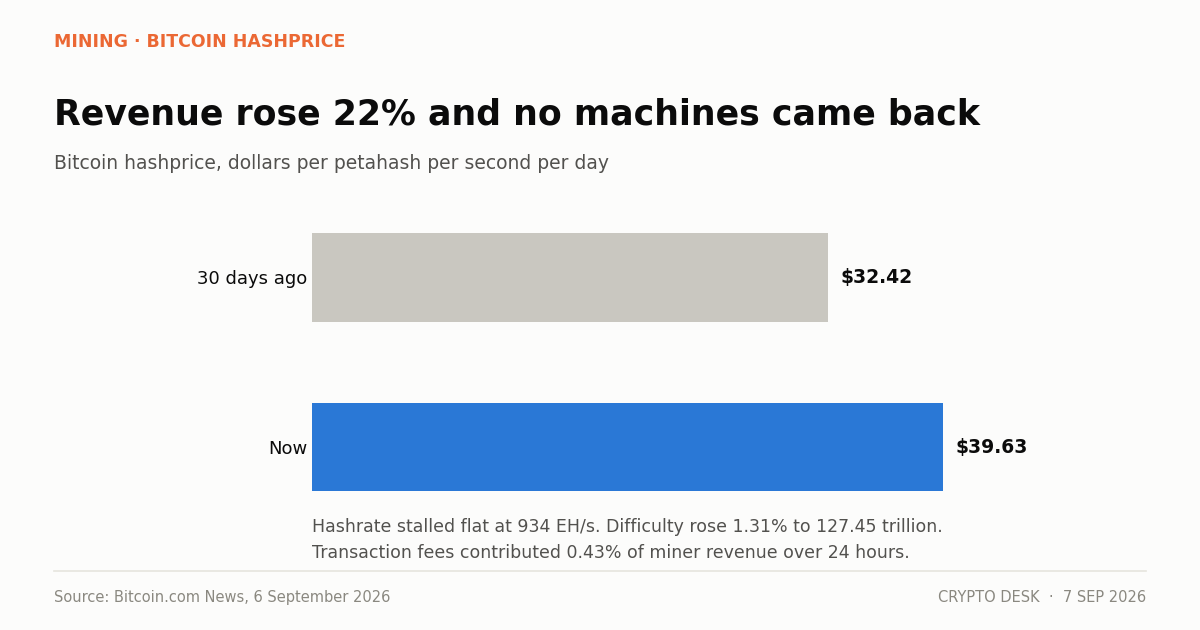
Bitcoin hashprice rose 22.24% over thirty days to $39.63 per PH/s per day, yet hashrate stalled at 934 EH/s and transaction fees contributed just 0.43% of miner revenue.
The three numbers together
| Metric | Value | Change |
|---|---|---|
| Difficulty | 127.45 trillion | +1.31% (8th rise of 2026) |
| Hashprice | $39.63 per PH/s/day | +22.24% over 30 days |
| Hashrate | 934 EH/s | flat |
| Fee share of block rewards | 0.43% | — |
Ordinarily a 22% improvement in mining revenue brings machines back online within weeks. Idle hardware becomes profitable, hosting agreements get signed, and hashrate climbs until difficulty absorbs the gain.
It has not happened. That is the informative part.
Why bitcoin hashprice rose but hashrate did not follow
The hashprice gain came almost entirely from bitcoin's price appreciation, not from network activity. Bitcoin is up 25% over thirty days, and hashprice scales with price.
But the operators who would normally respond have found something else to do with their megawatts. A bitcoin mining rig generates roughly $113 to $179 per megawatt-hour depending on the model. A full-stack AI operator earns between $807 and $1,213 for the same megawatt-hour. Miners unplugged 23% of their hashrate in the first half of 2026 — a reduction of 56 EH/s — while sector AI revenue rose 52% quarter on quarter.
A 22% improvement in mining economics does not close an elevenfold gap. It makes mining slightly less unattractive relative to an alternative that remains vastly more profitable, and the machines stay off.
There is a second constraint. The flat reading suggests operators are also facing hardware limits — the newest generation of rigs is allocated, and adding capacity means either capital expenditure or a hosting agreement, neither of which happens in a fortnight.
The difficulty picture for 2026
Eight increases totalling 33.34%, ten decreases totalling 45.27%. Net effect: difficulty is down about 13% from January's 146.47 trillion.
That is the protocol doing precisely what it was designed to do. Hashpower left, blocks came slower, difficulty fell, and the remaining miners earned more per unit of work until equilibrium returned. Nothing is broken.
What the adjustment mechanism cannot do is create demand for mining. It can only redistribute the existing reward among however many machines are running.
The 0.43% problem
The fee figure is the one that should concern anyone thinking about bitcoin beyond this cycle.
Miner revenue has two components: the block subsidy, which halves on a fixed schedule, and transaction fees, which depend on demand for block space. At 0.43%, fees are contributing essentially nothing.
The design assumption has always been that as the subsidy declines, fees rise to replace it, because block space becomes scarcer relative to demand. That is the mechanism intended to fund bitcoin's security in perpetuity.
The current data does not support it. Fees at half a percent of rewards, with the subsidy scheduled to halve again, means the security budget is falling with no offsetting growth.
Several things explain it. Layer 2 networks and sidechains moved transactions off the main chain by design. Exchanges batch withdrawals. Ordinals and inscription activity, which produced fee spikes in 2023 and 2024, has faded. Block space is simply not scarce right now.
None of that is a crisis today, with hashrate at 934 EH/s and difficulty at 127 trillion. It becomes a live question at the next halving, when subsidy revenue drops by half and there is no fee market to absorb the difference — particularly with AI data centres bidding for the same power at eleven times the revenue.
What miner economics look like now
As the underlying analysis put it, miner profits are very much connected to bitcoin's price this year. That is a precise description of a business with one variable input it cannot control and no revenue diversification.
Fee income would provide that diversification, and it is not there. Which leaves operators fully exposed to bitcoin's price, in a year when the asset is down 27.1% over twelve months despite the recent recovery.
It also explains the AI pivot better than any strategic narrative. A contracted AI hosting agreement provides revenue certainty that mining structurally cannot, and a lender will underwrite against it. Mining cash flow is much harder to borrow against.
What to watch
Whether hashrate crosses 1 ZH/s. It has stalled below the threshold repeatedly. Crossing it with hashprice near $40 would suggest machines are genuinely returning.
The next difficulty adjustment. A run of increases would confirm hashpower coming back; continued flatness confirms the AI competition is binding.
Fee share over a month. A single 24-hour reading of 0.43% is noise. A monthly average near that level is a structural signal about the security budget.
Hashprice against $60. Roughly where mining becomes competitive with AI hosting per megawatt. At $39.63 it is not close.
Mempool depth. The leading indicator for any fee market recovery. Persistent congestion would change the fee picture before it shows up in miner revenue.
Putting the fee number in context
It is worth being precise about how unusual 0.43% is, because bitcoin has had periods where fees mattered a great deal.
During the 2017 congestion, fees briefly exceeded 20% of miner revenue. In the 2023 and 2024 inscription waves they repeatedly passed 10% and touched much higher on individual days. Those episodes were held up as evidence that the fee market would mature into the subsidy's replacement.
At 0.43%, the fee market has effectively gone quiet. Layer 2 networks took the transactions that would have competed for block space, which is exactly what they were built to do — the scaling roadmap worked.
That is the tension at the centre of bitcoin's long-term economics. Successful scaling moves activity off the chain that needs fee revenue to fund its security. Nobody has proposed a resolution that does not involve either sustained main-chain congestion or a change to the issuance schedule, and neither is popular.
About this report. Difficulty, hashprice, hashrate, block height, fee share and the 2026 adjustment tally are from Bitcoin.com News mining coverage dated 6 September 2026. Revenue-per-megawatt-hour comparisons and the 23% unplugging figure are from Miner Weekly. Price performance is from Yahoo Finance for 7 September 2026. Hashrate estimates vary by methodology.
Not investment advice. Mining economics change with price, difficulty and power contracts.
Frequently asked questions
What is bitcoin's hashprice now?
$39.63 per petahash per second per day, up from $32.42 — a 22.24% gain over thirty days. The improvement came almost entirely from bitcoin's price appreciation rather than from transaction fee activity.
Why did hashrate not rise with hashprice?
Because the alternative pays far more. A mining rig earns roughly $113 to $179 per megawatt-hour while a full-stack AI operator earns $807 to $1,213. Miners unplugged 23% of hashrate in the first half of 2026, and a 22% revenue gain does not close an elevenfold gap.
Related reading
- Bitcoin Hashrate Stalls at 932 EH/s Below 1 Zettahash
- BitMine Ethereum Treasury Hits 5.93M ETH and $15.7bn
- Bitcoin Hashrate 316 Days Below Peak as Miners Chase AI
- Mining Earns $113/MWh vs $1,213 for AI: The Miner Exodus
Sources
- Difficulty Rises, Hashprice Rips 22% as Bitcoin Hashrate Stalls — Bitcoin.com News
- Bitcoin Mining Hits a Crossroads as Difficulty Hovers Near the Floor — Bitcoin.com News
- Miner Weekly: Bitcoin Miners Unplug 23% as AI Revenue Surges 52% — Bitcoin.com News
- Bitcoin Hashrate Chart — CoinWarz
Read next
- A Megawatt Earns $113 an Hour Mining Bitcoin and Up to $1,213 Hosting AI. That Is the Whole Story. Bitcoin mining yields roughly $113-179 per MWh while full-stack AI operators earn $807-1,213. Miners unplugge…
- 316 Days Below Peak: Bitcoin''s Hashrate Is in a Bear Market Because Miners Found a Better Customer Bitcoin's hashrate sits near 914 EH/s, about 20% under its October 2025 peak and 316 days below it, as miners…
- 93% of Last Week's Crypto Venture Money Went to Companies That Move Regulated Dollars Crypto VC funding reached $292.35m across ten deals in the week to 5 September, with 93% going to payments an…