316 Days Below Peak: Bitcoin''s Hashrate Is in a Bear Market Because Miners Found a Better Customer
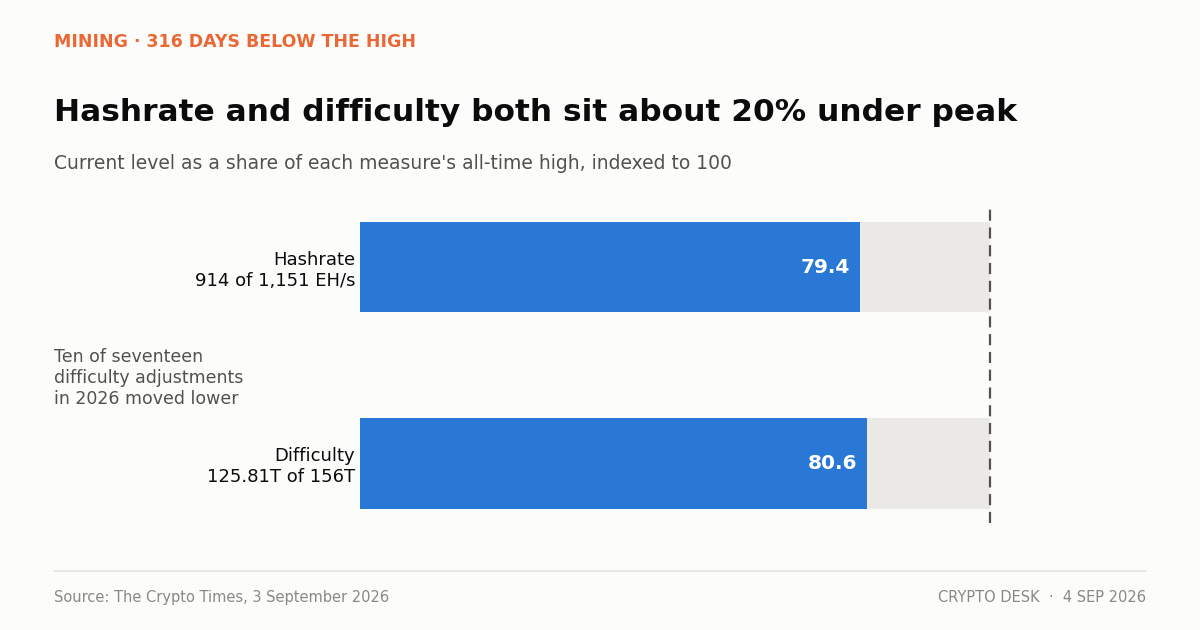
The bitcoin hashrate has now spent 316 consecutive days below its peak, running near 914 EH/s against the 1,151 EH/s record, as miners redirect power to AI contracts.
On this page
- The measurements
- What IREN's numbers show
- The arithmetic behind the exodus
- The equity market has already voted
- What this means for bitcoin's security
- What could reverse it
- What to watch
- The reframe
- The halving arithmetic nobody has run yet
Bitcoin's network hashrate has now spent 316 consecutive days below its all-time high. That is the longest stretch in roughly a decade, and it is happening for a reason the network has never encountered before: the people who own the electricity have found something more profitable to do with it.
The measurements
Hashrate sits around 914 EH/s on a rolling average basis as of August 2026, with live estimates bouncing between 910 and 930 EH/s. The peak was approximately 1,151 EH/s in late October 2025. The network is running about 20% below its high.
Difficulty tells the same story more slowly. It stood at 125.81 trillion on 23 August 2026, against an all-time high near 156 trillion in November 2025 — a discount of roughly 19%. Ten of the seventeen difficulty adjustments in 2026 have moved lower, including a 1.31% downward revision at block 963,648.
| Metric | Current | Peak | Gap |
|---|---|---|---|
| Hashrate | ~914 EH/s | ~1,151 EH/s (Oct 2025) | ~20% |
| Difficulty | 125.81T (23 Aug 2026) | ~156T (Nov 2025) | ~19% |
| Days below ATH | 316 | — | — |
Difficulty adjusting downward ten times in seventeen tries is the network doing precisely what it was designed to do. Hashpower leaves, blocks come slower, difficulty drops, the remaining miners get more revenue per unit of work, and equilibrium is restored. The protocol is fine. The industry is being restructured.
What IREN's numbers show
IREN Limited has disclosed the transition in more detail than most of its peers, and its filings read like a template for the sector.
The company cut mining capacity from around 50 EH/s to 23.2 EH/s as of 30 June 2026 — a reduction of more than half. Against that, it reported roughly $4 billion in contracted annualised run-rate AI revenue for 2026, with named counterparties including Cohere, Perplexity and Figure AI. Decommissioning the mining hardware produced $638.8 million in non-cash impairments. Management has indicated the transition will be substantially complete by the end of 2026.
Set the two figures side by side. Twenty-seven exahashes of retired mining capacity, and $4 billion of contracted AI revenue. There is no plausible bitcoin price at which the mining side of that trade competes.
The arithmetic behind the exodus
The decision facing a miner with a power contract is simpler than it looks.
Bitcoin mining revenue per megawatt is a function of hashprice, which depends on bitcoin's price, network difficulty and the block subsidy. It is volatile, it halves every four years by protocol design, and it declines whenever competitors add machines. It offers no contracts, no counterparty, no revenue floor.
AI compute revenue per megawatt comes from multi-year contracts with named customers at agreed rates. It is bankable. A lender will underwrite against it. Bitcoin mining cash flow is much harder to lend against.
For an operator whose actual asset is grid interconnection — a signed power contract at a site with transmission capacity, which in the current market can take three to five years to obtain — the question is not "do I believe in bitcoin?" It is "which customer pays more per megawatt, with what certainty?" Through 2026 the AI answer has been higher on both counts.
The equity market has already voted
Mining stocks rose as much as 85% in 2026, substantially outperforming bitcoin itself, which is down roughly 29% over twelve months.
That divergence is unusual and it is informative. Historically, mining equities traded as leveraged bitcoin proxies — up more in rallies, down more in drawdowns. A year in which the miners rise 85% while their underlying asset falls 29% means the market has stopped valuing them as bitcoin proxies and started valuing them as power infrastructure companies that happen to have a bitcoin business attached.
Investors buying MARA or IREN today are largely buying megawatts and interconnection queue positions. The mining rigs are, increasingly, what those companies used to do with the power.
What this means for bitcoin's security
Less than the headlines imply, but not nothing.
Nine hundred exahashes is an enormous amount of work. The cost of assembling a majority of it remains far beyond the reach of any realistic attacker, and 914 EH/s is still roughly double where the network sat two years ago. Nobody is attacking bitcoin because hashrate is 20% off its high.
The structural point is different and more interesting. Bitcoin's security budget has always been assumed to grow with price, because higher prices attract more miners. What 2026 demonstrates is that miners can be pulled away by an alternative use of the same energy regardless of bitcoin's price. The competition for the marginal megawatt is no longer between bitcoin miners; it is between bitcoin and everything else that wants power.
That matters most at the next halving, when the block subsidy halves again and mining revenue per unit of work drops by design. If AI data centre demand is still bidding aggressively for power at that point, the pool of operators willing to point machines at bitcoin gets smaller still.
What could reverse it
Three scenarios would bring hashpower back.
A large bitcoin price move. Hashprice scales with price. A return toward the October 2025 high of $126,198 would make mining competitive against AI contracts again for some operators.
AI compute demand cooling. If model training demand plateaus or GPU supply catches up with it, the premium currently paid for power evaporates and the trade reverses.
Power supply expanding. The current conflict is a scarcity problem. New generation and transmission built over the next several years reduces the competition for existing interconnections.
The first is possible within months. The second is unknowable. The third takes years.
What to watch
Difficulty adjustments. Published roughly every two weeks. Continued downward moves confirm hashpower is still leaving; a run of upward adjustments would signal the trend reversing.
Miner quarterly filings. The disclosure that matters is the ratio of megawatts allocated to mining versus AI hosting. IREN publishes it clearly. Others are less forthcoming, which is itself a signal.
Hashprice. The single best summary statistic for whether mining is worth doing at all.
The reframe
It is tempting to read a 20% hashrate decline as bitcoin weakening. That is the wrong frame. The network is producing blocks on schedule, difficulty is adjusting exactly as designed, and security remains far beyond any practical attack.
What has changed is that bitcoin mining is no longer the highest-value use of cheap, interruptible power. For fifteen years it was, and an entire industry organised itself around that fact. It is not any more, and the industry is reorganising accordingly.
The halving arithmetic nobody has run yet
Bitcoin's block subsidy halves again on a schedule the protocol fixes in advance. When it does, mining revenue per unit of hashpower falls by roughly half overnight, offset only by whatever the transaction fee market contributes and by whatever bitcoin's price does in the meantime.
In every prior halving, the marginal miner who shut down had nowhere better to point their power. Machines were sold, sites were mothballed, and hashrate returned within months as price recovered and difficulty adjusted downward.
The 2026 situation is structurally different. The marginal miner now has a customer paying contracted rates for the same megawatts, and that customer's demand does not fall when bitcoin's subsidy halves. A halving that arrives while AI compute is still bidding aggressively for power removes hashpower that has a standing alternative use, and there is no historical precedent for how much of it comes back.
This is the most consequential open question in mining, and it is not resolvable from current data.
About this report. Hashrate, difficulty and 316-day figures come from The Crypto Times' 3 September 2026 analysis. IREN's capacity, revenue and impairment figures are from company disclosures as reported in that piece and in sector coverage. Hashrate estimates vary by methodology; rolling averages and live estimates can differ by several percent.
Not investment advice. Mining equity performance cited is historical and does not predict future returns.
Frequently asked questions
What is the bitcoin hashrate now?
Roughly 914 EH/s on a rolling average as of August 2026, with live estimates between 910 and 930 EH/s. The peak was about 1,151 EH/s in late October 2025, so the network runs around 20% below its high.
Why are bitcoin miners switching to AI?
Revenue certainty. AI compute is sold on multi-year contracts at agreed rates that a lender will underwrite. IREN cut mining capacity from about 50 EH/s to 23.2 EH/s while reporting roughly $4 billion of contracted annualised AI revenue.
Does a falling hashrate make bitcoin less secure?
Not meaningfully at these levels. At 914 EH/s the cost of assembling a majority remains far beyond any realistic attacker, and difficulty adjusts downward automatically — ten of seventeen adjustments in 2026 moved lower.
Related reading
- Bitcoin Hashrate Stalls at 932 EH/s Below 1 Zettahash
- BitMine Ethereum Treasury Hits 5.93M ETH and $15.7bn
- Bitcoin Hashprice Up 22% but Hashrate Stalls at 934 EH/s
- Mining Earns $113/MWh vs $1,213 for AI: The Miner Exodus
Sources
- Bitcoin Hashrate Marks 316 Days Below Peak as Miners Redirect Power to AI — The Crypto Times
- Bitcoin enters first hashrate bear market, Twenty One Capital CEO says — crypto.news
- Bitcoin Mining Capacity Shifts as AI Data Center Demand Grows — Cointelegraph
- Bitcoin Miners Pivot to AI Data Centers: 2026 Company Analysis — Insights4.vc
Read next
- Hashprice Rose 22% and Miners Added No Machines. Transaction Fees Were 0.43% of Revenue. Bitcoin hashprice rose 22% to $39.63 per PH/s per day as difficulty hit 127.45T, but hashrate stalled at 934 …
- A Megawatt Earns $113 an Hour Mining Bitcoin and Up to $1,213 Hosting AI. That Is the Whole Story. Bitcoin mining yields roughly $113-179 per MWh while full-stack AI operators earn $807-1,213. Miners unplugge…
- 93% of Last Week's Crypto Venture Money Went to Companies That Move Regulated Dollars Crypto VC funding reached $292.35m across ten deals in the week to 5 September, with 93% going to payments an…