A Megawatt Earns $113 an Hour Mining Bitcoin and Up to $1,213 Hosting AI. That Is the Whole Story.
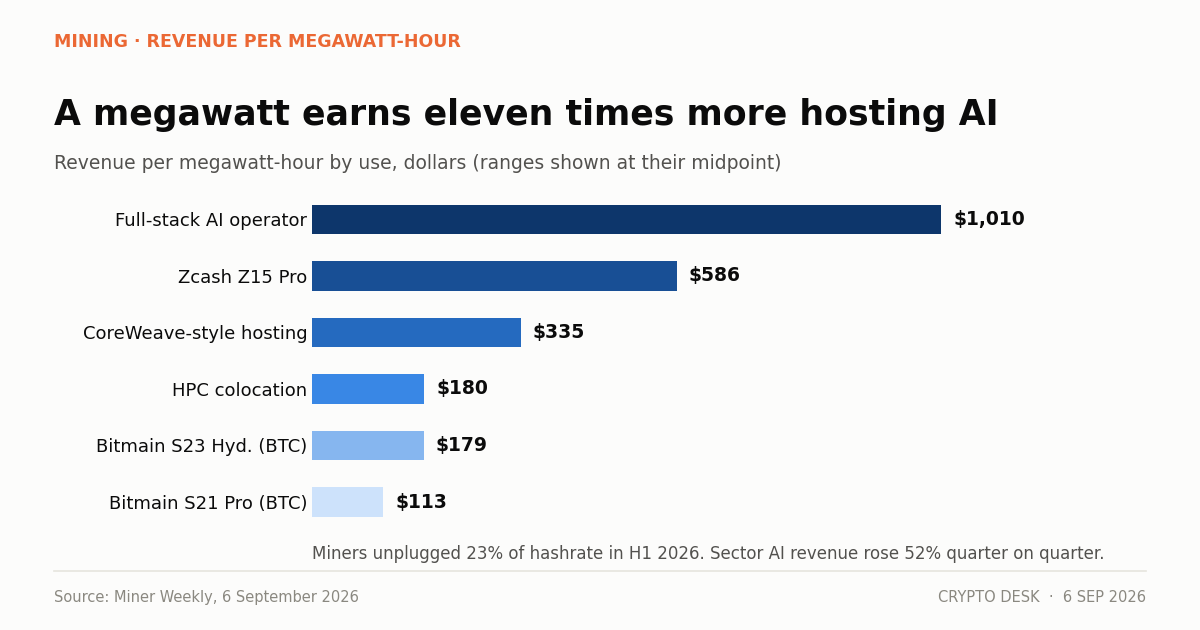
Bitcoin mining vs AI now comes down to one ratio: a megawatt-hour earns about $113.45 mining bitcoin and between $807 and $1,213 hosting AI workloads.
On this page
- The comparison, laid out
- The scale of what has moved
- The parity number
- What the industry actually is now
- What it means for bitcoin's security
- What to watch
- What would bring the hashpower back
- The number to remember
A Bitmain S21 Pro generates about $113.45 per megawatt-hour mining bitcoin. A full-stack AI operator running the same megawatt earns between $807 and $1,213.
Everything else about the mining industry's 2026 transformation is a footnote to that ratio.
The comparison, laid out
| Use of a megawatt-hour | Revenue |
|---|---|
| Bitmain S21 Pro (bitcoin) | $113.45 |
| Bitmain S23 Hyd. (bitcoin) | $179.13 |
| HPC colocation landlord | $140–$200 (median ~$180) |
| CoreWeave-style hosting | $268–$403 |
| Full-stack AI operator | $807–$1,213 |
| Zcash Z15 Pro (for reference) | $585.61, up to $727 |
Read the top and bottom rows together. The gap between the most common bitcoin rig and the most integrated AI operation is roughly elevenfold.
Even the least demanding AI use — being a landlord who rents space and power to someone else's GPUs, taking no operational risk — earns more per megawatt-hour than the newest, most efficient bitcoin miner. That is the finding that should end the debate about whether this pivot is a fad.
The Zcash line is included because it is the one genuine counterexample: a proof-of-work coin whose economics currently beat bitcoin's by a factor of five, driven by ZEC's move through $1,000 this month. It is also a market a fraction of the size, and one that will attract hashrate until the same arbitrage closes.
The scale of what has moved
Bitcoin miners unplugged 23% of their hashrate in the first half of 2026 — a reduction of 56 EH/s. Network-wide hashrate fell about 10%, because non-pivoting operators absorbed some of the gap.
AI revenue across the sector rose 52% from the first quarter to the second.
Fourteen companies analysed spent $18.6 billion in capital expenditure in a single quarter. For context on where that sits, PwC has estimated $31.6 trillion of AI data-centre buildout through 2050.
Current network conditions reflect the exodus. Hashprice sits at $40.15 per PH/s per day. Difficulty rose 1.3% to 127.45 trillion on 5 September, with implied hashrate around 912 EH/s.
The parity number
Hashprice would need to reach $60 to $70 per PH/s per day for bitcoin mining to compete with AI hosting on a per-megawatt basis. It is at $40.15.
That is a required increase of roughly 50% to 75%, and hashprice is a function of bitcoin's price, network difficulty and the block subsidy. Bitcoin closed the week at $77,024. Getting hashprice to $65 with difficulty flat would require bitcoin somewhere near $125,000 — approximately its October 2025 all-time high of $126,198.07.
Which frames the situation precisely: bitcoin mining becomes competitive with AI hosting again if bitcoin returns to its record high and difficulty does not rise to meet it. Difficulty always rises to meet it.
What the industry actually is now
The clearest way to understand a modern mining company is to stop thinking of it as a mining company.
What these firms own is grid interconnection — signed power contracts at sites with transmission capacity. In the current market, obtaining a new interconnection can take three to five years. That queue position is the scarce asset, and it is agnostic about what the power is used for.
Mining was the highest-value use of cheap, interruptible power for fifteen years, and an entire industry organised around that fact. It is not any more. As one analysis of the shift put it: "Much of that power was not leaving compute altogether. It was being redirected toward the AI retrofit."
The named operators pursuing full-stack AI economics include IREN, HIVE, WhiteFiber and Bitdeer. Their revenue per megawatt-hour is in the $807 to $1,213 band. The gap between that and $113.45 is not something a better rig closes.
What it means for bitcoin's security
Less than the headline suggests, and more than nothing.
At roughly 912 EH/s the network remains far beyond the reach of any realistic attacker, and difficulty adjusts downward automatically when hashpower leaves — it did so ten times out of seventeen adjustments in 2026 before the 1.3% rise on 5 September. The protocol is working as designed.
The structural point is different. Bitcoin's security budget was always assumed to scale with price, because higher prices attract more miners. What 2026 shows is that miners can be pulled away by an alternative use of the same energy regardless of bitcoin's price. The competition for the marginal megawatt is no longer between bitcoin miners. It is between bitcoin and everything else that wants power.
That matters most at the next halving, when the subsidy halves by protocol design and mining revenue per unit of work drops accordingly. In every prior halving, the marginal miner who shut down had nowhere better to point their power. This time they do, at eleven times the revenue.
What to watch
Hashprice against $60. The single number that determines whether mining is worth doing at all.
Difficulty adjustments. The 1.3% rise on 5 September was the first meaningful upward move in a while. A run of increases would suggest hashpower returning.
The megawatt split in quarterly filings. The disclosure that matters is megawatts allocated to mining versus AI hosting. IREN publishes it clearly. Others are less forthcoming, which is itself informative.
Whether Zcash mining economics hold. At $585.61 per megawatt-hour it is currently the outlier. Hashrate will chase it, and the arbitrage will close.
What would bring the hashpower back
Three scenarios, and they are worth ranking by plausibility rather than listing.
AI compute demand cooling is the most powerful and least predictable. If model training demand plateaus or GPU supply catches up, the premium paid for power evaporates and the arbitrage closes from the other side. Nobody can forecast this with confidence.
Bitcoin's price rising substantially is the most discussed and the most self-limiting. Hashprice scales with price, but difficulty scales with returning hashrate, so a price rally that brings miners back also raises the bar they must clear. The equilibrium moves as you approach it.
Power supply expanding is the most certain and the slowest. New generation and transmission built over the coming years reduces competition for existing interconnections. It takes years, and the interconnection queue in most US markets currently runs three to five years on its own.
The first could happen next quarter. The second is bounded by its own feedback loop. The third arrives after the next halving, not before it.
The number to remember
$113.45 per megawatt-hour against $807 to $1,213.
Every argument about miner loyalty, network security, or the long-term case for proof-of-work runs into that ratio. An eleven-fold revenue difference is not closed by conviction, a more efficient rig, or a moderate price rally. It is closed by the AI premium falling, and nothing in the current capital expenditure data — $18.6 billion across fourteen companies in a single quarter — suggests that is imminent.
About this report. Revenue-per-megawatt-hour figures, hashrate reduction, AI revenue growth and capital expenditure totals are from Miner Weekly's 6 September 2026 analysis. Hashprice, difficulty, implied hashrate and the parity range are from the Bitcoin News Digest of the same date. The bitcoin-price implication of $65 hashprice is this desk's estimate at flat difficulty and is labelled as such.
Not investment advice. Mining economics change with price, difficulty and power contracts.
Related reading
- Bitcoin Hashrate Stalls at 932 EH/s Below 1 Zettahash
- BitMine Ethereum Treasury Hits 5.93M ETH and $15.7bn
- Bitcoin Hashprice Up 22% but Hashrate Stalls at 934 EH/s
- Bitcoin Hashrate 316 Days Below Peak as Miners Chase AI
Sources
- Miner Weekly: Bitcoin Miners Unplug 23% as AI Revenue Surges 52% — Bitcoin.com News
- Bitcoin News Digest, September 6, 2026 — Mike Richardson
- Bitcoin vs. AI Computing 2026: Why Miners are Abandoning BTC for GPU Cloud Profits — KuCoin
- CoinShares Bitcoin Mining Report, Q1 2026
Read next
- Hashprice Rose 22% and Miners Added No Machines. Transaction Fees Were 0.43% of Revenue. Bitcoin hashprice rose 22% to $39.63 per PH/s per day as difficulty hit 127.45T, but hashrate stalled at 934 …
- 316 Days Below Peak: Bitcoin''s Hashrate Is in a Bear Market Because Miners Found a Better Customer Bitcoin's hashrate sits near 914 EH/s, about 20% under its October 2025 peak and 316 days below it, as miners…
- 93% of Last Week's Crypto Venture Money Went to Companies That Move Regulated Dollars Crypto VC funding reached $292.35m across ten deals in the week to 5 September, with 93% going to payments an…