Zcash Passes $1,000 for the First Time, Carried by the First US Privacy-Coin ETF
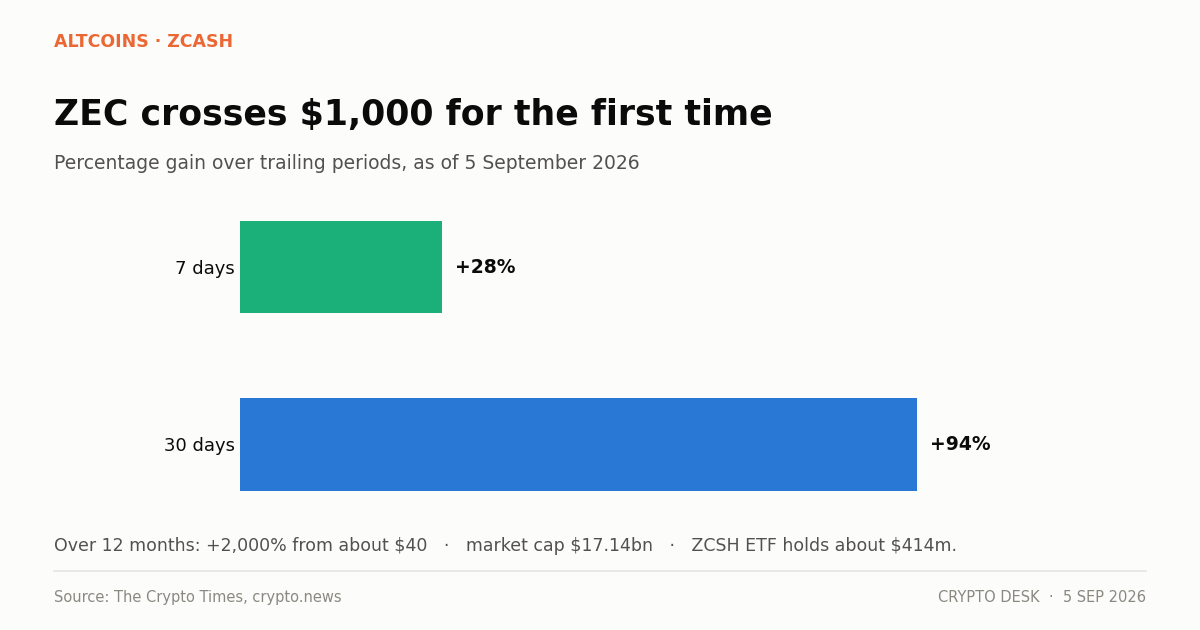
The Zcash price crossed $1,000 for the first time on 5 September 2026, reaching about $1,018 after Grayscale converted its Zcash Trust into the ZCSH spot ETF.
On this page
- What changed for the Zcash price
- The numbers behind the move
- The Grayscale thesis, and its limits
- The risk nobody in the rally is pricing
- Where it sits in a broader rotation
- What to watch
- The transparent-pool problem
Zcash traded at about $1,018.20 on Friday 5 September, crossing $1,000 for the first time in its ten-year history. The token is up 28% over seven days, 94% over a month, and more than 2,000% over twelve months from roughly $40 a year ago.
Bitcoin, over that same year, is down 27.3%.
What changed for the Zcash price
On 25 August 2026, Grayscale converted its $304 million Zcash Trust into a spot ETF trading on NYSE Arca under the ticker ZCSH, with Coinbase Custody holding the assets. It is the first US-listed spot ETF offering direct exposure to a privacy coin.
The fund has since grown to roughly $414 million in net assets — a gain of about 36% in eleven days, which reflects both inflows and the appreciation of the underlying holdings.
Trust-to-ETF conversion is a well-worn path at this point. Grayscale did it with GBTC in January 2024 and with its ether product later that year. What is new is the asset class: a token whose entire design purpose is transaction privacy, now available in a wrapper regulated by the SEC and custodied by a public company.
The numbers behind the move
| Metric | Value |
|---|---|
| Price | ~$1,018.20 |
| 7-day change | +28% |
| 30-day change | +94% |
| 12-month change | >+2,000% |
| Market capitalisation | ~$17.14bn |
| 24-hour volume | ~$1.28bn |
| Rank | 11th largest |
| Futures open interest | ~$2.15bn (record) |
| Short liquidations during advance | ~$34.5m |
Two of those numbers deserve attention over the price.
Open interest at a record $2.15 billion. For a token with a $17.14 billion market capitalisation, that is a very high ratio of derivatives exposure to spot value — around 12.5%. Leverage that concentrated cuts both ways and makes sharp reversals more likely, not less.
$34.5 million of short liquidations. Part of the advance was forced buying from traders positioned against it. That component of the move is mechanical and does not repeat.
The Grayscale thesis, and its limits
Grayscale's head of research has laid out a scenario in which ZEC could reach roughly $8,100 if it captured 10% of bitcoin's market value.
It is important to read that for what it is: a conditional arithmetic exercise, not a price target. The statement establishes what would have to be true — Zcash reaching a tenth of bitcoin's market capitalisation — and then reports what that implies for the token price. It does not argue that the condition will be met.
Coverage of this rally has repeatedly cited the $8,100 figure without the condition attached to it, which turns an if-then statement into a forecast. It is not one.
The underlying argument is more defensible: Zcash shares bitcoin's fixed 21 million supply cap and halving schedule, and adds shielded transactions. If demand for financial privacy grows — and the AI-era surveillance argument is the framing Grayscale has used — then an asset combining hard-money properties with privacy has a distinct case.
The risk nobody in the rally is pricing
Privacy coins carry a regulatory exposure that no other asset class does, and it is not theoretical.
Exchanges in Japan, South Korea, Australia and several European jurisdictions have delisted privacy coins over the past several years in response to anti-money-laundering pressure. The EU's AML package includes provisions that restrict anonymity-enhancing tokens for regulated entities. Each of those decisions removed liquidity from a specific market.
A US-listed spot ETF is a meaningful counterweight — it establishes that at least one regulated pathway exists in the largest market. It does not eliminate the risk in other jurisdictions, and it does not prevent a future US administration from taking a different view.
An asset up 2,000% in a year with $2.15 billion of open interest and an unresolved regulatory profile is a position that requires sizing accordingly.
Where it sits in a broader rotation
Zcash was not alone on Thursday and Friday. Ethena's ENA rose about 10% after its fee-switch proposal passed. Uniswap gained a similar amount on protocol revenue from Robinhood Chain. Two meme tokens ran 60% and 110%.
Bitcoin rose 5.1% on the same session, ether 4.9%.
When privacy coins, DeFi governance tokens and meme coins all outperform the majors by a factor of two to twenty in a single session, the common factor is risk appetite instead of any of the individual narratives. Fed Governor Christopher Waller's dovish comments cut September hike odds from about 63% to roughly 50%, and the assets furthest out on the risk curve moved the most, as they always do.
That does not invalidate the Zcash story. It does mean part of the 28% weekly gain belongs to the macro and not to the ETF.
What to watch
ZCSH net flows. The fund's asset growth conflates inflows with price appreciation. Isolating the flow number is the only way to know whether new money is arriving or the existing holdings simply went up.
Open interest. A record $2.15 billion at these prices is the clearest fragility in the setup. Watch whether it builds further or unwinds.
Delisting news. Any jurisdiction moving against privacy coins would hit this asset harder than the ETF helps it.
Whether the shielded pool grows. Zcash's privacy features are optional, and historically the majority of ZEC has sat in transparent addresses. Growth in shielded usage would support the thesis that people want the privacy, not the trade.
The transparent-pool problem
There is a structural fact about Zcash that gets little coverage during rallies and matters to the thesis.
Zcash's privacy features are optional. Transactions can be transparent, like bitcoin's, or shielded using zero-knowledge proofs. For most of the network's history, the large majority of ZEC has sat in transparent addresses and moved in transparent transactions — because exchanges, custodians and most wallets default to the transparent pool, and shielded transactions historically cost more in fees and computation.
That creates a gap between what the asset is marketed as and how it is mostly used. An investor buying ZEC for its privacy properties is buying a network on which most activity is not private.
It also cuts the other way on regulatory risk. A network where the majority of value sits in transparent, traceable addresses is a considerably easier compliance proposition for a US-listed ETF and its custodian than one where everything is shielded by default. The optionality that weakens the privacy thesis is arguably what made the ETF possible.
Growth in the shielded pool is therefore the metric that would validate the narrative — and the one that would complicate the regulated wrapper.
Worth noting too that shielded usage has risen since the network introduced unified addresses and mobile wallets that default to shielded sending. The trend is in the right direction for the thesis. It has not yet reversed the overall composition, and the data is public, so anyone can check it rather than take a rally's word for it.
About this report. Price, market capitalisation, open interest and liquidation figures are as reported by The Crypto Times on 5 September 2026. ETF conversion details, listing venue and custodian are from crypto.news and Grayscale's announcement coverage. The $8,100 figure is a conditional scenario cited by Grayscale's research team, not a price target.
Not investment advice. Assets that have risen more than twentyfold in a year carry correspondingly high drawdown risk.
Frequently asked questions
Why did the Zcash price pass $1,000?
Grayscale converted its $304 million Zcash Trust into a spot ETF, ZCSH, on 25 August 2026, listing on NYSE Arca with Coinbase Custody. The fund has grown to roughly $414 million in net assets, the first US spot privacy-coin ETF.
How much has ZEC risen?
About 28% over seven days, 94% over a month, and more than 2,000% over twelve months from roughly $40 a year ago. Market capitalisation reached about $17.14 billion, making it the eleventh-largest cryptocurrency.
What are the risks in the Zcash rally?
Futures open interest hit a record $2.15 billion against a $17.14 billion market cap — roughly 12.5% — which makes sharp reversals more likely. Privacy coins also face delisting risk in jurisdictions tightening anti-money-laundering rules.
Sources
- Zcash (ZEC) Surges 28% in a Week, Crosses $1,000 Amid ETF Inflows — The Crypto Times
- Zcash hits $1,000: privacy coin gets first US spot ETF — crypto.news
- Zcash Price Prediction: ZEC Hits $1,000 as Grayscale Links Rally to Hard Money Thesis — CoinGape
- Zcash hits $1,020, up 20% amid $34M short liquidations — Crypto Briefing
Read next
- A Token Called BUN Rose 243,540% on a Million Dollars. That Is Not a Rally. Microcap crypto gainers ran to absurd levels as BUN rose 243,540% on $1.09m of volume while bitcoin moved 0.1…
- Zcash Added 38.5% in a Week. The Privacy Trade Has Outrun Everything Else in Crypto. The Zcash price rose 38.5% over seven days, extending a run that has taken ZEC past $1,000 for the first time…
- Two Microcaps Ran 160% and 121% on a Day the Majors Went Nowhere The top altcoin gainers today were ORBIO at +160% and SHRUB at +121.5%, while bitcoin fell 0.2% and the Fear …