A Token Called USELESS Rose 60% and It Tells You More About This Market Than Bitcoin Did
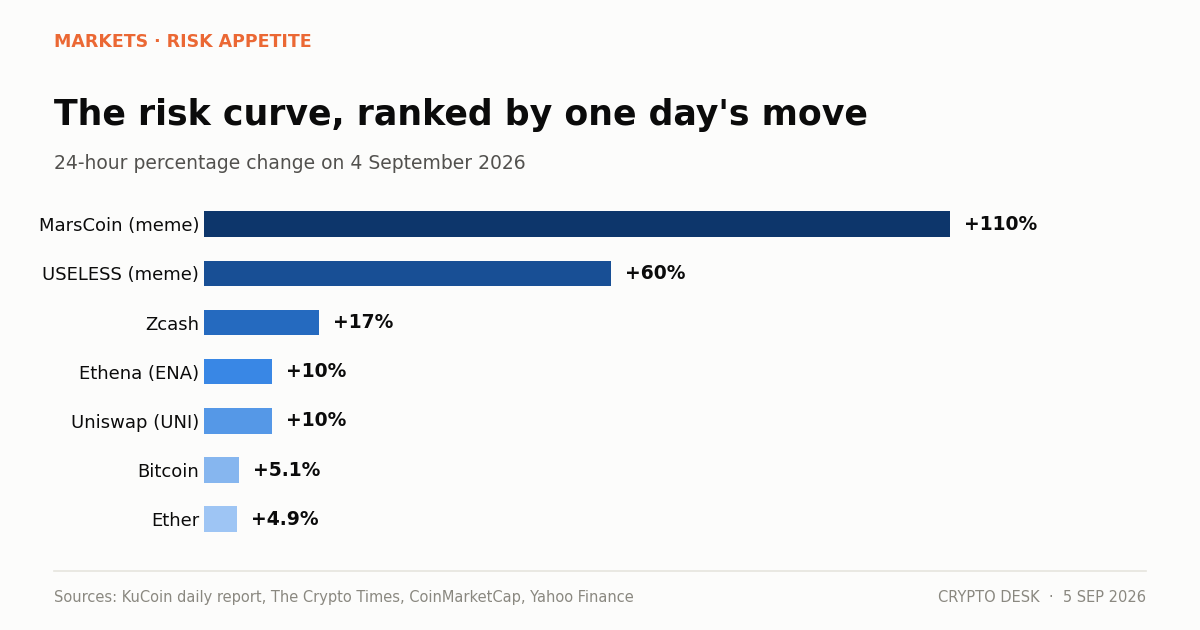
Meme coins September 2026 delivered the clearest risk-appetite signal of the quarter: USELESS rose about 60% and MarsCoin about 110% on a day bitcoin gained 5.1%.
On this page
- What a twenty-to-one day means
- What loosened
- Meme coins and the full risk curve on one day
- Why this is worth taking seriously and not seriously
- The counter-signal that landed hours later
- What to watch
- The summary
- What separates this from 2021
On 4 September, a meme token named USELESS gained about 60%, taking its market capitalisation to roughly $200 million. Another called MarsCoin rose approximately 110% to over $130 million.
Bitcoin rose 5.1% the same day. Ether rose 4.9%.
The meme coins are not the story. The ratio is.
What a twenty-to-one day means
When the furthest-out assets on the risk curve outperform the majors by a factor of twelve to twenty in a single session, something specific has happened to risk appetite. It is one of the more reliable behavioural signals in this market, and it does not require any view on the tokens themselves.
The mechanism is straightforward. Capital allocates along a risk spectrum. At the safe end sit bitcoin and, increasingly, ether — assets with ETF wrappers, institutional custody and regulatory pathways. At the far end sit tokens with no cash flow, no protocol, no roadmap and often no team, whose entire value is a coordination game about attention.
When conditions tighten, money retreats toward the safe end. When conditions loosen, it runs back out. The speed of that run is proportional to how far it retreated.
What loosened
Fed Governor Christopher Waller signalled support for holding rates steady if inflation continues cooling. Market-implied odds of a September hike fell from about 63% to roughly 50%.
That is the entire catalyst. A thirteen-point shift in expected policy, delivered in a set of remarks, and $1.6 trillion of crypto market value repriced — with the repricing concentrated hardest in the assets with the least to fall back on.
More than $400 million of short positions were liquidated across crypto in twenty-four hours, which amplified everything.
Meme coins and the full risk curve on one day
| Asset | 24-hour move | What it is |
|---|---|---|
| MarsCoin | ~+110% | Meme token |
| USELESS | ~+60% | Meme token |
| Zcash | ~+17% | Privacy coin with a new US spot ETF |
| Ethena (ENA) | ~+10% | DeFi token, fee switch just passed |
| Uniswap (UNI) | ~+10% | DeFi token, new protocol revenue |
| Bitcoin | +5.1% | — |
| Ether | +4.9% | — |
Read that column top to bottom and you have a near-perfect risk gradient. The assets with the most speculative profiles moved most; the assets with institutional infrastructure moved least; and the ones in between — DeFi tokens with actual revenue news — landed in between.
That ordering is what makes this a risk-appetite session instead of a collection of individual stories. Zcash had a real catalyst in its ETF. Ethena had a governance vote. Uniswap had genuine new revenue. And all three landed in the middle of a gradient set by tokens with no news at all.
Why this is worth taking seriously and not seriously
Worth taking seriously: the sequencing of a recovery. In previous cycles, capital returning to the far end of the risk curve preceded broader altcoin strength by weeks. It is an early indicator precisely because meme coins have no fundamental anchor — nothing slows their response to sentiment.
The context makes it more notable. This follows four months in which stablecoins flowed out of exchanges for 113 consecutive days, ending only on 1 September. Four months in which almost nothing outside bitcoin worked. Bitcoin is still down 27.3% over twelve months and ether 43.6%.
Worth not taking seriously: the tokens. A $200 million market capitalisation on a token named USELESS is a coordination game, and coordination games unwind faster than they build. The 60% gain is real; so is the 60% loss that these assets routinely produce in the other direction.
Anyone treating a meme coin rally as validation of a thesis about crypto has confused the thermometer with the weather.
The counter-signal that landed hours later
The August employment report was released the following morning: 162,000 payrolls against a consensus near 53,000, unemployment steady at 4.1%, average hourly earnings up 3.1% annually, and June-July revised up by a combined 55,000.
Market-implied odds of a quarter-point hike moved to roughly 59%, up from 52%. The dollar gained 0.3% and short-term yields rose.
So the dovish read that sent money out the risk curve was substantially reversed within a day. Which is why bitcoin, up 5.1% on the session, is up only 1.3% on the week — and why anyone extrapolating from a single risk-on day should hold the conclusion loosely.
What to watch
Whether the gradient persists. One session of meme-coin outperformance is sentiment. Three weeks of it is a rotation.
Stablecoin exchange flows. The 113-day outflow streak ended on 1 September at $13.85 million, falling to $6.85 million by 3 September. Meme coin rallies funded by leverage look different from ones funded by spot dollars arriving on exchanges, and the stablecoin data is how you tell them apart.
Open interest. Zcash's futures open interest hit a record $2.15 billion against a $17.14 billion market cap. Leverage concentrated at the speculative end of the curve is what turns a risk-off day into a cascade.
The Fed. With a dovish governor and a hawkish jobs print in the same 24 hours, the September meeting is genuinely uncertain, and the far end of the risk curve is where that uncertainty gets expressed most violently.
The summary
A token called USELESS rose 60% and a token called MarsCoin rose 110% on a day bitcoin rose 5%. Neither move says anything about those tokens.
What it says is that after four months of capital retreating toward safety, some of it ran back out to the furthest edge on a single Fed governor's remarks — and that a jobs report the next morning gave the market a reason to reconsider.
What separates this from 2021
The comparison to the last meme-coin cycle is inevitable and mostly misleading, for one structural reason.
In 2021, the far end of the risk curve was where most retail participation lived, because the regulated options barely existed. There were no US spot ETFs. Institutional custody was thin. If you wanted crypto exposure through a mainstream channel, you largely could not get it, so speculative capital and long-term capital ended up in the same venues buying the same things.
That is no longer true. Spot bitcoin ETFs hold roughly $99 billion in net assets. Ether products hold about $15.6 billion. Solana and XRP funds each hold near $1.5 billion. Zcash now has one. A conservative allocator has a regulated route to most of what they might want.
The consequence is a cleaner separation between the two ends of the curve than existed five years ago. Money moving into IBIT and money moving into a token called MarsCoin are now genuinely different pools of capital making different decisions, rather than the same pool at different levels of enthusiasm.
Which makes the risk-appetite signal more informative, not less. When the speculative end moves twenty times harder than the institutional end, it is telling you about one specific type of participant returning — and that participant has historically arrived early.
About this report. Meme coin price moves and market capitalisations are from KuCoin's 4 September daily market report. Comparative asset moves are from the same report and from The Crypto Times and CoinMarketCap coverage of Zcash and Uniswap. Bitcoin and ether prices are from Yahoo Finance at 7:21 a.m. ET on 4 September 2026. Employment data is from the BLS August release via CNBC and Babypips.
Not investment advice. Meme tokens have no underlying cash flow and can lose most of their value in a single session.
Frequently asked questions
Which meme coins rallied on 4 September 2026?
USELESS gained about 60% to a roughly $200 million market capitalisation, and MarsCoin rose approximately 110% to over $130 million. Bitcoin rose 5.1% and ether 4.9% the same session.
What causes meme coins to outperform by that much?
Position on the risk curve. Tokens with no cash flow and no protocol respond fastest to changes in risk appetite. Fed Governor Waller's dovish remarks cut September hike odds from about 63% to 50%, and the furthest-out assets moved most.
Is a meme coin rally a bullish signal for crypto?
It is an early indicator, not a thesis. In previous cycles capital returning to the far end of the risk curve preceded broader altcoin strength by weeks. But the August jobs report reversed the dovish read within a day.
Sources
- Crypto Daily Market Report – September 4, 2026 — KuCoin
- Bitcoin and ethereum prices today, Friday, September 4, 2026 — Yahoo Finance
- U.S. payrolls rose 162,000 in August, much more than expected — CNBC
- Stablecoin Inflows Return After Nearly Four Months of Outflows — DailyCoin
Read next
- Sentiment Has Fallen for Three Sessions While Price Did Nothing. That Is the Momentum Draining Out. The crypto Fear and Greed Index slipped to 66 from 69 and 71 across three sessions while bitcoin barely moved…
- Stablecoins Turned Over $76 Billion in a Day on a $291 Billion Base The stablecoin market cap sits at $291.3 billion with $76.11 billion of daily volume — a turnover ratio no ot…
- IBIT Took $117 Million on a Friday Nobody Was Watching IBIT inflows of over $117 million on Friday extended a bitcoin ETF run of three consecutive positive weeks an…