Bitcoin Reclaims $81,000 in Its Best Day Since Spring, and Short Sellers Paid for It
A bitcoin short squeeze took price to $81,240, up 5.1% on the session, after Fed Governor Christopher Waller's remarks cut September rate-hike odds and forced more than $400 million of shorts to close.
On this page
- What Waller said, and why it mattered so much
- The squeeze did the rest
- Where prices actually stand
- The data that lands next
- What was moving underneath
- The liquidity picture changed too
- What to watch
- A five percent day inside a one percent week
- The week in one line
Bitcoin opened Friday 4 September at $81,271.92 and was trading at $81,240.29 by 7:21 a.m. Eastern — a gain of roughly 5.1% against Thursday's open. Ether moved almost in lockstep, up 4.9% to $2,522.14.
Two days earlier the same market was selling off on Iranian missile strikes and rising oil. The reversal did not come from crypto. It came from a Federal Reserve governor.
What Waller said, and why it mattered so much
Fed Governor Christopher Waller signalled support for holding rates steady if inflation continues cooling. Market-implied odds of a September rate hike fell from about 63% to roughly 50% on the back of it.
That is a thirteen-point swing in the expected path of policy, delivered in a single set of remarks. For an asset class that has traded as a pure duration proxy for three years, it is the only variable that has consistently mattered.
The mechanism is worth stating plainly because it gets lost in coverage. Bitcoin produces no cash flow. Its value is entirely a function of what people will pay for it later, discounted back to now. Raise the discount rate and that number falls; lower it and the number rises. Waller lowered the market's expected discount rate by half a rate hike, and $1.6 trillion of crypto market value repriced accordingly.
The squeeze did the rest
More than $400 million of short positions were liquidated across crypto in twenty-four hours.
This is the part that turns a 2% move into a 5% one. Traders positioned for further downside after the Iran-driven selloff were holding leveraged shorts. When price rose through their liquidation levels, exchanges closed those positions by buying — which pushed price higher, triggering the next tier of liquidations, and so on.
None of that buying reflects a view on bitcoin. It is forced, mechanical and finished once the leveraged shorts are cleared out. Which is why a 5% day driven by liquidations reads as roughly half of it was real demand and roughly half was plumbing.
Where prices actually stand
| Bitcoin | Ether | |
|---|---|---|
| Price (7:21 a.m. ET, 4 Sept) | $81,240.29 | $2,522.14 |
| Day | +5.1% | +4.9% |
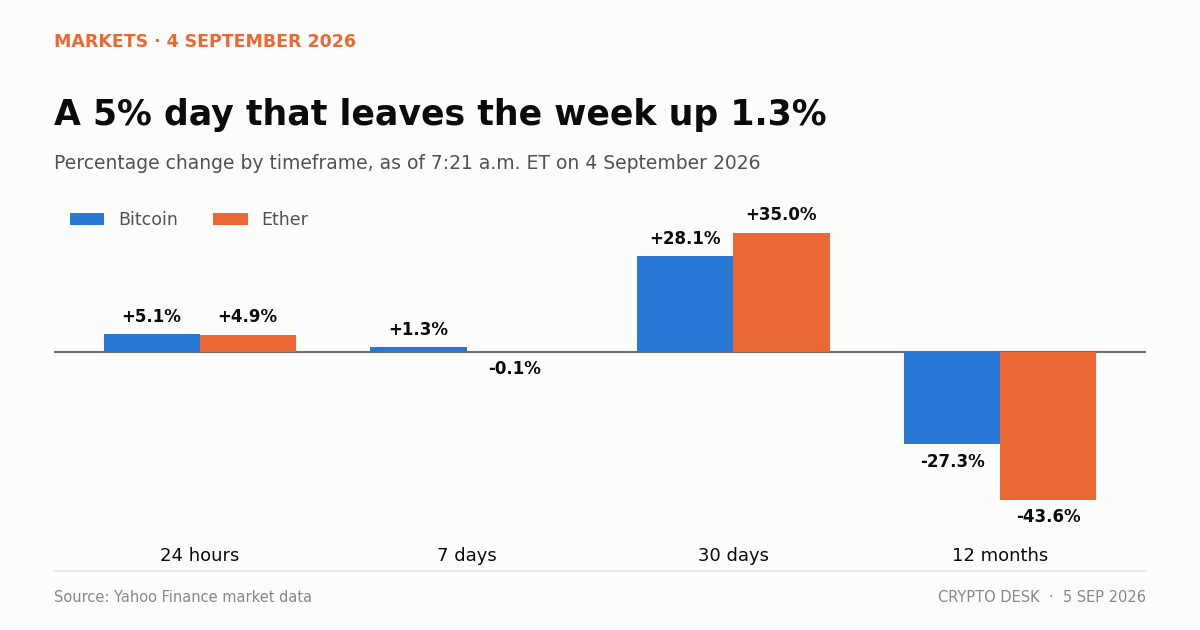
| Week | +1.3% | -0.1% |
| Month | +28.1% | +35.0% |
| Year | -27.3% | -43.6% |
| All-time high | $126,198.07 (6 Oct 2025) | $4,953.73 (24 Aug 2025) |
The weekly column is the one worth pausing on. After a 5% day, bitcoin is up 1.3% on the week and ether is down 0.1%. Friday's rally recovered what Tuesday and Wednesday took away and very little more.
The monthly and annual columns tell the structural story: a strong five-week recovery inside a deep twelve-month drawdown. Bitcoin remains 35.6% below its October 2025 record. Ether is 49.1% below its own.
The data that lands next
The August employment report was released the same morning, and it did not cooperate with the dovish read.
Payrolls came in at 162,000 against a consensus near 53,000 — the strongest month since March. June and July were revised up by a combined 55,000, with July flipping from a reported loss to a gain of 21,000. Unemployment held at 4.1%. Average hourly earnings rose 0.3% on the month to $37.75, up 3.1% over the year.
Market-implied odds of a quarter-point hike at the next meeting moved to roughly 59%, up from 52%. The dollar index added 0.3% and short-term Treasury yields rose.
So the same trading day contained a dovish Fed governor and a hawkish jobs print. Waller's remarks moved first and crypto rallied on them; the payrolls number pushed rate expectations back the other way within hours. That is an unstable setup, and it explains why the weekly change is 1.3%, not 5%.
What was moving underneath
Bitcoin and ether were not the day's best performers. Several individual stories outran the index by a wide margin.
Zcash rose about 17% as Grayscale's newly converted spot ETF continued drawing money, pushing ZEC through $1,000 for the first time. Ethena's ENA gained roughly 10% after its fee-switch proposal passed. Uniswap added a similar amount on fee revenue from Robinhood Chain deployments. Two meme tokens, USELESS and MarsCoin, rose 60% and 110% respectively.
A day where privacy coins, DeFi governance tokens and meme coins all outperform bitcoin by a factor of two to twenty is a day of returning risk appetite, not a day of defensive positioning. It is a meaningful behavioural signal after four months in which almost nothing outside bitcoin worked.
The liquidity picture changed too
Stablecoin net flows to exchanges turned positive on 1 September, ending 113 consecutive days of outflows running from May through 31 August.
The magnitude is small — $13.85 million of ERC-20 stablecoin net inflows on 1 September, falling to $6.85 million by 3 September, a 51% decline in two days. On-chain analyst Axel Adler Jr. was cautious about reading much into it: "Exchange flows are no longer clearly negative, while SSR is retreating from its recent local high, but neither metric confirms a sustained expansion in liquidity yet."
The direction is right. The magnitude is not yet convincing. Both things are true.
What to watch
Whether $80,000 holds as support. Bitcoin has traded through this level in both directions over the past fortnight. Holding it after a squeeze-driven move up would be more informative than the move itself.
Follow-through ETF flows. Thursday brought a $730.9 million inflow day, the largest since January. One day is a headline. Three in a row is a trend.
The next Fed communication. With Waller dovish and the jobs data hawkish, the committee's actual position is genuinely unclear, and crypto is currently trading the guesswork rather than the fundamentals.
A five percent day inside a one percent week
A 5% day that leaves the week up 1.3% is not a breakout. It is a recovery from a two-day selloff, amplified by leverage clearing out on the way back up.
What changed on Friday was not bitcoin. It was the market's estimate of what the Fed does in three weeks — and by the afternoon, the jobs report had already moved that estimate back.
The week in one line
Bitcoin ended Friday morning up 1.3% on the week after a 5.1% day. That single comparison contains everything.
Monday and Tuesday sold off on Iranian strikes and oil at a three-month high. Wednesday steadied. Thursday and Friday rallied on Waller. Net result across five sessions: a little over one percent.
Weeks like this are what a market with no directional conviction looks like. Large daily moves in both directions, driven entirely by inputs from outside the asset class, netting to close to nothing. It is the signature of a market waiting for something — in this case, a Federal Reserve decision in three weeks that currently sits near a coin flip.
The corollary is that the moves are not information about bitcoin. A 5% day on a Fed governor's remarks tells you about rate expectations. A 3% drop on an oil spike tells you about inflation expectations. Neither tells you anything about adoption, network activity, regulatory progress, or any of the things that determine where this asset trades in three years instead of three weeks.
About this report. Prices are from Yahoo Finance market data at 7:21 a.m. ET on 4 September 2026; other trackers showed bitcoin near $80,841 at slightly different timestamps. Liquidation and rate-odds figures are from KuCoin's daily market report. Employment data is from the BLS August release as reported by CNBC and Babypips. Stablecoin flow figures are from CryptoQuant data via DailyCoin.
Not investment advice. Digital assets are volatile and leveraged positions can be liquidated in full.
Sources
- Bitcoin and ethereum prices today, Friday, September 4, 2026 — Yahoo Finance
- Crypto Daily Market Report – September 4, 2026 — KuCoin
- U.S. payrolls rose 162,000 in August, much more than expected — CNBC
- Stablecoin Inflows Return After Nearly Four Months of Outflows — DailyCoin
Read next
- Sentiment Has Fallen for Three Sessions While Price Did Nothing. That Is the Momentum Draining Out. The crypto Fear and Greed Index slipped to 66 from 69 and 71 across three sessions while bitcoin barely moved…
- Stablecoins Turned Over $76 Billion in a Day on a $291 Billion Base The stablecoin market cap sits at $291.3 billion with $76.11 billion of daily volume — a turnover ratio no ot…
- IBIT Took $117 Million on a Friday Nobody Was Watching IBIT inflows of over $117 million on Friday extended a bitcoin ETF run of three consecutive positive weeks an…