Uniswap's Revenue Nearly Tripled in a Day, and It Came from Robinhood's Chain
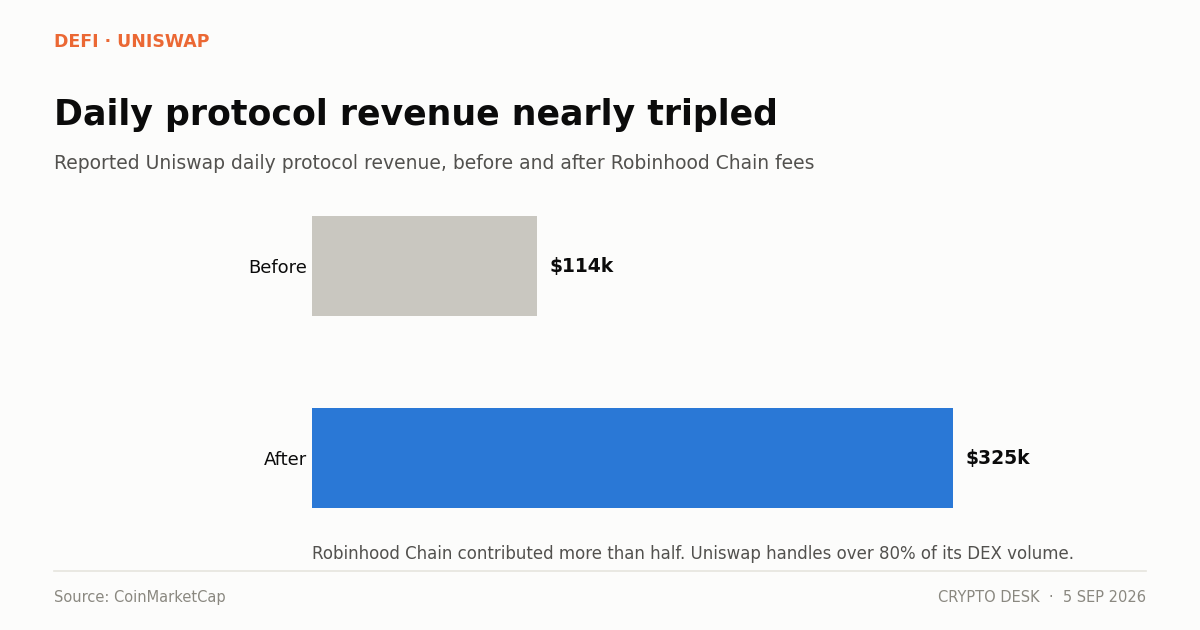
The Uniswap UNI price rose about 9.75% after protocol fees switched on for Robinhood Chain, lifting reported daily protocol revenue from roughly $114,000 to $325,000.
On this page
- What drove the Uniswap UNI price move
- Why this is different from most DeFi token news
- The burn mechanism deserves scrutiny
- The concentration risk
- The technical picture, briefly
- The session context
- What to watch
- The pattern across DeFi this week
Uniswap's reported daily protocol revenue jumped from roughly $114,000 to approximately $325,000 after governance activated protocol fees on Robinhood Chain. More than half the new total came from that one chain.
UNI rose about 9.75% over twenty-four hours, trading in a range from around $5.70 to $6.30, on volume of $972.51 million. The token is up roughly 30% on the week to a multi-month high near $6.
The wider market fell about 1.45% over the same period. Altcoins excluding bitcoin and ether were essentially flat at +0.19%. This move was idiosyncratic.
What drove the Uniswap UNI price move
Uniswap v4 and v3 deployments on Robinhood Chain generated several million dollars in trading fees within twenty-four hours. The chain processed approximately $1.49 billion in DEX volume, with Uniswap handling more than 80% of it.
Trading fees on Uniswap have always gone to liquidity providers. The change is that a protocol fee — a slice of those trading fees directed to the protocol rather than the LPs — is now switched on for these deployments.
The "Unification" governance proposal established the framework. Protocol fees accumulate in contracts, and to claim those accumulated assets, participants must burn UNI. That creates a mechanical link between protocol revenue and token supply reduction: more fees means more assets to claim, which means more UNI burned to claim them.
Estimated daily UNI burns nearly doubled over the same period.
Why this is different from most DeFi token news
The fee-switch debate has run in Uniswap governance since 2020. For most of that time the argument against was regulatory: turning on a protocol fee arguably makes UNI look more like a security by giving holders a claim on revenue, and the SEC's posture through 2023 and 2024 made that a live risk.
The regulatory environment has changed materially. The SEC proposed Regulation Crypto Assets on 18 August 2026, its first purpose-built offering framework for tokens, including a conditional safe harbor that would deem qualifying assets not to be investment contracts. Whatever the final rules say, an agency actively writing pathways is a different counterparty from an agency filing enforcement actions.
That shift is what made a fee switch politically possible, and it is the part of this story with implications beyond Uniswap. Every large DeFi protocol has a dormant fee-switch proposal. Ethena's passed on 2 September. Others will follow.
The burn mechanism deserves scrutiny
The design is elegant and it has a catch worth noting.
Claimants burn UNI to access accumulated protocol assets. That means the burn rate is a function of how much value has accumulated and how profitable it is to claim it. If the accumulated assets are worth more than the UNI required to claim them, claiming happens and UNI burns. If not, the assets sit.
So the burn is not a fixed percentage of revenue. It is a market-driven process whose rate depends on UNI's price relative to the value accumulated — which introduces reflexivity. A higher UNI price makes claiming less attractive, slowing burns. A lower price accelerates them.
That is a stabilising mechanism instead of a straightforward supply sink, and it behaves differently from the burn-per-transaction models people are used to.
The concentration risk
More than half of Uniswap's new protocol revenue comes from a single chain operated by a single public company.
Robinhood Chain's $1.49 billion of DEX volume in twenty-four hours is real, and Uniswap capturing 80%-plus of it reflects genuine product advantage. But revenue concentrated in one venue is revenue exposed to that venue's decisions. Robinhood could change its fee arrangements, promote a competing DEX, or alter the chain's economics. None of that requires Uniswap's consent.
Contrast that with Uniswap's Ethereum mainnet business, which is spread across thousands of independent liquidity providers and traders on a chain nobody controls. The mainnet revenue is smaller and considerably more durable.
Anyone valuing UNI on the new revenue run-rate should apply a discount for that concentration, in the same way an equity analyst would discount a supplier that derives half its sales from one customer.
The technical picture, briefly
UNI broke out of a multi-month consolidation range roughly between $2 and $10. Traders have flagged targets around $19 to $20, with RSI elevated and momentum described as strongly bullish.
Those targets should be read as what they are: chart-derived levels with no connection to the revenue arithmetic. At $6 and a fully diluted supply of one billion tokens, UNI carries a valuation of roughly $6 billion against annualised protocol revenue in the region of $119 million if the $325,000 daily figure holds every day for a year — which it will not, since it reflects a single strong day.
That is a demanding multiple on revenue that is one day old and majority-sourced from one counterparty. It may still be the right trade. It is not a cheap one.
The session context
Thursday and Friday saw broad risk appetite return after Fed Governor Christopher Waller signalled support for holding rates, cutting September hike odds from about 63% to roughly 50%. Bitcoin rose 5.1%, ether 4.9%, Zcash about 17%, Ethena's ENA around 10%, and two meme tokens ran 60% and 110%.
Uniswap's move stands out because the broader market fell 1.45% during its 24-hour window and altcoins were flat. Whatever the macro contributed, the fee revenue is doing most of the work here.
What to watch
Whether Robinhood Chain volume holds. The $1.49 billion figure is a single day on a young chain. Daily volume settling at a third of that changes the revenue arithmetic proportionally.
Actual burn totals. Estimated burns nearly doubled. The realised figure, published on-chain, is the one that matters.
Whether other protocols follow. Ethena's fee switch passed on 2 September. Aave, Curve and others have had proposals in various states for years. A sector-wide move to revenue sharing would be the more consequential story.
Uniswap's mainnet share. If Robinhood Chain revenue grows while mainnet revenue shrinks, the business is being cannibalised, not expanded.
The pattern across DeFi this week
Uniswap was not the only protocol with fee news. Ethena's fee switch proposal passed on 2 September, with 17,014,325 ENA in favour and zero against.
Two of the largest DeFi protocols activating or approving revenue mechanisms within days of each other is unlikely to be coincidence. Both proposals had been debated for years. Both moved once the SEC began writing rules rather than filing cases.
The distinction between them is instructive, though. Ethena's mechanism pays nothing until USDe supply grows roughly 84%, from about $4.07 billion to $7.5 billion — it is a commitment to share revenue at a scale not yet reached. Uniswap's is live, generating measurable revenue today, with burns already occurring.
One is a promise, the other is a cash flow. The market moved both tokens by roughly the same amount, which suggests it is pricing the category instead of the specifics.
About this report. Revenue, volume and price figures are from CoinMarketCap's reporting of Robinhood Chain and Uniswap data. Market-wide comparisons are from the same source. The annualised revenue calculation is this desk's arithmetic on the reported daily figure and is labelled as such. Fee-switch mechanics are from Uniswap's Unification proposal.
Not investment advice. Protocol revenue figures from a single day do not annualise reliably.
Frequently asked questions
Why did the UNI price rise?
Governance activated protocol fees on Robinhood Chain, where Uniswap handles more than 80% of about $1.49 billion in daily DEX volume. Reported daily protocol revenue jumped from roughly $114,000 to approximately $325,000.
How does the Uniswap fee switch burn UNI?
Protocol fees accumulate in contracts, and claiming those assets requires burning UNI. Estimated daily burns nearly doubled after activation. The burn rate depends on UNI's price relative to accumulated value, so it is market-driven, not fixed.
What is the risk in Uniswap's new revenue?
Concentration. More than half of the new protocol revenue comes from a single chain operated by one public company, which can change fee arrangements or promote a competing venue without Uniswap's consent.
Sources
- Uniswap (UNI) Surges 10–13% on Robinhood Chain Fees, DeFi Rotation — CoinMarketCap
- Crypto Daily Market Report – September 4, 2026 — KuCoin
- SEC Proposes New Regulation Crypto Assets — SEC press release 2026-76
- Ethena Fee Switch: When the ENA Buyback Starts — CryptoTicker
Read next
- Ethena's Fee Switch Passed Unanimously. It Does Nothing Until USDe Nearly Doubles. Ethena's fee switch passed with 17m ENA in favour and zero against, but buybacks only start when USDe supply …
- 93% of Last Week's Crypto Venture Money Went to Companies That Move Regulated Dollars Crypto VC funding reached $292.35m across ten deals in the week to 5 September, with 93% going to payments an…
- Sentiment Has Fallen for Three Sessions While Price Did Nothing. That Is the Momentum Draining Out. The crypto Fear and Greed Index slipped to 66 from 69 and 71 across three sessions while bitcoin barely moved…