Ethena's Fee Switch Passed Unanimously. It Does Nothing Until USDe Nearly Doubles.
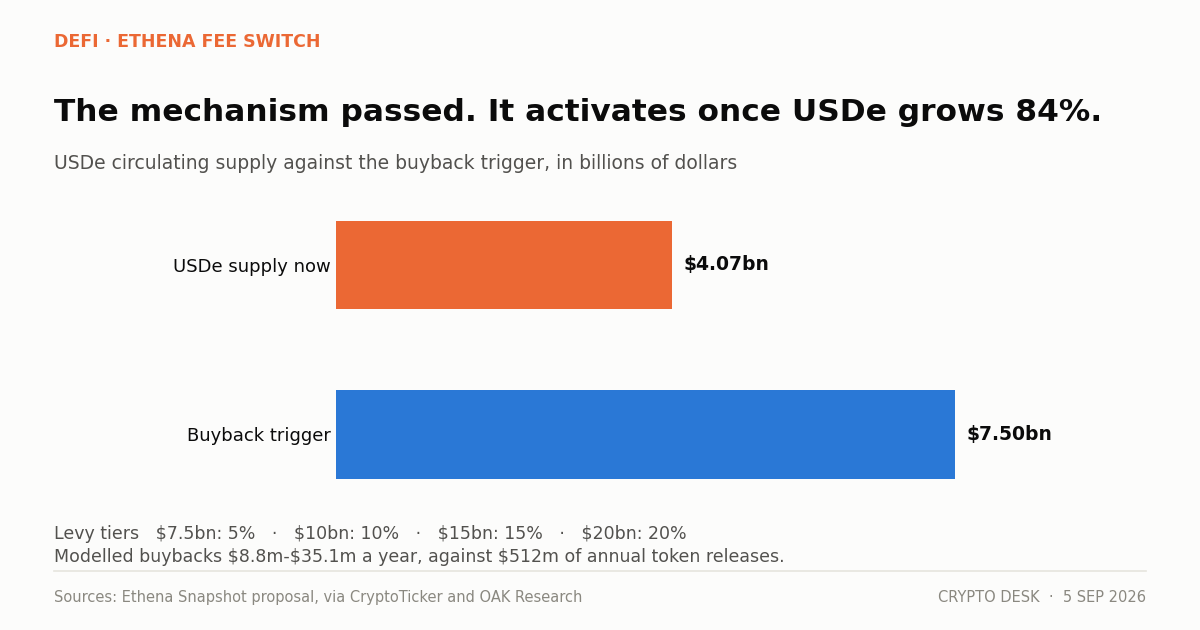
The Ethena fee switch passed with 17,014,325 ENA in favour and zero against, but no buyback occurs until USDe supply reaches $7.5 billion — an 84% increase from about $4.07 billion today.
On this page
- The vote
- The threshold that matters
- The tiered levy
- What it costs sUSDe holders
- Five things still undecided
- The context of the rally
- What to watch
- The summary
- What a fee switch is actually for
Ethena's fee switch proposal passed. ENA rose about 10% on the news. And the mechanism it approved will not pay a single dollar to token holders until USDe's circulating supply grows by roughly 84%.
Both halves of that are worth understanding, because the gap between them is where most of the commentary has gone wrong.
The vote
The Snapshot vote closed 2 September 2026 at 13:59 UTC. As of 30 August, 17,014,325 ENA had voted in favour and zero against, across 76 addresses — comfortably clearing the 5 million ENA quorum.
A unanimous governance vote is less remarkable than it sounds. Proposals that reach a Snapshot vote in most DeFi protocols have been negotiated in forums beforehand, and opposition typically manifests as abstention instead of a "no" vote. Seventy-six voting addresses on a token with a large holder base is a modest turnout by any measure.
The threshold that matters
No buybacks trigger at approval. The mechanism activates only when USDe circulating supply reaches $7.5 billion.
USDe currently sits at approximately $4.07 billion. Reaching the trigger requires about $3.4 billion of additional supply — an 84% expansion.
That is the single most important fact about this proposal, and it is the one most consistently omitted from coverage that treats the vote as an immediate value accrual event for ENA holders. It is a conditional commitment to share revenue at a scale the protocol has not yet reached.
The tiered levy
Once the trigger is met, the levy rate scales with supply:
| USDe supply | Levy on gross revenue |
|---|---|
| $7.5bn+ | 5% |
| $10bn+ | 10% |
| $15bn+ | 15% |
| $20bn+ | 20% |
Blockworks Advisory has modelled the annual buyback amounts this produces: roughly $8.8 million at the 5% tier, rising to about $35.1 million at the 20% tier.
Set that against the protocol's planned token releases of approximately $512 million a year. Even at the top tier, buybacks absorb around 7% of annual emissions. At the entry tier, closer to 1.7%.
This is the arithmetic that determines whether a fee switch supports a token price. Buybacks are only meaningful relative to the supply arriving from unlocks and emissions. A mechanism that offsets a fourteenth of new supply at its most aggressive setting is not a supply sink. It is a signal of intent.
What it costs sUSDe holders
The levy is taken from gross revenue, which means it comes proportionally out of the yield paid to staked USDe.
The mechanics are straightforward: a 10% levy reduces the sUSDe annual percentage yield by a tenth. At an 8% APY, that becomes approximately 7.2%.
So the fee switch transfers value from stablecoin yield-seekers to token holders. That is the trade every DeFi fee switch makes, and it is worth naming instead of glossing. Ethena's product proposition to USDe holders is yield; reducing that yield to buy back a governance token makes the product marginally less competitive against alternatives at exactly the moment the protocol needs supply to grow 84%.
Whether those two objectives are compatible is the open question. The tiering is presumably designed to address it — the levy only bites once the protocol has already achieved scale — but the incentive tension does not disappear.
Five things still undecided
The proposal leaves substantial implementation detail unresolved:
- Reference yield rates — what benchmark the levy calculation uses
- Continuity reserves — what buffer the protocol holds before distributing
- sENA reward structures — how staked ENA holders participate
- Public dashboards — how any of this gets verified by holders
- Token disposition after purchase — whether bought ENA is burned, held in treasury, or redistributed
That last item is not a detail. A buyback-and-burn permanently reduces supply. A buyback-and-hold moves tokens to a treasury that can sell them later. The two have materially different effects on a token's supply profile, and the proposal that just passed unanimously does not specify which one it is.
The context of the rally
ENA's roughly 10% gain came on a session where risk appetite returned broadly. Fed Governor Christopher Waller's dovish comments cut September rate-hike odds from about 63% to roughly 50%. Bitcoin rose 5.1%, ether 4.9%, Zcash about 17%, Uniswap around 10%, and two meme coins ran 60% and 110%.
In that company, a 10% move on genuine protocol news is roughly in line with what tokens with no news did. Attributing all of it to the fee switch would be generous.
What to watch
USDe supply growth. This is the only number that matters for the mechanism. From $4.07 billion toward $7.5 billion — or not.
The unresolved five. Particularly token disposition. A follow-up proposal specifying burn versus treasury would change the supply analysis considerably.
sUSDe yield competitiveness. If reducing yield slows supply growth, the mechanism becomes self-defeating, and the tiering exists precisely to prevent that.
Emissions schedule. $512 million of annual token releases against $8.8 million to $35.1 million of buybacks. Any change to the emissions side matters more than any change to the buyback side.
The summary
A unanimous vote to share revenue that begins after an 84% growth in the protocol's core product, funded by reducing the yield that drives that growth, offsetting between 1.7% and 7% of annual token emissions.
That is a reasonable governance decision. It is not, on these numbers, a reason to reprice the token.
What a fee switch is actually for
There is a reading of these proposals that has little to do with the cash flows, and it is probably the more accurate one.
A governance token with no revenue claim is difficult to value by any conventional method. It is difficult to explain to an allocator, difficult to defend against a claim that it is purely speculative, and difficult to distinguish from tokens with no protocol behind them at all.
A fee switch changes the category. Once a token has a mechanism connecting protocol revenue to holders, it can be discussed in terms of multiples, coverage and payout ratios — the vocabulary institutional capital already uses. The magnitude can be small and the framework still works.
That is a substantial part of what Ethena's vote achieved, and it explains why a mechanism that pays nothing until USDe grows 84% still moved the token 10%. The market is pricing the existence of the framework, not the cash flows inside it.
Whether that repricing is justified depends on whether the framework attracts the capital it is designed to speak to. On present evidence, that remains unproven across the whole sector.
The counter-argument deserves airing. Allocators who have spent two years unable to justify a governance token to a risk committee now have a document to point at. That is not nothing, even where the cash flows are years away. Whether it converts into actual allocations is measurable, and the next few quarters of token-holder composition data will answer it more honestly than any price move.
About this report. Vote totals, thresholds and levy tiers are from Ethena's Snapshot proposal as documented by CryptoTicker and OAK Research. Buyback projections are Blockworks Advisory estimates. USDe supply figures are as of the proposal period and change daily. Price context is from KuCoin's 4 September market report.
Not investment advice. Governance outcomes and protocol growth are uncertain.
Frequently asked questions
When does the Ethena fee switch start paying out?
Only when USDe circulating supply reaches $7.5 billion. Supply sits near $4.07 billion, so the trigger requires roughly $3.4 billion of additional supply, an 84% expansion. Nothing is paid at approval.
How large are the projected ENA buybacks?
Blockworks Advisory modelled roughly $8.8 million a year at the 5% levy tier, rising to about $35.1 million at the 20% tier. Against planned token releases near $512 million a year, that offsets between 1.7% and 7% of emissions.
Does the fee switch reduce sUSDe yield?
Yes. The levy is taken from gross revenue, so it comes proportionally out of the yield paid to staked USDe. A 10% levy reduces an 8% APY to approximately 7.2%.
Related reading
- Ethereum Quantum Resistance: December 2029 Deadline Set
- Ethereum Hegota: FOCIL and Frame Transactions Explained
- Ethereum Protocol Priorities: Five Arcs and a P0-P3 Ladder
- Solana Roadmap 2026: Alpenglow Consensus and Firedancer
Sources
- Ethena Fee Switch: When the ENA Buyback Starts — CryptoTicker
- Ethena's fee switch: our models proposal and doubts — OAK Research
- Weekly Unlock Digest: Aug 31–Sep 6, 2026 | Ethena's fee switch — Tokenomist
- Crypto Daily Market Report – September 4, 2026 — KuCoin
Read next
- Uniswap's Revenue Nearly Tripled in a Day, and It Came from Robinhood's Chain Uniswap's daily protocol revenue rose from about $114,000 to $325,000 after fees switched on for Robinhood Ch…
- 93% of Last Week's Crypto Venture Money Went to Companies That Move Regulated Dollars Crypto VC funding reached $292.35m across ten deals in the week to 5 September, with 93% going to payments an…
- Sentiment Has Fallen for Three Sessions While Price Did Nothing. That Is the Momentum Draining Out. The crypto Fear and Greed Index slipped to 66 from 69 and 71 across three sessions while bitcoin barely moved…