Ethereum Has Given Itself Until December 2029 to Survive a Quantum Computer
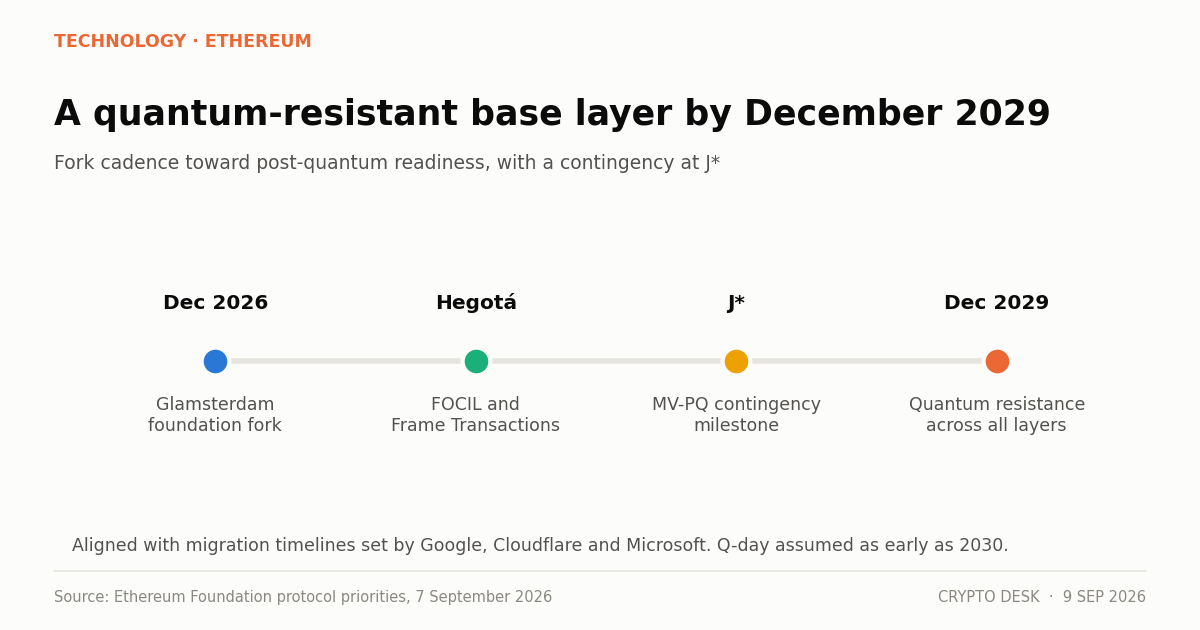
Ethereum quantum resistance now has a date: the Foundation targets a quantum-resistant base layer across execution, consensus and data by December 2029.
Why the Ethereum quantum resistance date is not arbitrary
December 2029 aligns with migration timelines set independently by Google, Cloudflare and Microsoft.
That alignment is the strongest argument for taking the deadline seriously. These are organisations with no stake in Ethereum, working from their own threat models and their own cryptographic inventories, and they landed in the same window. When the infrastructure companies securing a large share of internet traffic converge on a date, the date reflects a shared read of the research, not any one party's caution.
The threat is specific. Ethereum accounts are secured by ECDSA signatures. A sufficiently capable quantum computer running Shor's algorithm can derive a private key from a public key. Every address that has ever sent a transaction has exposed its public key on-chain, which means the exposure is retroactive as well as prospective.
The fork cadence
The Foundation set out a path with unusually aggressive intervals of seven to twelve months between forks.
| Fork | Timing | Role |
|---|---|---|
| Glamsterdam | December 2026 | Foundation fork |
| Hegotá | Scoping | FOCIL and Frame Transactions |
| I*, J*, K*, L* | Through 2029 | Progressive post-quantum implementation |
The placeholder names for the later forks are themselves informative. The Foundation is committing to a cadence and a sequence before it has committed to contents, which is the opposite of how Ethereum upgrades have historically been scoped.
The contingency milestone
Buried in the plan is the most pragmatic element: a "Minimum Viable Post-Quantum" milestone, MV-PQ, sitting at fork J*.
MV-PQ would let Ethereum operate through Q-day with reduced guarantees if full resistance is not complete. It is an explicit acknowledgement that the deadline may not be met and that partial protection arriving on time beats complete protection arriving late.
Publishing a contingency plan alongside a target is rare in this industry and it is the right call. It also tells you the Foundation's own confidence level, which is high enough to commit and low enough to hedge.
What it costs the rest of the roadmap
The priority ladder makes the trade-off explicit. P0 is mainnet safety. P1 is delivering Hegotá and the critical components of I* and J* toward MV-PQ. P2 reserves capacity for the remaining post-quantum items in K* and L*. P3 is research capability for everything else.
Hegotá's consensus-layer scope has been deliberately limited to preserve development capacity for post-quantum work.
In plain terms: scaling, fee reduction and user-facing improvements now sit behind a cryptographic migration for three years. Anyone expecting Ethereum's roadmap to be primarily about throughput between now and 2029 should read the priority ladder again.
The part nobody can schedule
Migrating the protocol is the tractable half. The other half is migrating the users.
Post-quantum signature schemes produce considerably larger signatures than ECDSA, which affects block size, propagation and gas costs. Every wallet, every smart contract that verifies signatures, every bridge and every exchange integration has to change. Contracts that are immutable by design cannot change at all.
The Foundation controls the protocol. It does not control the several hundred billion dollars of value sitting in addresses whose owners may not act until something breaks — and by definition, the moment something breaks is the moment it is too late.
What to watch
Glamsterdam shipping in December 2026. The first test of whether the seven-to-twelve-month cadence is achievable.
MV-PQ scoping at J*. The contents of the minimum viable milestone tell you what the Foundation considers non-negotiable.
Signature scheme selection. Hash-based and lattice-based candidates have very different size and verification costs, and the choice constrains everything downstream.
Whether other chains publish deadlines. Bitcoin has no comparable roadmap. If Ethereum's December 2029 target holds and Bitcoin's does not exist, that becomes a genuine differentiator in institutional risk assessments.
What Q-day actually means for a holder
The threat is often described as quantum computers "breaking bitcoin" or "breaking Ethereum," which is imprecise enough to be unhelpful.
The specific exposure is this: an address that has ever sent a transaction has published its public key on-chain. A sufficiently capable quantum computer can derive the private key from that public key. Addresses that have only ever received funds are better protected, because the public key remains hashed.
That distinction produces a practical implication. Funds sitting in addresses that have transacted are exposed on Q-day. Funds in never-spent addresses have an additional layer.
It also means the migration is not something a protocol can complete alone. Every holder has to move funds to a post-quantum address, and the holders least likely to act are the ones who have been inactive longest — which is precisely the supply most exposed.
About this report. The December 2029 target, Q-day assumption, fork cadence, MV-PQ milestone and priority ladder are from the Ethereum Foundation's protocol priorities post published 7 September 2026, with additional detail from The Block and Unchained coverage. The Google, Cloudflare and Microsoft alignment is as stated by the Foundation.
Not investment advice. Protocol roadmaps change and target dates in this industry routinely slip.
Frequently asked questions
When will Ethereum be quantum resistant?
The Ethereum Foundation's stated target is December 2029, covering all three layers — execution, consensus and data. The planning assumption is that Q-day could arrive as early as 2030, and the date aligns with migration timelines set independently by Google, Cloudflare and Microsoft.
What is the MV-PQ milestone?
Minimum Viable Post-Quantum, a contingency sitting at fork J*. It would let Ethereum operate through Q-day with reduced guarantees if full resistance is not complete, which is an explicit acknowledgement that the deadline may not be met.
Sources
- EF Protocol: Current and Emerging Priorities — Ethereum Foundation Blog
- Ethereum aims for quantum-safe L1 by 2029 as Hegotá upgrade takes form — The Block
- Ethereum Foundation Targets a Quantum-Resistant Base Layer by December 2029 — Unchained
- Ethereum Targets 2029 for Post-Quantum L1 Readiness — The Crypto Times
Read next
- Glamsterdam Explained: Ethereum''s Q4 Upgrade Takes Block Building Back On-Chain Ethereum's Glamsterdam upgrade targets Q4 2026 with enshrined proposer-builder separation and block-level acc…
- 93% of Last Week's Crypto Venture Money Went to Companies That Move Regulated Dollars Crypto VC funding reached $292.35m across ten deals in the week to 5 September, with 93% going to payments an…
- Sentiment Has Fallen for Three Sessions While Price Did Nothing. That Is the Momentum Draining Out. The crypto Fear and Greed Index slipped to 66 from 69 and 71 across three sessions while bitcoin barely moved…