Glamsterdam Explained: Ethereum''s Q4 Upgrade Takes Block Building Back On-Chain
The Ethereum Glamsterdam upgrade targets Q4 2026 and moves block building into the protocol itself, ending a dependence on off-chain relays that build over 88% of blocks today.
On this page
- Where Glamsterdam sits
- EIP-7732: putting block building back where it belongs
- EIP-7928: the boring change that unlocks the gas limit
- What did not make the cut
- What Fusaka already did
- The market context
- What to watch between now and Q4
- The summary
- Why the gas limit will not jump on day one
Ethereum's next mainnet upgrade, Glamsterdam, targets the fourth quarter of 2026. It carries two headline changes, and one of them addresses a problem the network has been quietly living with since 2021: more than 88% of Ethereum blocks are currently built by off-chain relays rather than by validators.
Where Glamsterdam sits
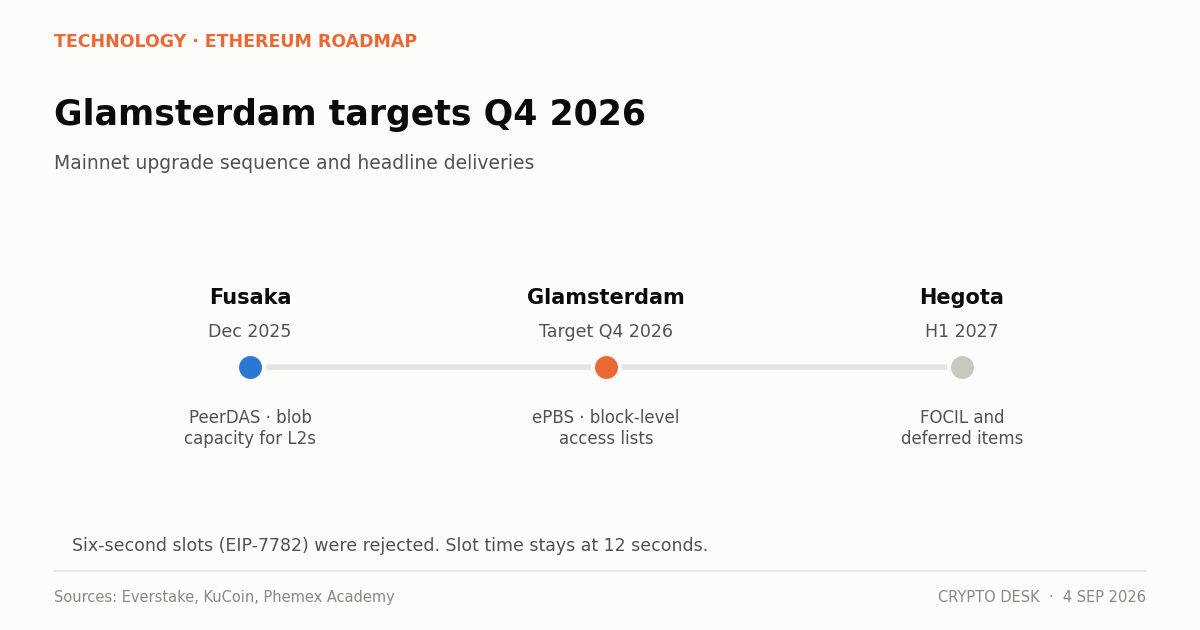
The schedule, as it currently stands:
| Upgrade | Timing | Headline delivery |
|---|---|---|
| Fusaka | December 2025 | PeerDAS, expanded blob capacity for L2s |
| Glamsterdam | Target Q4 2026 | ePBS, block-level access lists |
| Hegotá | H1 2027 | FOCIL and deferred items |
Glamsterdam was originally scoped for the second half of 2026 and narrowed to Q3-Q4 after devnet testing in May 2026. Q4 is the current target, and Ethereum upgrade targets have historically slipped instead of arrived early. Treat it as a date to watch, not a date to plan around.
EIP-7732: putting block building back where it belongs
Today, when a validator is selected to propose an Ethereum block, it usually does not build one. It outsources the job to a specialised builder through MEV-Boost, a piece of off-chain middleware, and accepts the most valuable block offered. Over 88% of blocks arrive this way.
This works, and it has worked for years. It also means Ethereum's block production depends on a small number of relays that exist entirely outside the protocol. They are not consensus participants. They can go offline, be censored, be compelled by regulators, or simply decide to change their terms, and the protocol has no say in any of it.
Enshrined proposer-builder separation moves that arrangement into the protocol itself. Rather than trusting an external relay to deliver a block after the proposer commits to it, the separation between proposing and building becomes a consensus-level construct with its own rules.
The mechanical change most likely to matter in practice is timing. EIP-7732 introduces a new validator duty, the Payload Timeliness Committee, and extends the data propagation window from about 2 seconds to roughly 9 seconds. That is a substantial relaxation of one of the tightest constraints in Ethereum's block cycle, and it has knock-on benefits for validators running on ordinary hardware and consumer connections, not in data centres.
EIP-7928: the boring change that unlocks the gas limit
Block-level access lists are the less glamorous half of the upgrade and possibly the more consequential one.
The idea: have each block declare, upfront, every account and storage slot the transactions in it will touch. Once a node knows that in advance, it can determine which transactions do not interact with each other and validate them in parallel rather than strictly in sequence.
Sequential execution has been one of the hard limits on Ethereum's throughput since genesis. Every transaction must be processed in order because any transaction might touch any state. Pre-declaring access patterns breaks that dependency for the majority of transactions that touch nothing in common.
The practical target this enables is raising the gas limit from 60 million toward 200 million. That is a threefold-plus increase in the amount of computation a block can contain. For users, more gas capacity per block means lower base fees for the same demand.
What did not make the cut
EIP-7782, six-second slots, was rejected from Glamsterdam. Slot time stays at 12 seconds. Halving it would have doubled the frequency of blocks and roughly halved confirmation latency, which sounds attractive and imposes real costs on validators with slower connections and on the network's bandwidth requirements. The decision to defer reflects a consistent pattern in Ethereum's process: changes that raise the hardware floor for solo validators get resisted.
FOCIL, the censorship-resistance mechanism, was deferred to Hegotá. This is the proposal that would make it harder for block builders to exclude specific transactions. Given that ePBS restructures block building, sequencing FOCIL afterwards is defensible engineering. It also means Glamsterdam changes who builds blocks without directly changing what they can refuse to include.
Eight further proposals are scheduled for inclusion, covering gas pricing adjustments, state-bloat mitigation and new EVM opcodes.
What Fusaka already did
Glamsterdam's predecessor shipped in December 2025 and its main delivery was PeerDAS, which expanded blob capacity for Layer 2 rollups and established the data availability foundation the L2 ecosystem depends on.
The sequencing is deliberate. Fusaka made data cheaper for rollups. Glamsterdam makes execution cheaper on L1 and restructures who builds blocks. Both point at the same objective: more capacity without raising the cost of running a node.
The market context
None of this is currently reflected in the price. Ether trades near $2,373, down roughly 44% over twelve months and about 52% below its August 2025 record of $4,953.73.
August was better — a 31.2% monthly gain, with spot ether ETFs running an eleven-day inflow streak and reaching approximately $15.6 billion in assets. But protocol upgrades have a poor record as price catalysts. The Merge, arguably the most significant technical achievement in the network's history, was followed by a decline. Markets price expectations well in advance and then sell the event.
Glamsterdam is infrastructure work with a multi-year payoff. If block-level access lists genuinely enable a 200 million gas limit, the effect shows up over quarters in lower fees and higher throughput, not in a candle on upgrade day.
What to watch between now and Q4
Devnet and testnet results. Every Ethereum upgrade goes through devnets, then public testnets, then mainnet. Problems found at the testnet stage push dates. May 2026's devnet testing is what narrowed the window to Q3-Q4 in the first place.
Whether the gas limit actually rises after activation. BALs enable a higher limit; they do not set one. Validators adjust the limit themselves, gradually and conservatively. Expect months between activation and any meaningful increase.
Relay behaviour under ePBS. The existing MEV-Boost relay operators do not disappear when block building is enshrined. How that ecosystem adapts is the most uncertain part of the upgrade, and the part least amenable to prediction from a specification.
The summary
Glamsterdam targets Q4 2026 with two substantive changes: block building moves into the protocol, and block execution becomes parallelisable. Slot times stay at 12 seconds. Censorship resistance waits for 2027.
It is a serious upgrade that will change how Ethereum works internally and will be largely invisible to anyone using it, which is roughly the definition of good infrastructure work.
Why the gas limit will not jump on day one
A common misreading of block-level access lists is that the gas limit rises automatically when the upgrade activates. It does not.
Ethereum's gas limit is set by validators, each of whom signals a preferred value, with the network converging on the median. Raising it is a social process that happens gradually and conservatively, because a limit set too high increases state growth and the hardware burden on node operators — the constituency that Ethereum's governance has consistently protected.
The historical pattern is instructive. Previous increases moved in increments of a few million gas over months, with pauses to observe the effect on node performance and sync times. There is no reason to expect a jump from 60 million to 200 million in a single step, and good reason to expect the opposite.
What EIP-7928 does is remove the technical objection to raising it. Removing a technical objection and actually raising the limit are separated, in Ethereum's history, by quarters instead of days.
About this report. Upgrade specifications, EIP numbers and timeline details come from Everstake's Glamsterdam and Fusaka technical write-ups and KuCoin's upgrade coverage. Price data is from Yahoo Finance as of 2 September 2026. Ethereum upgrade dates are targets set by client teams and change routinely.
Not investment advice. Protocol upgrades do not reliably move prices in either direction.
Frequently asked questions
When is the Ethereum Glamsterdam upgrade?
It targets the fourth quarter of 2026, narrowed from the second half of the year after devnet testing in May 2026. It follows Fusaka, which shipped in December 2025, and precedes Hegotá in the first half of 2027.
What does EIP-7732 change?
Enshrined proposer-builder separation moves block building into consensus, not off-chain MEV-Boost relays. It adds a Payload Timeliness Committee duty and extends the data propagation window from about 2 seconds to roughly 9.
Will Glamsterdam make Ethereum cheaper to use?
Eventually. Block-level access lists enable parallel validation and lay the groundwork for raising the gas limit from 60 million toward 200 million, but validators raise the limit gradually, so expect months between activation and any real increase.
Related reading
- Ethereum Quantum Resistance: December 2029 Deadline Set
- Ethereum Hegota: FOCIL and Frame Transactions Explained
- Ethereum Protocol Priorities: Five Arcs and a P0-P3 Ladder
- Solana Roadmap 2026: Alpenglow Consensus and Firedancer
Sources
- Ethereum Glamsterdam: Upgrade Overview and EIPs Explained — Everstake
- Inside Fusaka: Ethereum's Next Evolution — Everstake
- Ethereum's Glamsterdam Upgrade to Focus on the Execution Layer and ePBS in 2026 — KuCoin
- Ethereum 2026: Fusaka, Glamsterdam & Future Technical Developments — Phemex Academy
Read next
- Ethereum Has Given Itself Until December 2029 to Survive a Quantum Computer The Ethereum Foundation set December 2029 as its deadline for quantum resistance across execution, consensus …
- 93% of Last Week's Crypto Venture Money Went to Companies That Move Regulated Dollars Crypto VC funding reached $292.35m across ten deals in the week to 5 September, with 93% going to payments an…
- Sentiment Has Fallen for Three Sessions While Price Did Nothing. That Is the Momentum Draining Out. The crypto Fear and Greed Index slipped to 66 from 69 and 71 across three sessions while bitcoin barely moved…