Inside Regulation Crypto Assets: The SEC''s First Real Rulebook for Token Offerings
Regulation Crypto Assets is the SEC's first purpose-built rulebook for token offerings, proposed on 18 August 2026 under file S7-2026-27.
On this page
- The two exemptions, plainly
- The safe harbor is the important part
- Where Regulation Crypto Assets came from
- What the proposal does not do
- What it means if you are building
- Timeline to watch
- What the proposal is and is not
- How to read a proposing release without a law degree
For nine years the American answer to "how do I legally sell a token in the United States?" was a shrug, a Howey analysis and a very expensive law firm. On 18 August 2026 the Securities and Exchange Commission proposed something closer to an actual answer.
Regulation Crypto Assets, filed under S7-2026-27 with proposing release 33-11434, is the first attempt to write purpose-built offering rules for crypto rather than bolt crypto onto rules drafted in 1933. It is a proposal, not a final rule, and the comment period runs 60 days from publication in the Federal Register. But it is the most concrete thing the agency has produced on this question.
The two exemptions, plainly
The proposal creates two registration exemptions under the Securities Act of 1933. They are tiered by size, and the trade-off between them is disclosure burden.
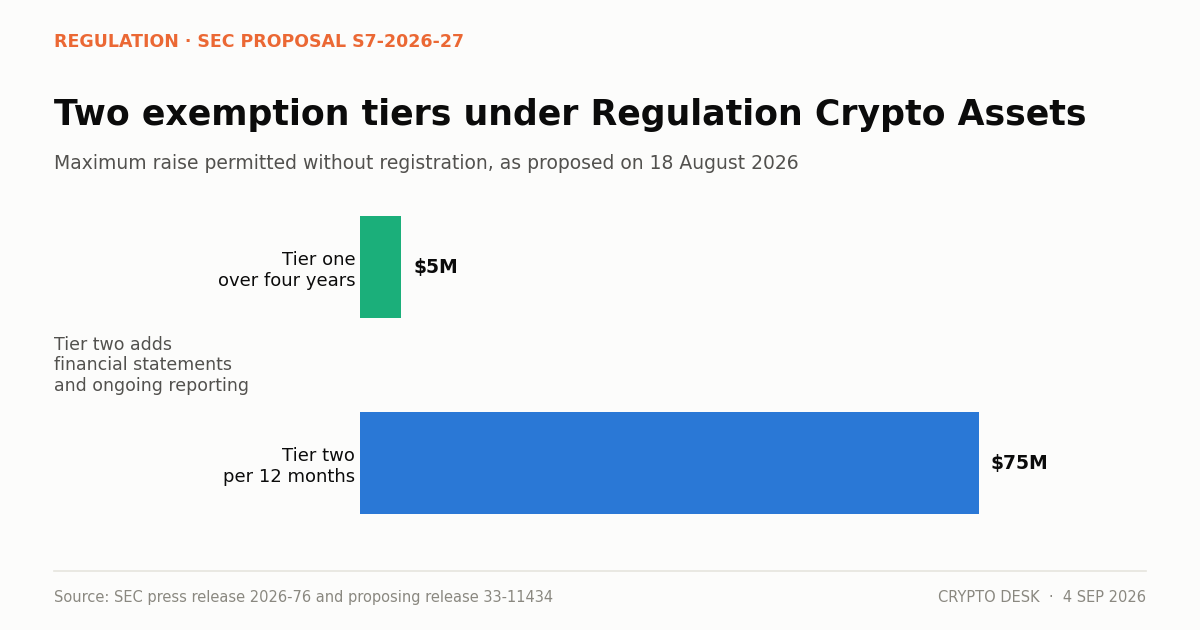
Tier one — up to $5 million over four years. A small issuer can raise up to $5 million across a rolling four-year window without registering. Disclosure is principles-based and narrative: describe the project, the token, the risks, the people, in plain language instead of in a prescribed form.
Tier two — up to $75 million per twelve months. The larger exemption carries real obligations. Issuers must provide financial statements and commit to ongoing reporting. This is not a registration statement, but it is not a press release either.
Both tiers rest on narrative disclosure, not the line-item schedules that define traditional securities filings. The Commission's reasoning is that a token project's material risks are genuinely different from a manufacturer's, and forcing them into the same boxes has produced filings that inform nobody.
The safe harbor is the important part
The exemptions matter, but the conditional safe harbor is what practitioners will read first.
Under the proposal, a crypto asset that meets specified conditions would be deemed not subject to the investment contract definitions in either the 1933 Act or the Securities Exchange Act of 1934. In practice, that means a token can stop being a security — permanently, provided the conditions are met and maintained.
This has been the industry's central ask since 2018. Bill Hinman's 2018 speech floated the idea that a token could start as a security and later become sufficiently decentralised that it stopped being one, but that was a speech, not a rule, and the agency spent the following years litigating positions that did not always align with it. A conditional safe harbor written into regulation is a different animal from a speech at Yahoo Finance's All Markets Summit.
The proposal also preempts certain state securities law requirements. That detail will get less coverage than it deserves. Blue-sky compliance across fifty states has been a meaningful cost centre for token issuers, and preemption removes a layer of duplicative filing.
Where Regulation Crypto Assets came from
Regulation Crypto Assets does not appear from nowhere. It builds directly on interpretive guidance the Commission issued in March 2026, which set out how the staff was thinking about the investment contract analysis for digital assets. The August proposal converts that thinking into proposed rule text.
Chairman Paul S. Atkins framed the initiative as giving "crypto asset entrepreneurs and market participants with clear pathways to raise capital" while keeping investor protections in place and supporting domestic innovation. The framing is deliberate. A recurring argument from the Commission's current leadership is that unclear rules pushed token issuance offshore, which protected nobody and cost the US market activity.
Commissioners Hester Peirce and Mark Uyeda each issued separate statements alongside the proposal. Peirce, who has argued for a token safe harbor since 2020, titled hers around "filling the regulatory tank," which is about as close to enthusiasm as a commissioner statement gets.
What the proposal does not do
Three limits are worth stating clearly, because coverage of this proposal has occasionally overstated its reach.
It is not market structure. Regulation Crypto Assets governs how tokens are offered and sold. It does not settle which agency regulates secondary trading venues, how exchanges must register, or where the SEC's jurisdiction ends and the CFTC's begins. That question sits with Congress and the CLARITY Act, which faces a Senate procedural vote on 15 September.
It is not final. A 60-day comment period will produce substantial industry and academic input. Proposed rules routinely change between proposal and adoption, sometimes materially. The safe harbor conditions in particular are the sort of provision that gets tightened after comment.
It is not a general amnesty. Existing enforcement matters are not affected by a proposed rule, and conduct that was fraudulent before the proposal remains fraudulent after it.
What it means if you are building
For a founder planning a token launch, the practical read is straightforward. The $5 million tier is a genuine seed-stage on-ramp that did not exist in a usable form before. The $75 million tier is more interesting for projects that would otherwise have gone offshore or used a SAFT-then-airdrop structure to avoid the question entirely.
The safe harbor conditions will determine whether any of this is actually usable. If they require a level of decentralisation that only a handful of networks achieve, the practical effect will be modest. If they are achievable by a well-run project within a few years of launch, the effect could be large. The conditions are exactly where the comment letters will concentrate.
For anyone already operating, the near-term action is unglamorous: read the proposing release, model your project against the conditions, and file a comment if the conditions do not work for your structure. Comment letters do change rules. The Commission's own record shows it.
Timeline to watch
| Date | Event |
|---|---|
| March 2026 | SEC interpretive guidance on crypto investment contracts |
| 18 August 2026 | Regulation Crypto Assets proposed (S7-2026-27) |
| ~60 days from Federal Register publication | Comment period closes |
| 15 September 2026 | Senate cloture vote on CLARITY Act (separate track) |
| 2027 | Earliest realistic window for a final rule |
The two tracks — the SEC's rulemaking and Congress's market structure bill — are related but independent. The proposal proceeds whether or not CLARITY passes. If CLARITY does pass, some of what the SEC has proposed may need conforming amendments, because a statute that reassigns jurisdiction would sit above an agency rule.
What the proposal is and is not
This is a real proposal with real content, and it is a meaningful improvement on regulation by enforcement. It is also a proposal from one agency covering one slice of the problem, arriving in a year when the broader legislative effort is struggling.
Anyone reading it as the end of American crypto's regulatory uncertainty is reading too much into it. Anyone reading it as nothing has not read the safe harbor section.
How to read a proposing release without a law degree
Three sections of a proposing release carry most of the useful information, and the rest is procedural.
The conditions are where the rule actually lives. In this proposal, the conditions attached to the safe harbor determine whether it is a workable pathway or a theoretical one, and they are stated as a list rather than as prose.
The request for comment section is a list of numbered questions the Commission is genuinely unsure about. Those questions are the parts of the rule most likely to change between proposal and adoption, and answering them in a comment letter is the highest-leverage thing an affected firm can do.
The economic analysis section estimates costs and benefits. It is often the least read and the most litigated — challenges to SEC rules in recent years have frequently turned on the adequacy of this analysis instead of on the substance of the rule.
Read those three, in that order, and skip the background section unless the history is new to you.
About this report. Details are drawn from the SEC's own press release and rule page for S7-2026-27, the proposing release 33-11434, and the accompanying commissioner statements. Where the SEC's published materials did not disclose commissioner vote counts, this article does not speculate about them.
Not legal advice. Securities law is fact-specific. Talk to counsel before structuring an offering.
Frequently asked questions
What are the two exemption tiers in Regulation Crypto Assets?
Tier one permits raises up to $5 million across a rolling four-year window with narrative disclosure only. Tier two permits up to $75 million per twelve months but requires financial statements and a commitment to ongoing reporting.
Does the SEC proposal mean tokens are no longer securities?
Not automatically. The proposal creates a conditional safe harbor under which a crypto asset meeting specified conditions would be deemed outside the investment contract definitions of the 1933 and 1934 Acts. The conditions decide whether it is usable.
When would Regulation Crypto Assets take effect?
It is a proposal, not a final rule. The comment period runs 60 days from Federal Register publication, and proposed rules routinely change before adoption. A final rule is unlikely before 2027.
Related reading
- Asia Stablecoin Regulation: Japan, Hong Kong and Korea Move
- Crypto Exchange Bank Charters: Three Very Different Routes
- ESMA MiCA to MiFID II: Europe's Dual Licensing Pathway
- CLARITY Act Vote on 15 September Is Barely Priced
Sources
- SEC Proposes New Regulation Crypto Assets — SEC press release 2026-76
- Regulation Crypto Assets — SEC rule page S7-2026-27
- Proposed Rule: Regulation Crypto Assets — release 33-11434 (PDF)
- Filling the Regulatory Tank — Commissioner Peirce statement
- Statement on Regulation Crypto Assets — Commissioner Uyeda
Read next
- The CLARITY Act Vote Lands on 15 September, and the Rate Market Is Louder Than the Senate The CLARITY Act vote on 15 September needs sixty Senate votes, but crypto is trading Fed hike odds above 60% …
- The SEC Asked 27 Questions About Crypto ETFs. The Answers Decide Whether Staking Funds Can Exist. The SEC's crypto ETF rules review closed to comment on 31 August. Release 33-11426 asks 27 questions on Rule …
- Japan's Banks Can Issue Stablecoins, Hong Kong Is Licensing, and Korea Will Tax Tokenized Stocks Asia stablecoin regulation is accelerating: Japan''s Payment Services Act lets banks issue, Hong Kong is lice…