The SEC Asked 27 Questions About Crypto ETFs. The Answers Decide Whether Staking Funds Can Exist.
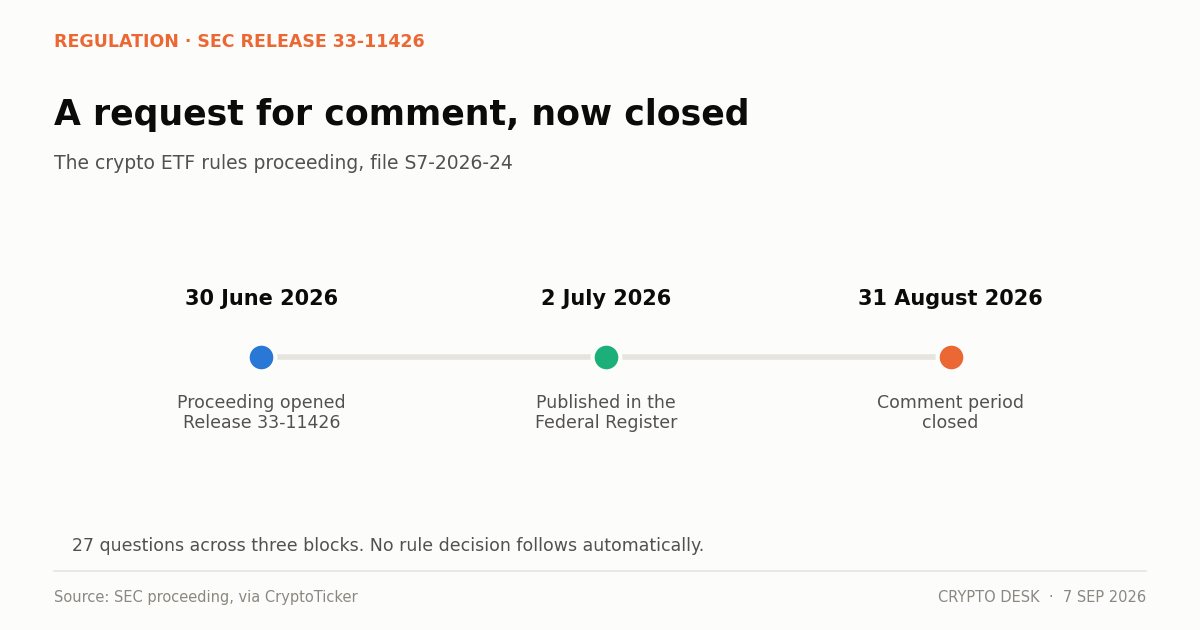
The SEC crypto ETF rules review under Release 33-11426 closed to comment on 31 August, and its twenty-seven questions will decide whether a US fund can ever pay staking rewards.
The SEC crypto ETF rules in three blocks
The questions cluster around three problems, and each one is more fundamental than it sounds.
Do crypto funds meet the investment company definition? This is the threshold question. The Investment Company Act was written for pooled vehicles holding securities. A trust holding bitcoin is not obviously one, which is why the existing spot products are structured as commodity trusts instead of registered funds. Answering it differently would change the entire wrapper.
Is Rule 6c-11 suitable for crypto portfolios? Rule 6c-11 is the ETF rule — it lets exchange-traded funds operate without individual exemptive orders, on the assumption that arbitrage between share price and net asset value keeps them tracking properly. That assumption requires the underlying assets to be available for redemption on demand.
Does Rule 485(a) automatic effectiveness work here? Currently registration statements can go effective automatically after 60 to 75 days. Applied to crypto, that is a fast lane, and the Commission is asking whether it should be.
The staking problem, stated precisely
The second question is where the real difficulty sits, and the SEC's own framing identifies it: "part of the holding may be tied up by lock-up and waiting periods and is not immediately available for the redemption of shares."
That is the whole issue in one sentence.
Staking on a proof-of-stake network requires locking tokens. Unstaking takes time — on Ethereum, an exit queue that varies with how many validators are leaving; on other networks, fixed unbonding periods measured in days. During that window the assets exist but cannot be moved.
An ETF promises that authorised participants can redeem shares for the underlying at any time. If a meaningful share of the fund's assets is locked, that promise is conditional in a way Rule 6c-11 does not contemplate. The arbitrage mechanism that keeps an ETF trading near NAV depends on redemption working reliably, and a fund that must wait out an unbonding period cannot guarantee it.
The two competing designs
Two approaches to the problem are already visible, and they solve it differently.
Keep the yield inside. European staking ETPs accrue rewards into the product, raising the net asset value instead of distributing anything. The redemption question remains, but there is no separate distribution mechanic to reconcile.
Distribute in cash. Fidelity has filed to stake the ether in its ETF and pay the proceeds out quarterly in cash. That converts a staking yield into something resembling a dividend, which is a structure the US market and its tax treatment already understand.
The second is more familiar to American investors and more complex operationally. Which one the Commission's answers permit will shape the product category for years.
Why this matters commercially
The gap is not theoretical. Ethereum staking has yielded in the region of 3% to 5% annualised and Solana around 6% to 7%.
An investor holding ether directly and staking it captures that. An investor holding a non-staking ETF does not. Over a five-year hold, compounding a 4% annual difference produces roughly a 22% performance gap against the underlying asset — before the fund's management fee.
That is not a rounding error. It is the difference between a product that tracks its asset and one that structurally lags it. For ether products holding roughly $15.6 billion and Solana funds near $1.5 billion, the resolution of this question is worth more than any flow figure this quarter.
What already works: generic listing standards
The reason altcoin ETFs have arrived in quick succession since 2025 is a change that has already happened.
Generic listing standards — NYSE Arca Rule 5.2-E(j)(8), Nasdaq Rule 5704 and Cboe BZX Rule 14.11(l) — let an exchange list a qualifying product without filing a separate rule change with the Commission for each one. Before that, every single asset required its own filing and its own months of review.
That is why Solana, XRP and now Zcash products exist. Grayscale converted its Zcash Trust into the ZCSH spot ETF on 25 August, and ZEC crossed $1,000 for the first time within a fortnight.
The listing bottleneck is gone. The staking question is what remains.
What happens next
Nothing automatic. A request for comment produces a comment file, and the Commission then decides whether to propose a rule, and later whether to adopt one. Each stage takes months.
That process runs alongside Regulation Crypto Assets, the offering framework the SEC proposed on 18 August under file S7-2026-27, which addresses how tokens are sold rather than how funds holding them are structured. The two are related and independent.
What to watch
The comment file. Now closed and public. The issuer letters, particularly on redemption mechanics, are the best available preview of what the industry thinks is workable.
Fidelity's ether filing. The most concrete test case for cash-distributed staking rewards.
Whether any staking approval arrives before the CLARITY Act. The Senate votes on cloture on 15 September. A statute reassigning jurisdiction would sit above anything the Commission adopts here.
Fee compression. With listing no longer a barrier, the surviving differentiator among altcoin funds is cost — and, if permitted, staking yield.
Why the investment company question is the sleeper
Most attention on this proceeding has gone to staking, and that is where the commercial money is. But the first block of questions is the one that could reshape the category.
The existing spot products are commodity trusts, not registered investment companies. That structure came about because bitcoin is not a security and a trust holding it is not obviously a pooled investment vehicle under the 1940 Act.
If the Commission's answers move crypto funds toward registered investment company status, everything changes: the disclosure regime, the board requirements, the custody rules, the affiliate transaction limits. Some of that would be a genuine improvement in investor protection. All of it would be expensive, and some existing products would need restructuring instead of amendment.
That question is asked first in the release for a reason. It is upstream of everything else.
About this report. Release number, file number, dates, question count and the redemption quote are from the SEC proceeding as reported by CryptoTicker. Exchange rule references are as cited there. Staking yield ranges are widely reported network averages and vary continuously. Fund asset figures are from Cointelegraph and Bitcoin Foundation ETF coverage.
Not legal or investment advice. A request for comment does not indicate the Commission's eventual position.
Frequently asked questions
What is SEC Release 33-11426?
A request for comment opened on 30 June 2026 under file S7-2026-24, published in the Federal Register on 2 July and closed to comment on 31 August. It asks twenty-seven questions across three blocks and no rule decision follows automatically.
Why can't US crypto ETFs pay staking rewards yet?
Because staked assets are locked. As the SEC put it, 'part of the holding may be tied up by lock-up and waiting periods and is not immediately available for the redemption of shares' — which conflicts with the redemption mechanics Rule 6c-11 assumes.
Sources
- Crypto ETF Approval in the US: Why the SEC Is Rewriting Its Rules for Staking and Altcoin Funds — CryptoTicker
- Crypto ETFs head into 2026 with regulatory tailwinds as issuers brace for a crowded year — The Block
- What Cryptocurrencies Are Listed as SEC-Approved ETFs in 2026 — KuCoin
- SEC Proposes New Regulation Crypto Assets — SEC press release 2026-76
Read next
- The CLARITY Act Vote Lands on 15 September, and the Rate Market Is Louder Than the Senate The CLARITY Act vote on 15 September needs sixty Senate votes, but crypto is trading Fed hike odds above 60% …
- Japan's Banks Can Issue Stablecoins, Hong Kong Is Licensing, and Korea Will Tax Tokenized Stocks Asia stablecoin regulation is accelerating: Japan''s Payment Services Act lets banks issue, Hong Kong is lice…
- Russia's Crypto Law Took Effect on 1 September. Its Largest Bank Will Lend Against Bitcoin. Russia's digital-asset framework took effect 1 September 2026. Sberbank plans bitcoin-backed loans, with ETH …