The CLARITY Act Vote Lands on 15 September, and the Rate Market Is Louder Than the Senate
The CLARITY Act cloture vote is set for 2:15 p.m. Eastern on 15 September and needs sixty senators, while crypto trades rate-hike odds above 60% instead.
On this page
- Where the bill stands
- Why cloture is the hard part
- Why the market is ignoring it
- What passage would actually change
- The week it sits in
- What to watch
- What a failed vote would actually cost
The Senate votes on cloture for the Digital Asset Market Clarity Act at 2:15 p.m. Eastern on 15 September. Sixty votes are required.
Bitcoin traded at $78,893.77 on Wednesday, up 0.1%. The market is not pricing the vote. It is pricing CME FedWatch odds of a rate hike that have now passed 60%.
Where the bill stands
The legislation has cleared harder tests than the one ahead. The House passed it 294-134 in July 2025, including 78 Democratic votes. The Senate Banking Committee approved its version 15-9 in May 2026. Majority Leader John Thune filed the cloture motion on 8 August, which set the 15 September date.
Senator Cynthia Lummis has said the Senate text absorbed hundreds of pages of Democratic priorities and more than a hundred separate compromises.
What remains contested is not the market structure mechanics. It is four adjacent issues: ethics restrictions on federal officials holding crypto, the scope of anti-money-laundering obligations, where regulation stops for decentralised finance, and whether stablecoin issuers may pass yield to holders.
Why cloture is the hard part
Cloture on a motion to proceed only decides whether the Senate begins debating. It is procedural, and it requires sixty votes in a chamber where Republicans do not hold sixty seats.
That cuts both ways in vote counting. Some senators support cloture while reserving judgment on the final text, on the principle that a bill deserves debate. Others treat it as a proxy vote and withhold it precisely to avoid the debate. Procedural counts are unreliable for exactly this reason.
Prediction markets have been marking down the odds of 2026 enactment through August.
Why the market is ignoring it
Three reasons, and none is that the bill does not matter.
The alternative is not deregulation. If cloture fails, agencies keep regulating. The SEC proposed Regulation Crypto Assets on 18 August under file S7-2026-27, and its separate crypto ETF rules review under Release 33-11426 closed to comment on 31 August. GENIUS Act stablecoin enforcement begins January 2027. Nothing stops.
Failure is substantially priced. A vote that markets expect to fail produces little reaction when it fails.
The Fed is bigger. Bitcoin moved 5% in a session on a Fed governor's remarks earlier this month and gave part of it back on a jobs report. No legislative outcome has moved this market that hard in two years.
What passage would actually change
A statute allocating jurisdiction between the SEC and CFTC does something agency rules cannot: it survives a change of administration.
That is the entire argument, and it is a strong one for anyone making ten-year infrastructure decisions. An exchange choosing where to build, a bank deciding whether to offer custody, a fund sizing a crypto allocation — all of them discount agency rules for the possibility that the next Commission takes a different view. A statute removes that discount.
It would also require conforming changes to what the SEC has already proposed, since a statute sits above a rule.
The week it sits in
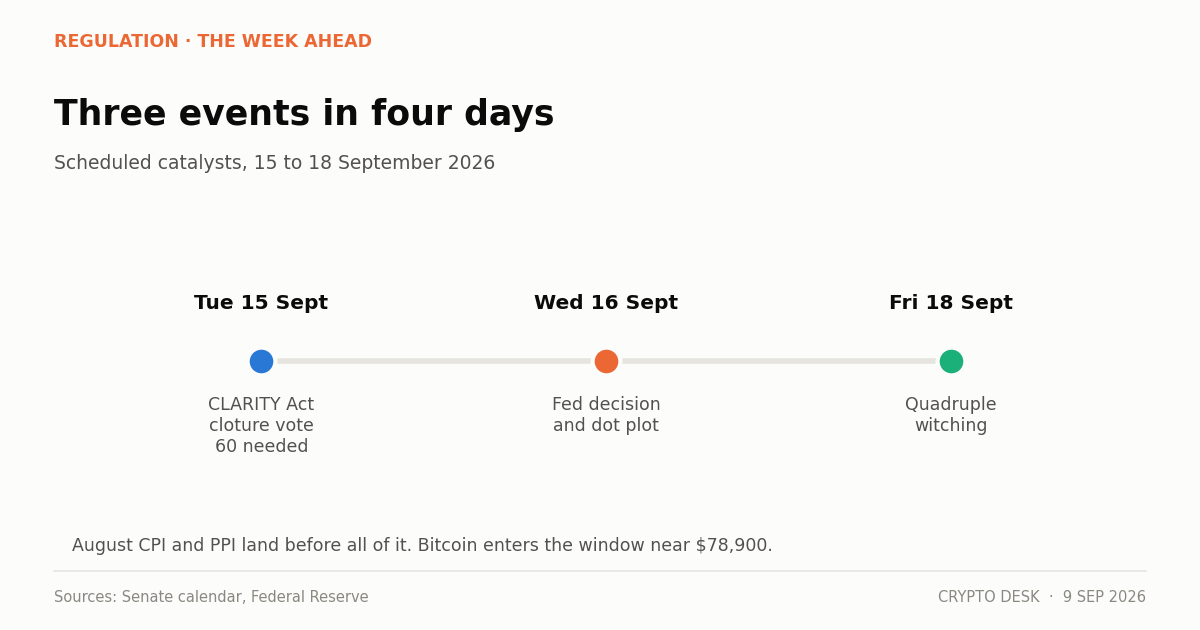
The vote is the first of three events in four days.
| Date | Event |
|---|---|
| 15 September | CLARITY Act cloture vote, 60 needed |
| 16 September | Federal Reserve decision and dot plot |
| 18 September | Quadruple witching |
August CPI and PPI land before all of it, and economists have described those prints as capable of swinging the Fed between a hike and a hold.
By the time the Senate votes, the market will already have repriced on inflation data. That sequencing is why a genuinely consequential piece of legislation is arriving into a week where it is the third most important thing.
What to watch
Whether the vote gets rescheduled. Cloture votes get pulled when the count is not there. A postponement announced before Monday is the clearest possible signal.
A manager's amendment. Substitute text released before the vote would mean a deal was struck on at least one of the four contested issues.
Statements from undecided Democratic senators. Public positions in the final week are negotiated positions.
The reaction function. If the bill clears cloture and crypto does not move, that tells you something durable about what this market currently trades on.
What a failed vote would actually cost
The concrete cost is not chaos. It is a discount rate.
Every institution deciding whether to build crypto infrastructure applies a probability to the rules changing. Agency rules can be rewritten by a new Commission; a statute cannot. That difference shows up as a haircut on any ten-year investment case.
Without a statute, the haircut persists. Firms build anyway — the past two years demonstrate that — but they build smaller, hedge more, and keep optionality to move jurisdictions.
The measurable version of that cost is where new venues get licensed. If the next wave of tokenized securities platforms authorises in Hong Kong and the EU, not the United States, the CLARITY Act's failure will have been priced, just not in bitcoin.
About this report. Vote timing, the cloture threshold, prior vote counts and the four contested issues are from CoinDesk, Quartz and Bitcoin Foundation reporting on the Senate calendar. Rate-odds figures are CME FedWatch data as reported by The Motley Fool on 8 September 2026. Price data is from CoinGabbar's 9 September summary.
Not legal or investment advice. Legislative outcomes are uncertain and this article does not predict one.
Related reading
- Asia Stablecoin Regulation: Japan, Hong Kong and Korea Move
- Crypto Exchange Bank Charters: Three Very Different Routes
- ESMA MiCA to MiFID II: Europe's Dual Licensing Pathway
- Tokenized Equities: The Custody Problem Banks Are Solving
Sources
- CLARITY Act Hits a September 15 Deadline — Bitcoin Foundation
- Crypto enters September with legislative policy gamble hanging by a thread — CNBC
- SEC Proposes New Regulation Crypto Assets — SEC press release 2026-76
- Crypto Market Today, Sept. 8: Bitcoin Slides as Fed Hike Odds Pass 60% — The Motley Fool
Read next
- The SEC Asked 27 Questions About Crypto ETFs. The Answers Decide Whether Staking Funds Can Exist. The SEC's crypto ETF rules review closed to comment on 31 August. Release 33-11426 asks 27 questions on Rule …
- Japan's Banks Can Issue Stablecoins, Hong Kong Is Licensing, and Korea Will Tax Tokenized Stocks Asia stablecoin regulation is accelerating: Japan''s Payment Services Act lets banks issue, Hong Kong is lice…
- Russia's Crypto Law Took Effect on 1 September. Its Largest Bank Will Lend Against Bitcoin. Russia's digital-asset framework took effect 1 September 2026. Sberbank plans bitcoin-backed loans, with ETH …