A $314 Billion Market Gets Its Rulebook: Stablecoins Enter the GENIUS Act Endgame
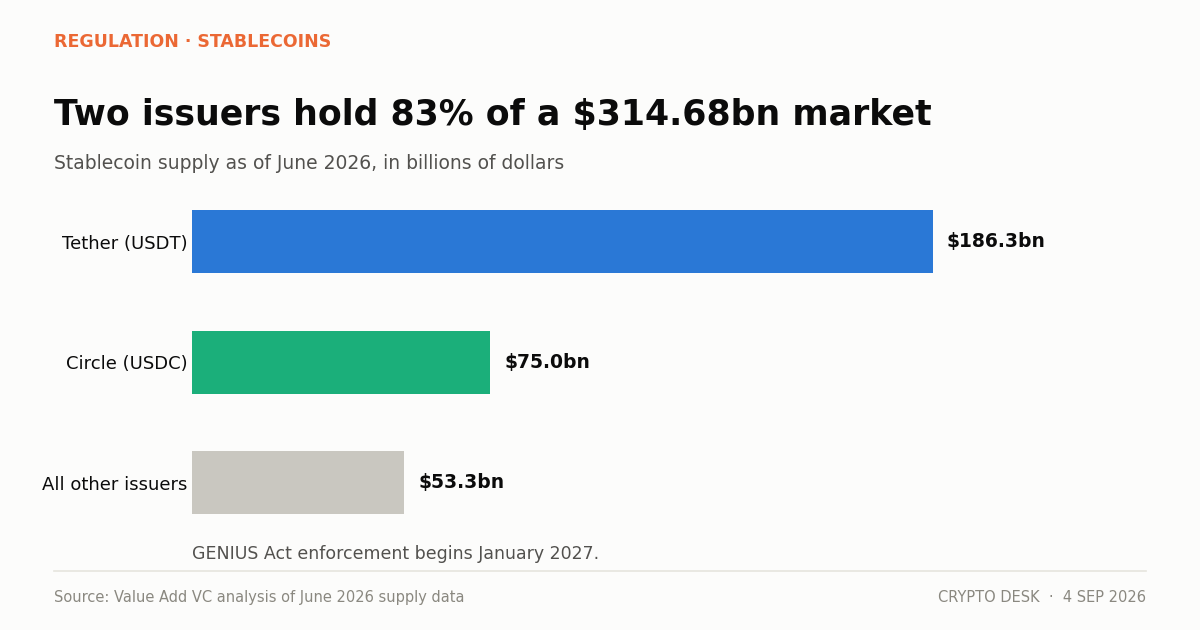
GENIUS Act stablecoin rules move from rulemaking to enforcement in January 2027, applied to a $314.68 billion market in which two issuers hold 83% of supply.
The market as it stands
| Issuer | Approximate supply | Share |
|---|---|---|
| Tether (USDT) | $186.35bn | ~59% |
| Circle (USDC) | ~$75bn | ~24% |
| Everyone else | ~$53bn | ~17% |
Two firms, 83% of the market. The remaining 17% is split across dozens of issuers, most of them small, several of them attached to a single exchange or chain.
That concentration existed before the GENIUS Act. What the statute does is add a fixed cost of compliance that falls on every issuer regardless of size, which is a well-understood way to make a concentrated market more concentrated.
The compliance calendar
| Date | Milestone |
|---|---|
| 18 July 2025 | GENIUS Act signed |
| 25 February 2026 | OCC proposed rule for federally chartered non-bank issuers |
| 9 April 2026 | Treasury/FinCEN rule on AML and sanctions |
| 18 July 2026 | Statutory deadline for final rules |
| January 2027 | Full enforcement begins (or 120 days after rules finalise, whichever is earlier) |
The division of labour across agencies is unusually clean by American financial regulation standards. The OCC handles federally chartered non-bank issuers. The FDIC covers insured depository institutions issuing through subsidiaries. Treasury, through FinCEN and OFAC, handles anti-money-laundering and sanctions across all issuers. The NCUA licenses credit unions.
Four regulators, four defined lanes. Compare that to the jurisdictional argument over crypto market structure that the CLARITY Act has been trying to resolve since 2025, and the stablecoin framework looks positively tidy.
What issuers actually have to do
The core change is that the GENIUS Act classifies payment stablecoin issuers as financial institutions under the Bank Secrecy Act. Everything else follows from that single reclassification.
A BSA financial institution must run a risk-based AML programme. It must file suspicious activity reports. It must conduct enhanced due diligence on higher-risk customers. And it must submit to examination by a federal or state regulator.
For an issuer that already operates like a bank, this is incremental. For an issuer that operates like a software company — which describes most of the market outside the top two — it is a different business model. Compliance officers, examination readiness, SAR filing infrastructure, sanctions screening tuned to on-chain transaction patterns, not wire transfers. None of that is optional and none of it is cheap.
The consolidation maths
Industry estimates put stablecoin compliance costs at 11% to 15.5% of payroll, comparable to what community banks spend.
Run that against a small issuer. A firm with $500 million in circulating supply, earning perhaps 4% on reserves in the current rate environment, generates roughly $20 million a year in gross revenue before any costs. A compliance function costing a meaningful fraction of payroll on a team of thirty people is a serious bite out of that. Below a few hundred million in supply, the arithmetic stops working entirely.
The comparison analysts keep reaching for is US banking after the deposit insurance and examination regime matured: roughly 14,000 institutions in 1985, fewer than 4,500 today. Fixed regulatory costs do not scale down.
Expect the same trajectory here. Not because regulators want two issuers, but because a compliance floor applied to an industry with enormous economies of scale produces one.
What the framework leaves unresolved
Yield. Whether stablecoin issuers or their distribution partners can pass returns to holders is contested and has spilled into the CLARITY Act negotiations in the Senate. Banks argue that yield-bearing stablecoins are deposits by another name and will pull funding out of the banking system. Crypto firms argue that refusing to let holders earn on their own money protects bank margins rather than consumers. The GENIUS Act did not fully settle it, and it is now one of the four issues holding up the market structure bill.
Foreign issuers. Tether, the largest issuer by a wide margin, is not a US company. How the framework applies to offshore issuers whose tokens circulate freely on-chain to American users is a jurisdictional problem that regulation alone does not solve. A permissionless token does not check where its holder lives.
Interaction with MiCA. Europe's regime is already in enforcement, and Asian jurisdictions have moved to licensing regimes through 2026. The three frameworks are not harmonised. An issuer operating across all three faces overlapping and occasionally contradictory requirements, and regulatory arbitrage between them is a live strategy instead of a theoretical one.
Why this matters beyond stablecoins
Stablecoins are the settlement layer for most crypto trading. Volumes in USDT and USDC exceed those of any individual token pair by a wide margin, and they are the unit of account for the majority of on-chain activity.
A regulatory change that consolidates issuance into two or three regulated entities changes the risk profile of the entire market. It reduces the chance of a small issuer failing and taking a chunk of DeFi collateral with it. It also concentrates systemic risk into fewer points of failure, and gives those points enormous leverage over which chains and which applications their tokens support.
Both effects are real. Which one dominates depends on how the surviving issuers behave, and there is no rule that constrains a dominant stablecoin issuer's commercial decisions about where its token is available.
What to watch
Final rule text. The 18 July 2026 statutory deadline has passed for finalisation. The specific conditions in the final rules determine whether mid-sized issuers have a viable path or not.
Market share drift. If the "everyone else" tranche shrinks below 15% over the coming year, consolidation is happening as predicted. If it holds, the compliance costs are more manageable than estimated.
The yield fight in the CLARITY Act. Resolution there would settle the largest open commercial question in the sector.
Tether's US posture. How the largest issuer positions itself relative to a framework built primarily for domestic entities is the single most consequential unknown in stablecoin regulation.
The question that decides the next two years
Everything above assumes issuers comply. The more interesting scenario is what happens where compliance is optional in practice.
A dollar-denominated token issued by an entity outside US jurisdiction, circulating on permissionless chains, reaches American users regardless of whether its issuer has registered with anyone. The GENIUS Act binds entities. Tokens are not entities, and the blockchains carrying them do not check passports.
The tools available to regulators in that scenario are indirect: pressure on exchanges to delist, pressure on banks not to serve the issuer's counterparties, sanctions designations in extreme cases. All are workable and all have been used against other targets. None removes a token from a chain.
The most likely outcome is a two-tier market — regulated issuers serving institutions, banks and payment companies that need compliance certainty, and offshore issuers serving everyone else. That is roughly the market that exists today, which suggests the statute may formalise the status quo more than it changes it.
About this report. Market size and share figures are as of June 2026, drawn from Value Add VC's regulatory analysis. Regulatory dates and agency responsibilities come from the same source and from Orochi Network's 2026 regulatory expectations review. Compliance cost estimates are industry projections, not measured figures, and are labelled as such.
Not legal advice. Stablecoin compliance obligations are entity-specific. Consult counsel.
Frequently asked questions
When does GENIUS Act enforcement begin?
January 2027, or 120 days after final rules are published, whichever comes earlier. The Act was signed on 18 July 2025 and the statutory deadline for final rules was 18 July 2026.
Which regulators supervise stablecoin issuers?
The OCC handles federally chartered non-bank issuers, the FDIC covers insured depository institutions issuing through subsidiaries, Treasury through FinCEN and OFAC handles AML and sanctions, and the NCUA licenses credit unions.
Related reading
- Asia Stablecoin Regulation: Japan, Hong Kong and Korea Move
- Crypto Exchange Bank Charters: Three Very Different Routes
- ESMA MiCA to MiFID II: Europe's Dual Licensing Pathway
- CLARITY Act Vote on 15 September Is Barely Priced
Sources
- Stablecoin Regulation 2026: GENIUS Act Rules on a $314B Market — Value Add VC
- 2026 Stablecoin Regulatory Expectations: GENIUS Act Is Law, MiCA Is Enforcing, Asia Is Licensing — Orochi Network
- GENIUS Act 2026: OCC, FDIC and FinCEN Stablecoin Rules — Spazio Crypto
- Stablecoin Statistics & Data 2026 — Reap
Read next
- The CLARITY Act Vote Lands on 15 September, and the Rate Market Is Louder Than the Senate The CLARITY Act vote on 15 September needs sixty Senate votes, but crypto is trading Fed hike odds above 60% …
- The SEC Asked 27 Questions About Crypto ETFs. The Answers Decide Whether Staking Funds Can Exist. The SEC's crypto ETF rules review closed to comment on 31 August. Release 33-11426 asks 27 questions on Rule …
- Japan's Banks Can Issue Stablecoins, Hong Kong Is Licensing, and Korea Will Tax Tokenized Stocks Asia stablecoin regulation is accelerating: Japan''s Payment Services Act lets banks issue, Hong Kong is lice…