A Token Called BUN Rose 243,540% on a Million Dollars. That Is Not a Rally.
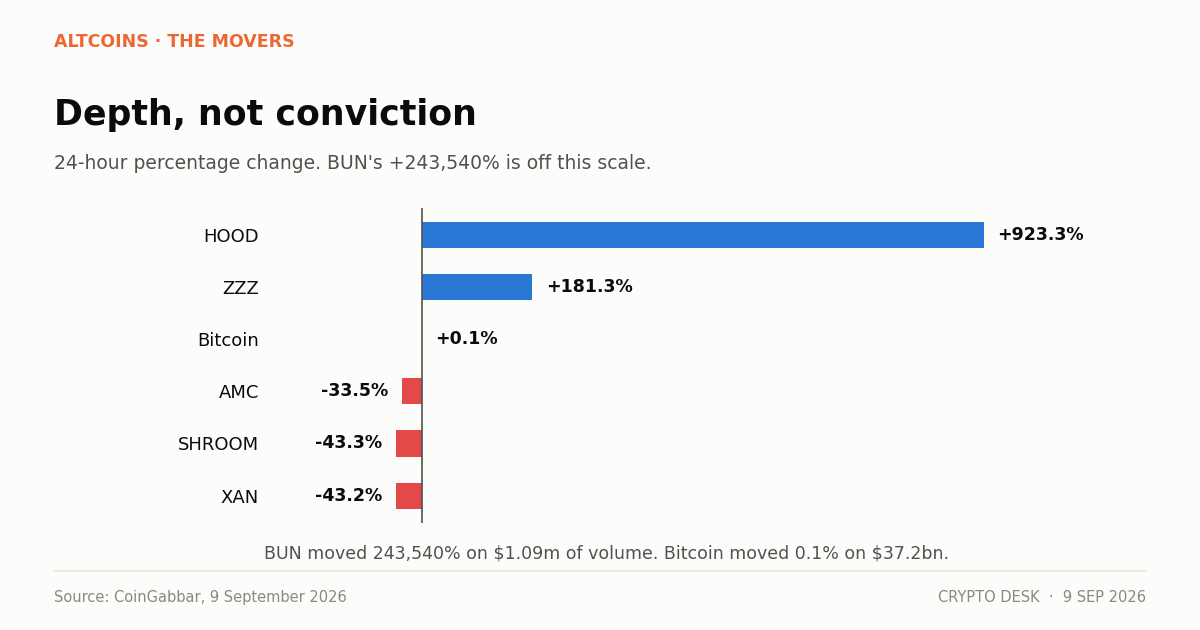
The day's microcap crypto gainers ran to absurd levels: BUN rose 243,540% on $1.09 million of volume while bitcoin moved 0.1% on $37.2 billion.
The day's extremes
| Asset | Change | Volume |
|---|---|---|
| BUN (Smol Bun) | +243,540% | $1.09m |
| HOOD (Greenhood) | +923.3% | $412.66k |
| ZZZ | +181.3% | $26.00m |
| SHROOM (Mushroom) | -43.3% | $6.50m |
| XAN (Anoma) | -43.2% | $27.26m |
| AMC (A Meme Coin) | -33.5% | $29.37m |
Note that the largest gainer traded the second-smallest volume on the list. That relationship is the entire explanation.
What a move like that actually is
It is an order book with nothing in it.
When a token has almost no resting sell orders, a modest amount of buying consumes what exists and price gaps to wherever the next order sits. If the next order is three orders of magnitude higher, the printed price is three orders of magnitude higher. Trades occurred, so the move is real in a narrow technical sense, and it conveys nothing about how much capital believes anything.
A million dollars cannot move bitcoin by a measurable amount. It moved BUN by 243,540%. The difference is depth, not conviction.
The same mechanic runs in reverse and faster, because the buyers who created the move are also the only bid underneath it. SHROOM at -43.3% and XAN at -43.2% on the same day are the other half of the distribution.
Why these lists get published at all
Because they are cheap to generate and they get clicked.
A daily gainers table is a sorted column. It requires no judgment, and it reliably produces numbers that look extraordinary. The problem is that the sort is dominated by whichever tokens had the thinnest books that day, which means the list systematically surfaces the least meaningful moves in the market.
A more useful sort would weight percentage change by volume, or filter for a minimum market capitalisation. Neither produces headlines.
The one thing the data does tell you
Not about the tokens — about the environment.
Speculative capital is present. It is not sitting entirely in bitcoin ETFs and corporate treasuries. Somebody is buying tokens with no protocol, no revenue and no roadmap, and that willingness is a genuine signal about risk appetite even when the individual moves are noise.
Read against the rest of the market, though, it is a narrow signal. The Fear and Greed Index reads 66, down from 69 the previous day and 71 on Monday. CME FedWatch odds of a September rate hike have passed 60%. Global market capitalisation is $2.78 trillion on $91.4 billion of volume.
That is a market with decaying sentiment and a hawkish rate backdrop, in which a handful of illiquid tokens can still print absurd numbers. Both things are true and only one of them matters.
How to read a movers table
Three checks, in order.
Volume against market capitalisation. A large percentage on volume that is a small fraction of the token's own market cap is a liquidity event.
Whether the name is recognisable. Not snobbery — a token with no listings on major venues has no depth by definition.
What the losers column looks like. If the biggest losers are down 40%+ on similar volumes, you are looking at the same phenomenon in both directions, which confirms it is structural, not news-driven.
What to watch
Whether any mover holds its gain for 72 hours. Most do not.
Total market volume. $91.4 billion across everything, with bitcoin alone at $37.2 billion, means the tail is thin.
The Fear and Greed Index through the CPI print. A fall into Neutral would confirm this week's appetite was conditional.
What a useful movers table would look like
The fix is straightforward and nobody implements it, because the corrected version produces boring numbers.
Filter for a minimum market capitalisation — say $50 million — and a minimum daily volume as a share of that capitalisation. Then sort. What survives is a list of assets where a meaningful amount of capital changed its mind, which is the thing a reader is actually trying to learn.
Applied to this session, ZZZ at +181.3% on $26 million of volume would likely survive that filter. BUN at +243,540% on $1.09 million would not.
The unfiltered table is not wrong, exactly. It answers a question — which token's price changed most — that nobody has a use for.
The asymmetry between the two columns
Gainers and losers are not mirror images, and the difference is instructive.
The biggest gainers moved 243,540% and 923.3% on volumes of $1.09 million and $412,660. The biggest losers moved -43.3% and -43.2% on $6.50 million and $27.26 million — considerably more volume for a much smaller percentage.
That is what depth looks like on the way down. A token can gap upward through an empty book, but selling into any bid at all produces a bounded move, because the percentage floor is negative one hundred and the buyers who arrive are buying something visibly cheap.
The practical implication is that the upside tail is far longer than the downside tail in percentage terms, which is exactly what makes these tables misleading.
About this report. Prices, percentage moves, volumes, market capitalisation and the sentiment reading are from CoinGabbar's 9 September 2026 market summary. Bitcoin's volume figure is from the same source. The tokens named are cited as market data.
Not investment advice. Microcap tokens can lose most of their value in a single session, and the assets named here are not recommendations.
Frequently asked questions
Which crypto gained the most on 9 September?
BUN, trading as Smol Bun, rose 243,540% to $0.01658 on $1.09 million of volume. HOOD, or Greenhood, rose 923.3% on $412,660, and ZZZ added 181.3% on $26 million. Bitcoin moved 0.1% on $37.2 billion.
Do these moves mean real demand?
No. They mean an order book with almost nothing in it. A modest amount of buying consumes the available sell orders and price gaps to wherever the next order sits. A million dollars cannot move bitcoin measurably; it moved BUN by three orders of magnitude.
Sources
- Crypto News September 9: Bitcoin Near $79K As BUN Token Surges 243K% — CoinGabbar
- Crypto Market Today, Sept. 8: Bitcoin Slides as Fed Hike Odds Pass 60% — The Motley Fool
- Cryptocurrency Market Trends Highlight September's Rates-Driven Rally — Cryptonomist
- Bitcoin and ethereum prices today, Monday, September 7, 2026 — Yahoo Finance
Read next
- Zcash Added 38.5% in a Week. The Privacy Trade Has Outrun Everything Else in Crypto. The Zcash price rose 38.5% over seven days, extending a run that has taken ZEC past $1,000 for the first time…
- Two Microcaps Ran 160% and 121% on a Day the Majors Went Nowhere The top altcoin gainers today were ORBIO at +160% and SHRUB at +121.5%, while bitcoin fell 0.2% and the Fear …
- Zcash Passes $1,000 for the First Time, Carried by the First US Privacy-Coin ETF ZEC reached $1,018 on 5 September, up 28% in a week and over 2,000% in a year, after Grayscale converted its …