Solana Is Rebuilding Its Consensus for Institutions While Its Token Trades at $103
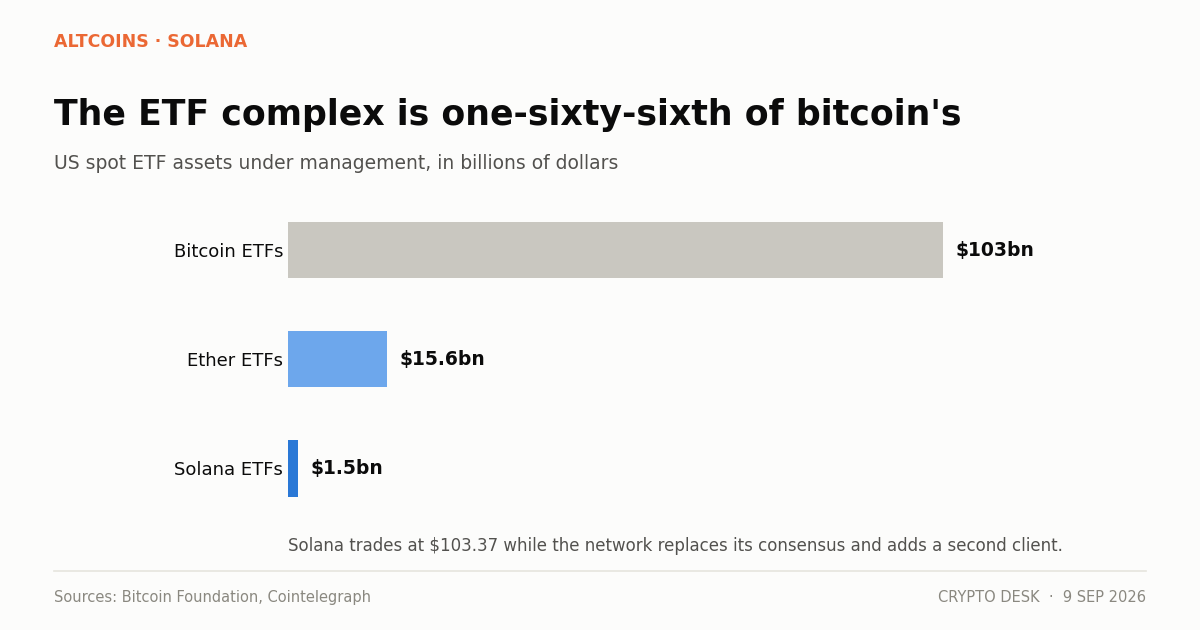
The Solana price sits at $103.37 while the network replaces its consensus mechanism and adds a second validator client, with its US ETF complex holding roughly $1.5 billion.
What the roadmap is for
Alpenglow reworks consensus toward sub-second finality. Firedancer is an independent client written in C by Jump Crypto, separate from the original Rust implementation.
Neither improves anything for a retail trader. Both are precisely what an institutional venue requires before it will settle meaningful value on a chain.
Finality is how long before a transaction cannot be reversed. Exchanges, bridges and payment processors wait for it before crediting anything, and every second of that wait is working capital tied up. For comparison, Ethereum finalises in roughly 13 minutes and has fast finality at the lowest priority tier of its roadmap, behind post-quantum work running to 2029.
Client diversity removes a single point of failure. A network running one implementation halts entirely if that codebase has a bug — a problem Solana has experienced repeatedly. Two clients written by different teams in different languages means a bug in one is unlikely to exist in the other.
Where the Solana price sits
| Metric | Value |
|---|---|
| Price | $103.37 (-0.6%) |
| ETF complex assets | ~$1.5bn |
| August ETF inflows | >$170m |
| Share of bitcoin ETF assets | ~1.5% |
Bitcoin ETFs hold roughly $103 billion. Ether products about $15.6 billion. Solana's $1.5 billion is around one-sixty-sixth of bitcoin's footprint.
That is real money in a product category that did not exist in usable form eighteen months ago. It is also small enough that ETF demand is not currently a meaningful driver of Solana's price.
The staking question that decides the product
A Solana ETF that cannot stake forgoes the network's staking yield, historically in the region of 6% to 7% annualised.
An investor holding SOL directly and staking captures that. An ETF holder does not, unless the fund is permitted to stake. Over a five-year hold, compounding a 6% annual gap produces roughly a 34% performance difference against the underlying asset, before fees.
The SEC's Release 33-11426 review, which closed to comment on 31 August, addresses exactly this. Its central difficulty is that staked assets are locked: "part of the holding may be tied up by lock-up and waiting periods and is not immediately available for the redemption of shares," which conflicts with the redemption mechanics Rule 6c-11 assumes.
For Solana specifically, that resolution matters more than any upgrade. A fund capturing 6% to 7% is a different product from one that does not.
Why the token and the network diverge
They measure different things and always have.
A network's technical capability determines what can be built on it. A token's price determines what the market will pay for a claim on that network's future. The two connect only through mechanisms that capture value — fees, staking, scarcity — and those mechanisms are weak or contested on most chains.
Solana's fee revenue is low by design, since low fees are the product. Its staking yield is meaningful but currently unavailable through the ETF wrapper. Its supply is not fixed.
An investor betting on Solana's technical roadmap is betting that institutional settlement volume eventually arrives and that some of it accrues to token holders. That is a longer and less direct chain of reasoning than bitcoin's.
What to watch
Firedancer's validator share. Client diversity counts only when meaningful stake actually runs the alternative.
Whether outages recur during the transition. The riskiest window is when both changes are partially deployed.
Staking approval. The single change that would most alter the ETF's value proposition.
ETF flows into September. August delivered over $170 million. Whether that continues through a week containing August CPI, the Fed decision and quadruple witching is the near-term test.
The valuation problem with infrastructure chains
There is a structural difficulty in pricing a network whose selling point is low fees.
A chain that charges meaningfully for block space has an identifiable revenue stream, and some of it can accrue to token holders. A chain competing on being cheap has deliberately minimised that stream.
Solana's answer has been staking yield and supply mechanics, not fee capture. That works while yields are attractive relative to alternatives, and it depends on issuance the protocol controls rather than on demand for the network.
The result is that Solana's token can be a good investment or a bad one for reasons largely disconnected from whether Alpenglow and Firedancer succeed. A network can become critical infrastructure while its token underperforms, and several have.
That disconnect is not unique to Solana. It is sharper there because the technical roadmap is unusually ambitious and the value-capture mechanism unusually indirect.
About this report. Solana's price is from The Motley Fool's 8 September 2026 summary. ETF asset and flow figures are from Bitcoin Foundation coverage. Roadmap components are from published Solana 2026 analyses by StakePoint and Cryptopolitan. Staking yield ranges are widely reported network averages that vary continuously. The compounding calculation is this desk's arithmetic. SEC review details and the redemption quote are from CryptoTicker's reporting of Release 33-11426.
Not investment advice. Network capability and token price are distinct and frequently diverge.
Frequently asked questions
What is the Solana price now?
$103.37, down 0.6%. Its US spot ETF complex holds roughly $1.5 billion after more than $170 million of inflows in August — around one-sixty-sixth of the $103 billion held in bitcoin ETFs.
Who is Solana's roadmap aimed at?
Institutions. Sub-second finality through Alpenglow and client diversity through Firedancer are what a venue requires before settling meaningful value on a chain. Neither improves anything for a retail trader.
Related reading
- Ethereum Quantum Resistance: December 2029 Deadline Set
- Ethereum Hegota: FOCIL and Frame Transactions Explained
- Ethereum Protocol Priorities: Five Arcs and a P0-P3 Ladder
- Solana Roadmap 2026: Alpenglow Consensus and Firedancer
Sources
- Crypto Market Today, Sept. 8: Bitcoin Slides as Fed Hike Odds Pass 60% — The Motley Fool
- Solana 2026 Roadmap Breakdown: Alpenglow, Firedancer, ZK Compression — StakePoint
- Crypto ETFs Enter a New Phase in September — Bitcoin Foundation
- Crypto ETF Approval in the US: Why the SEC Is Rewriting Its Rules — CryptoTicker
Read next
- A Token Called BUN Rose 243,540% on a Million Dollars. That Is Not a Rally. Microcap crypto gainers ran to absurd levels as BUN rose 243,540% on $1.09m of volume while bitcoin moved 0.1…
- Zcash Added 38.5% in a Week. The Privacy Trade Has Outrun Everything Else in Crypto. The Zcash price rose 38.5% over seven days, extending a run that has taken ZEC past $1,000 for the first time…
- Two Microcaps Ran 160% and 121% on a Day the Majors Went Nowhere The top altcoin gainers today were ORBIO at +160% and SHRUB at +121.5%, while bitcoin fell 0.2% and the Fear …