Solana Is Replacing Its Consensus and Its Client at the Same Time
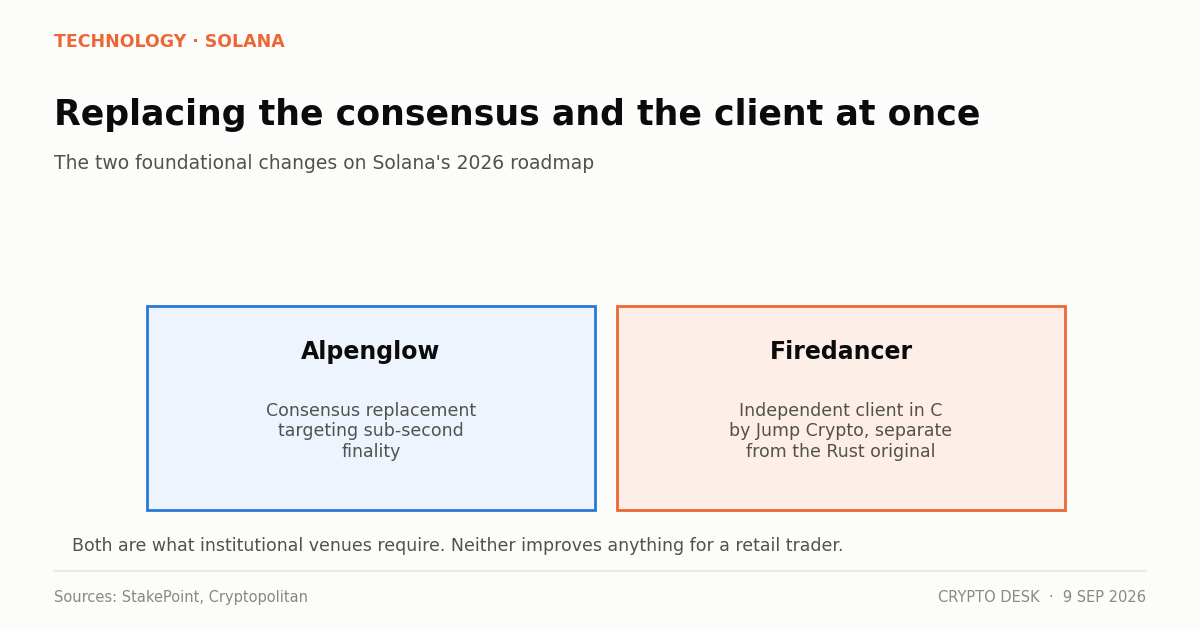
The Solana roadmap pairs Alpenglow, a consensus replacement targeting sub-second finality, with Firedancer, an independent validator client written in C by Jump Crypto.
On this page
- Alpenglow: replacing the clock
- Firedancer: a second implementation
- Doing both at once
- What it is for
- What to watch
- The risk of shipping both at once
- What the roadmap does not address
Solana's 2026 roadmap contains two changes that most networks would attempt separately and a decade apart: a replacement for its consensus mechanism, and a validator client written from scratch by a different team.
Alpenglow is the consensus change. Firedancer is the client. Alongside them sit ZK compression and a set of smaller upgrades.
Alpenglow: replacing the clock
Solana's original design used Proof of History — a verifiable delay function acting as a cryptographic clock, letting validators agree on transaction ordering without communicating about timestamps. It is the mechanism that made Solana's throughput possible and the mechanism most often blamed for its outages.
Alpenglow reworks consensus with the target of dramatically faster finality, moving toward sub-second confirmation.
Finality is the property that matters for anyone building on a chain. It is not how fast a transaction appears; it is how long before it cannot be reversed. Exchanges, bridges and payment processors all wait for finality before crediting anything, and every second of that wait is working capital tied up.
For comparison, Ethereum finalises in roughly 13 minutes and has fast finality listed as one of five research arcs, sitting at the lowest priority tier behind its post-quantum work through 2029.
Firedancer: a second implementation
Firedancer is an independent validator client built by Jump Crypto in C, entirely separate from the original Rust implementation.
Client diversity is the least glamorous and most important property a blockchain can have. A network running one client has a single point of failure: a bug in that codebase halts everything. Ethereum learned this through repeated client incidents and now has several independent implementations.
Solana has had a well-documented history of network halts. A second client written by a different team in a different language means a bug in one is unlikely to be present in the other, and validators can switch.
The trade-off is coordination cost. Every future upgrade must be implemented by both teams and must produce identical behaviour, which slows the cadence Solana has been known for.
Doing both at once
This is the part worth being honest about.
Replacing consensus while introducing a second client means changing the rules and the implementation of those rules simultaneously. Each is a multi-year undertaking. Together they create a testing surface where a failure could come from the new consensus, the new client, or the interaction between them.
Solana's engineering culture has favoured shipping over caution, which produced both its performance and its outages. The roadmap is a bet that the same culture can execute two foundational changes in parallel.
What it is for
Solana trades at $103.37. Its ETF complex holds roughly $1.5 billion in assets after more than $170 million of inflows in August — real money, and about one-sixty-sixth of what bitcoin ETFs hold.
The gap between the network's technical ambition and its market position is the context for everything above. Sub-second finality and client diversity are exactly what an institutional venue requires before it will settle meaningful value on a chain. Neither improves anything for a retail trader.
That tells you who the roadmap is written for.
What to watch
Firedancer's validator share. Client diversity only counts when a meaningful fraction of stake actually runs the alternative.
Alpenglow devnet results. Consensus changes fail in testing or they fail in production, and the first is preferable.
Whether outages recur during the transition. The riskiest window is the one where both changes are partially deployed.
Whether the ETF complex grows. At $1.5 billion, Solana funds are a proof of concept. Institutional adoption of the network and institutional demand for the token are separate questions, and only one of them is addressed by faster finality.
The risk of shipping both at once
Solana's engineering culture has favoured speed, which produced its performance and its outage record. The roadmap asks that culture to execute two foundational changes in parallel.
The specific danger is diagnostic. When a network running new consensus on a new client fails, the cause could be either, or the interaction between them. Debugging under those conditions is materially harder than debugging one change at a time, and the pressure to restore service quickly works against careful root-cause analysis.
Ethereum's approach is the opposite: a published priority ladder that explicitly limits Hegotá's consensus scope to preserve capacity for post-quantum work, and a seven-to-twelve-month fork cadence that ships less per upgrade.
Neither approach is correct in the abstract. Solana is optimising for capability and accepting execution risk; Ethereum is optimising for safety and accepting that competitors ship features first.
What the roadmap does not address
Neither Alpenglow nor Firedancer changes Solana's economics.
Fees remain deliberately low, because low fees are the product. Supply is not fixed. Staking yield, historically around 6% to 7% annualised, remains the primary value-capture mechanism and is currently unavailable through the US ETF wrapper pending the SEC's Release 33-11426 review.
So a successful execution of both changes produces a faster, more reliable network with the same token economics it has today. That may well be the right sequencing — capability first, economics later — but it is worth stating plainly, because roadmap coverage routinely implies the two are connected.
About this report. Roadmap components are drawn from published Solana 2026 roadmap analyses by StakePoint, Cryptopolitan and The Motley Fool. Solana's price is from The Motley Fool's 8 September 2026 summary. ETF asset figures are from Bitcoin Foundation coverage. Ethereum comparison figures are from the Ethereum Foundation's 7 September protocol priorities post. Upgrade contents and timing remain subject to change.
Not investment advice. Protocol roadmaps are not delivery commitments.
Frequently asked questions
What is Alpenglow?
A rework of Solana's consensus targeting dramatically faster finality, moving toward sub-second confirmation. It replaces the role played by Proof of History, the verifiable delay function that made Solana's throughput possible and has been blamed for its outages.
What is Firedancer?
An independent validator client built by Jump Crypto in C, entirely separate from the original Rust implementation. Client diversity means a bug in one codebase is unlikely to exist in the other, so validators can switch instead of the network halting.
Why does finality speed matter?
Finality is how long before a transaction cannot be reversed. Exchanges, bridges and payment processors wait for it before crediting anything, and every second is working capital tied up. Ethereum finalises in roughly 13 minutes and has fast finality at its lowest priority tier.
What is the risk of doing both at once?
Diagnosis. When a network running new consensus on a new client fails, the cause could be either or the interaction between them, and debugging under restoration pressure works against careful root-cause analysis.
Sources
- Solana 2026 Roadmap Breakdown: Alpenglow, Firedancer, ZK Compression — StakePoint
- Solana's Roadmap: Key Upgrades and What They Mean for Adoption — Cryptopolitan
- 2 Game-Changing Updates Coming to Solana in 2026 — The Motley Fool
- EF Protocol: Current and Emerging Priorities — Ethereum Foundation Blog
Read next
- Hegotá Has Two Headline EIPs, and One of Them Finally Addresses Censorship The Ethereum Hegota upgrade pairs EIP-7805 FOCIL for censorship resistance with EIP-8141 Frame Transactions f…
- Ethereum Has Given Itself Until December 2029 to Survive a Quantum Computer The Ethereum Foundation set December 2029 as its deadline for quantum resistance across execution, consensus …
- Glamsterdam Explained: Ethereum''s Q4 Upgrade Takes Block Building Back On-Chain Ethereum's Glamsterdam upgrade targets Q4 2026 with enshrined proposer-builder separation and block-level acc…