Hegotá Has Two Headline EIPs, and One of Them Finally Addresses Censorship
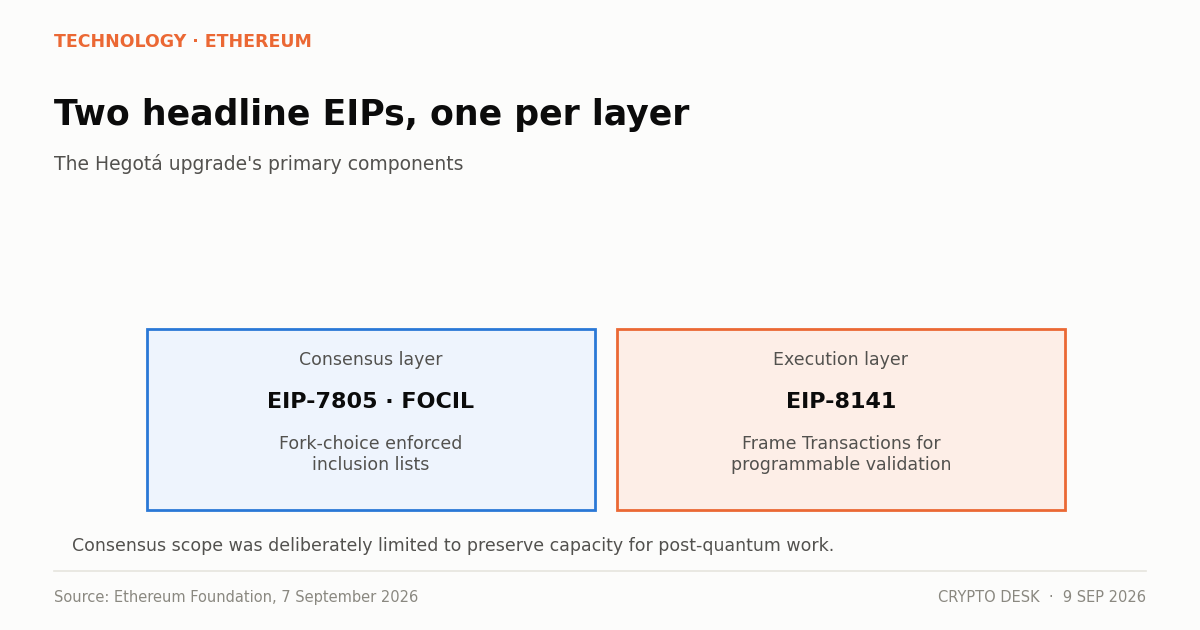
The Ethereum Hegota upgrade pairs EIP-7805 FOCIL on the consensus layer with EIP-8141 Frame Transactions on execution, finally addressing censorship at the protocol level.
On this page
- The censorship problem FOCIL solves
- Why it took this long
- EIP-8141 and programmable validation
- The deliberate constraint
- Where the Ethereum Hegotá upgrade sits in the sequence
- What to watch
- Why inclusion lists are harder than they sound
- What users would actually notice
The Ethereum Foundation's 7 September protocol priorities post put shape on Hegotá, the upgrade following Glamsterdam. It carries two headline changes, one per layer.
Consensus: EIP-7805, FOCIL — fork-choice enforced inclusion lists. Execution: EIP-8141, Frame Transactions for programmable validation.
FOCIL is the one that has been deferred before, and it addresses a problem Ethereum has been living with since 2022.
The censorship problem FOCIL solves
Today more than 88% of Ethereum blocks are built off-chain by specialised builders through MEV-Boost relays. A validator selected to propose a block usually does not build one; it accepts the most valuable block offered.
That arrangement works, and it has a consequence. A small number of relays decide which transactions appear in blocks. They are not consensus participants, they operate outside the protocol, and they can be pressured — by regulation, by commercial interest, or by their own policies — to exclude specific transactions.
FOCIL changes the default. Fork-choice enforced inclusion lists let a committee of validators specify transactions that must be included in the next block. A builder that omits them produces a block the fork-choice rule will not accept.
The distinction matters. Previous proposals made inclusion a suggestion. FOCIL makes exclusion a consensus violation.
Why it took this long
FOCIL was scoped for Glamsterdam and deferred to Hegotá. The sequencing was defensible engineering: Glamsterdam brings enshrined proposer-builder separation via EIP-7732, which restructures who builds blocks. Building censorship resistance on top of a block-building architecture that is itself changing would have meant designing against a moving target.
It also means Glamsterdam changes who builds blocks without directly changing what they can refuse to include. That gap exists for roughly one upgrade cycle.
EIP-8141 and programmable validation
Frame Transactions are the less discussed half and arguably the more consequential for users.
Ethereum transaction validation is currently fixed: check the signature against the sender's key, check the nonce, check the balance. Every account works the same way.
Programmable validation lets an account define its own rules. That opens social recovery without a smart contract wallet, spending limits enforced at the protocol level, session keys that expire, sponsored transactions where someone else pays gas, and signature schemes other than ECDSA.
That last item connects directly to the quantum roadmap. An account abstraction framework that supports arbitrary signature verification is the natural migration path to post-quantum signatures, and the Foundation has set December 2029 as its deadline for quantum resistance across all three layers.
Frame Transactions are not billed as a quantum measure. They make one considerably easier.
The deliberate constraint
The Foundation stated that Hegotá's additional consensus scope is limited specifically to preserve development capacity for post-quantum work.
That is a public statement that Ethereum is rationing its own upgrade bandwidth. Supporting additions cover censorship resistance, privacy infrastructure and account security hardening — and then the list stops.
Anyone hoping Hegotá would deliver a large throughput increase should read that constraint as the answer.
Where the Ethereum Hegotá upgrade sits in the sequence
| Fork | Timing | Headline |
|---|---|---|
| Glamsterdam | December 2026 | ePBS, block-level access lists |
| Hegotá | Following | FOCIL, Frame Transactions |
| I*, J*, K*, L* | Through 2029 | Post-quantum implementation |
The pipeline from idea to mainnet runs Research → EIP → Prototype → Devnet → PFI → CFI → SFI → Mainnet. Hegotá is in scoping, which is early. Contents at this stage routinely change.
What to watch
Whether FOCIL survives scoping. It has been dropped from an upgrade once already.
Relay behaviour under ePBS and then FOCIL. The existing MEV-Boost operators do not disappear. How that ecosystem adapts is the least predictable part of both upgrades.
Frame Transaction signature flexibility. If it supports arbitrary verification logic, the post-quantum migration path for accounts is largely solved.
Glamsterdam's December 2026 date. Everything downstream depends on the cadence holding, and Ethereum upgrade dates historically slip, not hold.
Why inclusion lists are harder than they sound
FOCIL's difficulty is not the mechanism. It is the incentives around it.
An inclusion list forces a builder to include specified transactions. That is straightforward to specify and straightforward to enforce through the fork-choice rule. The complication is what happens when including a transaction is unprofitable for the builder, or when the list itself becomes an attack surface.
A committee that can force inclusion can also be pressured to force inclusion of something. The censorship-resistance property runs in both directions, and designing it so the committee cannot be captured is the part that has taken years.
There is also a bandwidth cost. Every validator in the committee must propagate its list, and that traffic competes with block propagation in a network already tightening its timing budget through Glamsterdam's changes.
What users would actually notice
Almost nothing, immediately, and a great deal eventually.
FOCIL changes who can exclude a transaction. For the overwhelming majority of users who have never had a transaction censored, that is invisible — it is insurance against a scenario they have not encountered. Its value is to the people who would be first excluded, and to anyone building an application that cannot afford to be.
Frame Transactions are the opposite. Programmable validation is what makes a wallet recoverable without a seed phrase, lets an account set its own spending limits, and allows a third party to pay gas on someone's behalf. Those are the changes that could finally make self-custody something an ordinary person will accept.
The catch is that none of it arrives automatically. Every capability requires wallets to implement it, and wallet adoption of previous account abstraction work has been slow. The protocol makes it possible; the ecosystem decides whether it happens.
About this report. EIP numbers, layer assignments, the scope constraint and the development pipeline are from the Ethereum Foundation's protocol priorities post of 7 September 2026, with additional detail from The Block. The MEV-Boost share figure is from Everstake's Glamsterdam analysis. Hegotá is in scoping and its contents are not final.
Not investment advice. Protocol upgrades have historically been poor short-term price catalysts.
Frequently asked questions
What is in the Ethereum Hegotá upgrade?
Two headline changes: EIP-7805, fork-choice enforced inclusion lists known as FOCIL, on the consensus layer; and EIP-8141, Frame Transactions for programmable validation, on the execution layer. Supporting additions cover privacy infrastructure and account security hardening.
What does FOCIL do?
It lets a committee of validators specify transactions that must be included in the next block. A builder that omits them produces a block the fork-choice rule will not accept. Previous proposals made inclusion a suggestion; FOCIL makes exclusion a consensus violation.
What are Frame Transactions?
EIP-8141 lets an account define its own validation rules rather than using the fixed signature, nonce and balance checks every account uses today. That enables social recovery, protocol-level spending limits, expiring session keys, sponsored gas and signature schemes other than ECDSA.
Why does this matter for quantum resistance?
An account abstraction framework supporting arbitrary signature verification is the natural migration path to post-quantum signatures. Frame Transactions are not billed as a quantum measure, but they make one considerably easier ahead of the December 2029 deadline.
Related reading
- Ethereum Quantum Resistance: December 2029 Deadline Set
- Ethereum Protocol Priorities: Five Arcs and a P0-P3 Ladder
- Solana Roadmap 2026: Alpenglow Consensus and Firedancer
- Solana Price $103 as the Network Rebuilds for Institutions
Sources
- EF Protocol: Current and Emerging Priorities — Ethereum Foundation Blog
- Ethereum aims for quantum-safe L1 by 2029 as Hegotá upgrade takes form — The Block
- Ethereum Glamsterdam: Upgrade Overview and EIPs Explained — Everstake
- Ethereum Quantum Resistance Roadmap Locks 2029 Deadline — ETHNews
Read next
- Solana Is Replacing Its Consensus and Its Client at the Same Time The Solana roadmap pairs Alpenglow, a consensus replacement targeting sub-second finality, with Firedancer, a…
- Ethereum Has Given Itself Until December 2029 to Survive a Quantum Computer The Ethereum Foundation set December 2029 as its deadline for quantum resistance across execution, consensus …
- Glamsterdam Explained: Ethereum''s Q4 Upgrade Takes Block Building Back On-Chain Ethereum's Glamsterdam upgrade targets Q4 2026 with enshrined proposer-builder separation and block-level acc…