Three Events in Four Days: Why 15 to 18 September Is the Densest Risk Window of the Quarter
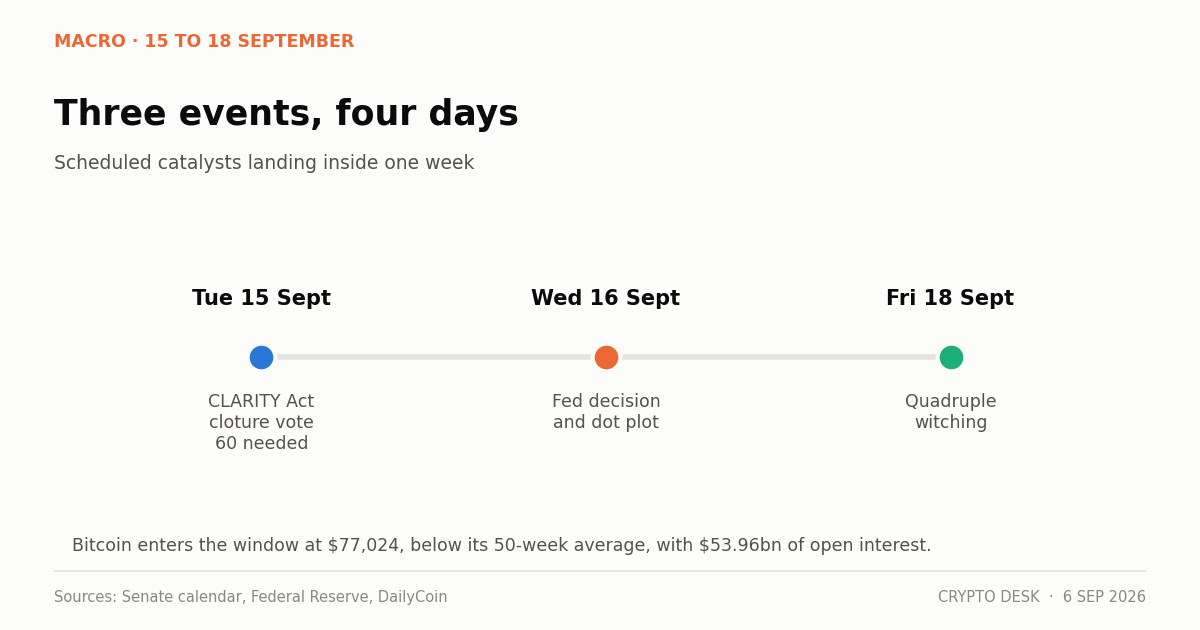
The September 15 crypto vote opens the densest risk window of the quarter: a Senate cloture vote on the CLARITY Act, then the Fed decision on the 16th and quadruple witching on the 18th.
On this page
- Why the 15 September crypto vote and each event matters separately
- Why the clustering makes it worse
- The seasonality argument, examined
- What would actually surprise the market
- The flow context going in
- What to watch
- What happens the following week
- A note on trading scheduled events
Three scheduled events land inside four days next week, and each one is capable of moving crypto on its own.
Tuesday 15 September, 2:15 p.m. ET. The Senate votes on cloture for the Digital Asset Market Clarity Act. Sixty votes required.
Wednesday 16 September. The Federal Reserve decision, with an updated dot plot.
Friday 18 September. Quadruple witching — the simultaneous expiry of stock index futures, index options, single-stock futures and single-stock options.
Bitcoin enters that window at $77,024, having closed the week below its 50-week moving average of $80,300, with $53.96 billion of derivatives open interest outstanding.
Why the 15 September crypto vote and each event matters separately
The CLARITY vote is a procedural motion to proceed, not final passage. But at sixty votes in a chamber where Republicans do not hold sixty seats, it requires meaningful Democratic support. The bill passed the House 294-134 in July 2025 with 78 Democratic votes and cleared Senate Banking 15-9 in May 2026. Majority Leader John Thune filed cloture on 8 August.
Failure would not leave crypto unregulated — the SEC's Regulation Crypto Assets proposal is already out for comment, GENIUS Act stablecoin rules move toward January 2027 enforcement — but it would leave the US without a statute assigning jurisdiction between the SEC and CFTC. Agency rules can be rewritten by a future administration. Statutes cannot.
The Fed decision arrives with rate expectations genuinely unsettled. Governor Christopher Waller signalled support for a hold in early September, pushing hike odds from about 63% toward 50%. Two days later August payrolls printed 162,000 against a consensus near 55,000, and odds moved back up toward 59%. The dot plot matters more than the decision, because it shows the committee's own view of the path, not the single meeting.
Quadruple witching is mechanical rather than informational. Large volumes of derivatives expire simultaneously, dealers rebalance hedges, and volume spikes. It affects crypto through correlated equity flows and through crypto derivatives positioned around the same dates.
Why the clustering makes it worse
Any of these on its own produces a manageable reaction. Together, they create a specific problem: positioning.
Traders hedge scheduled risk events. When three land in four days, the hedging for one interacts with the hedging for the others, and unwinding after the first event can trigger moves that get amplified by positioning for the second.
The current derivatives setup makes this more acute. Open interest at $53.96 billion, funding at +0.0079% — mildly net long — and price below a widely watched long-term average is a configuration in which a single directional shock produces cascading liquidations instead of an orderly repricing.
The evidence is from the past week: three separate liquidation events in five sessions. $400 million on 30 August, $77.08 million on 2 September, and between $318 million and $510 million on 3 September, in alternating directions.
The seasonality argument, examined
The analyst view circulating ahead of the window is that September, not the more widely watched October, delivers the next volatility test. The case rests on this event cluster, not on calendar effects.
There is a supporting structural argument. Bitcoin has advanced roughly 40% from June lows in the high $50,000s. Post-2022 rallies have typically run 30% to 50% before being interrupted by sizeable drawdowns. Bitcoin's RSI exceeded 80 during the early-September squeeze — conventionally overbought.
The counter-argument is that seasonality in crypto is weak evidence. The sample is small, the market's structure has changed materially with the arrival of ETFs, and the same seasonal patterns have failed in enough years to make them unreliable as a standalone signal.
What is not seasonality is the calendar of scheduled events. Those are on the record.
What would actually surprise the market
Three scenarios are not priced.
CLARITY passing cloture comfortably. Prediction markets have been marking down 2026 enactment odds through August. A vote clearing sixty by a margin would be a genuine surprise and would open a floor debate that markets have not modelled.
A hawkish dot plot showing multiple hikes. The market is trading the September meeting. It is not trading a sequence. A dot plot implying two or three more moves would reprice long-duration assets considerably harder than a single hike.
A dovish hold with soft guidance. The mirror image, and equally unpriced.
The scenario that is priced is roughly: cloture fails or is pulled, the Fed does something close to a coin flip, and witching passes without incident.
The flow context going in
US spot bitcoin ETFs hold $103 billion in assets after $3.8 billion of net inflows over three weeks. Year-to-date flows remain roughly $2.5 billion below where they started, despite August being the strongest month since October 2025.
That matters for the window because ETF flows have led price more often than they have followed it this cycle. Allocators buying into a risk window is a different signal from allocators buying after it clears.
What to watch
Whether the cloture vote gets rescheduled. Cloture votes get pulled when the count is not there. A postponement announced before the 15th is the clearest possible tell.
Funding rates into the 16th. Rising funding with flat price ahead of the Fed means crowded long positioning going into a binary event.
The dot plot's 2027 column. More informative than the 2026 one, because it shows whether the committee sees the current level as a peak or a waypoint.
Volume on the 18th. Quadruple witching produces mechanical volume. Unusually large crypto volume that day would suggest correlated positioning rather than independent flow.
What happens the following week
The events cluster, but the consequences do not resolve inside the window.
If cloture fails on the 15th, the immediate reaction is likely modest — prediction markets have been marking down 2026 enactment odds through August, so a failure is substantially priced. The consequence unfolds over months: agencies continue rulemaking, the SEC's Regulation Crypto Assets proposal proceeds through its comment period, and the US ends the year without a statute assigning jurisdiction.
If the Fed delivers a hawkish dot plot on the 16th, the repricing runs through the fourth quarter instead of through the week. Long-duration assets adjust to a path, not to a meeting.
Quadruple witching on the 18th is the exception. Its effects are almost entirely mechanical and almost entirely over within a session or two.
So one of the three events has a same-week effect and two of them set up conditions that play out over the rest of the year. Positioning for a single volatile week may be positioning for the wrong thing.
A note on trading scheduled events
The recurring mistake with a calendar like this is positioning for the event, not for the reaction to it.
Scheduled events are, by definition, known to everyone. What is not known is how positioning has accumulated around them, and that is what determines the size of the move. A hawkish dot plot into light positioning produces a shrug. The same dot plot into $54 billion of net-long open interest produces a cascade.
Which is why funding rates and open interest into the 16th are more informative than any forecast of what the Fed will do.
About this report. Event dates and the cloture threshold are from CoinDesk and Bitcoin Foundation reporting on the Senate calendar. The seasonality argument and RSI observation are attributed to the analyst cited by DailyCoin. Market structure figures — open interest, funding, liquidations, ETF assets — are from the Bitcoin News Digest of 6 September 2026.
Not investment advice. Scheduled events have unpredictable outcomes and market reactions.
Frequently asked questions
What happens on 15 September 2026?
The Senate votes at 2:15 p.m. ET on cloture for the Digital Asset Market Clarity Act. Sixty votes are needed to open floor debate. The bill passed the House 294-134 in July 2025 and Senate Banking 15-9 in May 2026.
What else lands that week?
The Federal Reserve decision and updated dot plot on 16 September, and quadruple witching on 18 September — the simultaneous expiry of index futures, index options, single-stock futures and single-stock options.
Why does clustering these events increase risk?
Traders hedge scheduled events, and hedging for one interacts with hedging for the others. With $53.96 billion of open interest and price below the 50-week average, a single directional shock produces cascading liquidations rather than orderly repricing.
Related reading
- Fed Hike Odds Pass 60% and Bitcoin Holds $78,900
- Bitcoin $82,000 Resistance: Three Rejections in Two Weeks
- Bitcoin Dominance at 56.9% Leaves Altcoins 32% of the Market
- Crypto Fear and Greed Index Falls to 66 on a Flat Tape
Sources
- September, Not October, May Test Crypto's Big 2026 Rally — DailyCoin
- CLARITY Act Hits a September 15 Deadline — Bitcoin Foundation
- Bitcoin News Digest, September 6, 2026 — Mike Richardson
- U.S. payrolls rose 162,000 in August — CNBC
Read next
- The Fed Chair Says Financial Conditions Are Not Restrictive. Crypto Should Read That Twice. Chairman Kevin Warsh called inflation the Fed's predominant focus with PCE at 3.7%, and said he would be hard…
- Crypto Spent Monday Waiting. Next Week's CPI Print Decides Whether the Fed Hikes. Bitcoin held near $79,350 on 7 September as traders waited on the August CPI report, which economists say cou…
- The 30-Year Yield Hit 5.26% and US Debt Passed $40 Trillion. Crypto Is Trading Inside That. The 30-year Treasury yield reached a cycle high of 5.26% and US sovereign debt passed $40 trillion, with Bren…