The Fed Chair Says Financial Conditions Are Not Restrictive. Crypto Should Read That Twice.
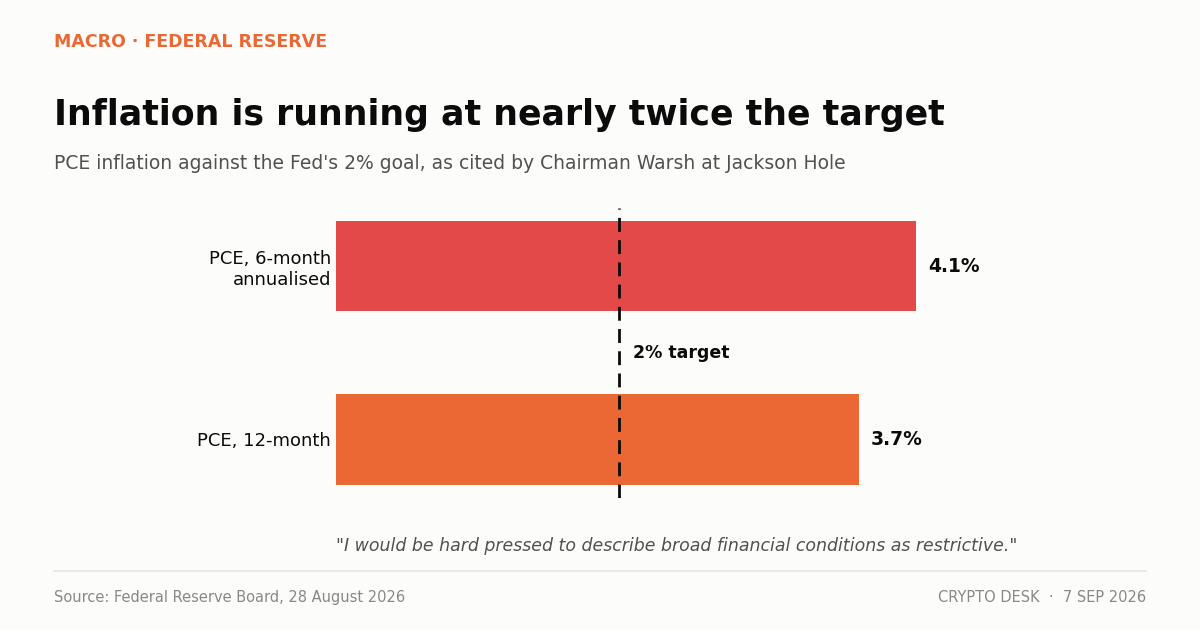
The odds of a Warsh Fed rate hike firmed after the chairman told Jackson Hole he would be hard pressed to call financial conditions restrictive, with PCE inflation running at 3.7%.
On this page
- The inflation picture he described
- Why the case for a hike rests on one phrase
- The forward guidance change is the bigger story
- On the balance sheet
- What he did not say
- What this means for positioning
- What to watch
- What a chair who dislikes forward guidance means in practice
At Jackson Hole on 28 August, Federal Reserve Chairman Kevin Warsh said something that has not been fully priced by any risk asset, crypto included: "I would be hard pressed to describe broad financial conditions as restrictive."
That is a central bank chair saying policy is not currently tight. With PCE inflation at 3.7% over twelve months against a 2% target.
The inflation picture he described
| Measure | Reading | Target |
|---|---|---|
| PCE, 12-month | 3.7% | 2.0% |
| PCE, 6-month annualised | 4.1% | 2.0% |
The six-month figure running above the twelve-month one is the detail that matters. It means the recent trend is worse than the trailing average, not better. Warsh described progress over the past two years as "modest," with recent readings showing no meaningful trend improvement.
His framing was direct: "Inflation is running above our 2 percent target. So the Fed's predominant focus right now should be on prices."
There is no dual-mandate hedging in that sentence. It is a statement that the employment side of the mandate is not currently the binding constraint — a position the 162,000 August payroll print, against a consensus near 55,000, made considerably easier to hold.
Why the case for a hike rests on one phrase
A central bank fighting inflation needs policy to be restrictive — tight enough to slow demand. If the chair believes conditions are not restrictive while inflation runs at 3.7%, the logical conclusion is that policy has further to go.
Warsh listed what he was looking at: resilient credit markets, strong corporate investment with AI-related capital expenditure growing around 9%, elevated profit margins, and low credit spreads. Every one of those is a sign that money is still cheap and available.
That assessment is the reason market-implied odds of a September quarter-point hike sit near 59%. It is also why the August CPI and PPI releases next week carry so much weight — economists describe them as capable of swinging the decision between a hike and a hold.
The forward guidance change is the bigger story
Buried in the same speech is a structural shift that will outlast the September meeting.
"In normal times, the role of forward guidance should be limited and circumscribed," Warsh said, adding that the committee should commit to "a discipline, not to a decision."
For fifteen years the Fed has told markets roughly what it intends to do next. Forward guidance became a policy tool in its own right after 2008, and asset prices came to embed it. Warsh is signalling he intends to use it far less.
For crypto this matters more than one rate decision. A market that cannot rely on guidance has to price a wider distribution of outcomes, and a wider distribution means higher volatility around every data release. The pattern of the past fortnight — bitcoin moving 5% on a Fed governor's remarks, then giving half of it back on a jobs number — is what that world looks like in practice.
On the balance sheet
Warsh was equally clear that he does not intend to reach for the tools that inflated asset prices in previous cycles: "Unconventional policies to spur economic activity may suit genuine crises but should otherwise be used sparingly, if at all."
That is a preference for short-term rates as the primary instrument and a marked reluctance toward balance sheet expansion outside an emergency.
Crypto's two largest bull markets, in 2020-21 and to a lesser extent 2024, coincided with expanding central bank balance sheets. A chair who regards that expansion as an emergency measure removes a tailwind the asset class has relied on twice.
What he did not say
The speech contained no substantive commentary on cryptocurrencies or digital assets at all.
That silence is worth noting instead of reading into. Crypto's regulatory agenda in the United States runs through the SEC, the CFTC, banking regulators and Congress — the CLARITY Act faces a Senate cloture vote on 15 September. Monetary policy touches crypto through the discount rate, not through any digital-asset-specific channel, and the chair treated it accordingly.
What this means for positioning
Three things follow, and none of them is a forecast.
The bar for a cut has risen. A chair who does not think conditions are restrictive is not close to easing.
Data releases matter more than they did. Less forward guidance means each print carries more information, and markets reprice harder on each one.
The long end is where the damage happens. The 30-year Treasury yield reached a cycle high of 5.26%, with US sovereign debt past $40 trillion. For a zero-cash-flow asset valued as a claim on distant future price, the long rate matters more than the policy rate.
Bitcoin at $79,349.91 is up 25% over thirty days and down 27.1% over twelve months. That recovery has taken place against a hawkish chair, a strong labour market and cycle-high long yields — which is either a sign of genuine underlying demand or a sign that the market has not finished pricing what Warsh said at Jackson Hole.
What to watch
August CPI and PPI next week. The single largest input to the 16 September decision.
The dot plot, particularly 2027. With forward guidance being deprecated, the dots may be the last explicit signal the committee gives.
Credit spreads. Warsh cited them as evidence conditions are loose. Widening spreads would undercut his own argument and shift the balance toward a hold.
Whether ETF flows persist. Bitcoin and ether funds took in a combined $1.2 billion in the week to 4 September. Allocators buying through a hawkish repricing is a meaningful signal; allocators pausing is equally meaningful.
What a chair who dislikes forward guidance means in practice
There is a second-order effect worth thinking through, because it changes how every future release trades.
Under heavy forward guidance, markets price the path the Fed has described and then adjust at the margins. Data matters, but it matters within a corridor the committee has already drawn.
Remove the corridor and each release carries the full weight of the decision. The distribution of plausible outcomes widens, options premiums rise, and the reaction function becomes less predictable — not because the Fed is being erratic, but because it has stopped pre-announcing.
For a zero-cash-flow asset that reprices directly off the discount rate, that means structurally higher volatility around every scheduled release, indefinitely. Traders who built positioning models on the guidance era are working with a broken assumption.
About this report. Quotes and inflation figures are from Chairman Warsh's keynote at the 2026 Jackson Hole Economic Policy Symposium, published by the Federal Reserve Board on 28 August 2026. Employment data is from the BLS August release. Rate-odds figures are market-implied probabilities as reported after that release. Price data is from Yahoo Finance for 7 September 2026.
Not investment advice. Central bank commentary is subject to interpretation and policy paths change with incoming data.
Frequently asked questions
What did Chairman Warsh say at Jackson Hole?
That inflation is running above the 2% target and 'the Fed's predominant focus right now should be on prices', and that he 'would be hard pressed to describe broad financial conditions as restrictive' — with PCE at 3.7% over twelve months and 4.1% annualised over six.
Is the Fed abandoning forward guidance?
Warsh signalled a sharp reduction in it, saying that 'in normal times, the role of forward guidance should be limited and circumscribed' and that the committee should commit to 'a discipline, not to a decision'. That means wider outcome distributions and higher volatility around each data release.
Did Warsh comment on crypto?
No. The Jackson Hole keynote contained no substantive commentary on cryptocurrencies or digital assets. Monetary policy reaches crypto through the discount rate rather than any digital-asset-specific channel.
Related reading
- Fed Hike Odds Pass 60% and Bitcoin Holds $78,900
- Bitcoin $82,000 Resistance: Three Rejections in Two Weeks
- Bitcoin Dominance at 56.9% Leaves Altcoins 32% of the Market
- Crypto Fear and Greed Index Falls to 66 on a Flat Tape
Sources
- Keynote remarks by Chairman Warsh at the 2026 Jackson Hole Economic Policy Symposium — Federal Reserve Board
- Fed chair Warsh, concerned about inflation, says bank may have 'work to do' — The Washington Post
- Warsh Sounds Hawkish, but Will There Be a September Rate Hike? — Morningstar
- Bitcoin and ethereum prices today, Monday, September 7, 2026 — Yahoo Finance
Read next
- Crypto Spent Monday Waiting. Next Week's CPI Print Decides Whether the Fed Hikes. Bitcoin held near $79,350 on 7 September as traders waited on the August CPI report, which economists say cou…
- The 30-Year Yield Hit 5.26% and US Debt Passed $40 Trillion. Crypto Is Trading Inside That. The 30-year Treasury yield reached a cycle high of 5.26% and US sovereign debt passed $40 trillion, with Bren…
- Three Events in Four Days: Why 15 to 18 September Is the Densest Risk Window of the Quarter The Senate CLARITY Act cloture vote on 15 September, the Fed decision and dot plot on the 16th, and quadruple…