One Company Now Holds 5.93 Million Ether. That Is Roughly 5% of the Supply.
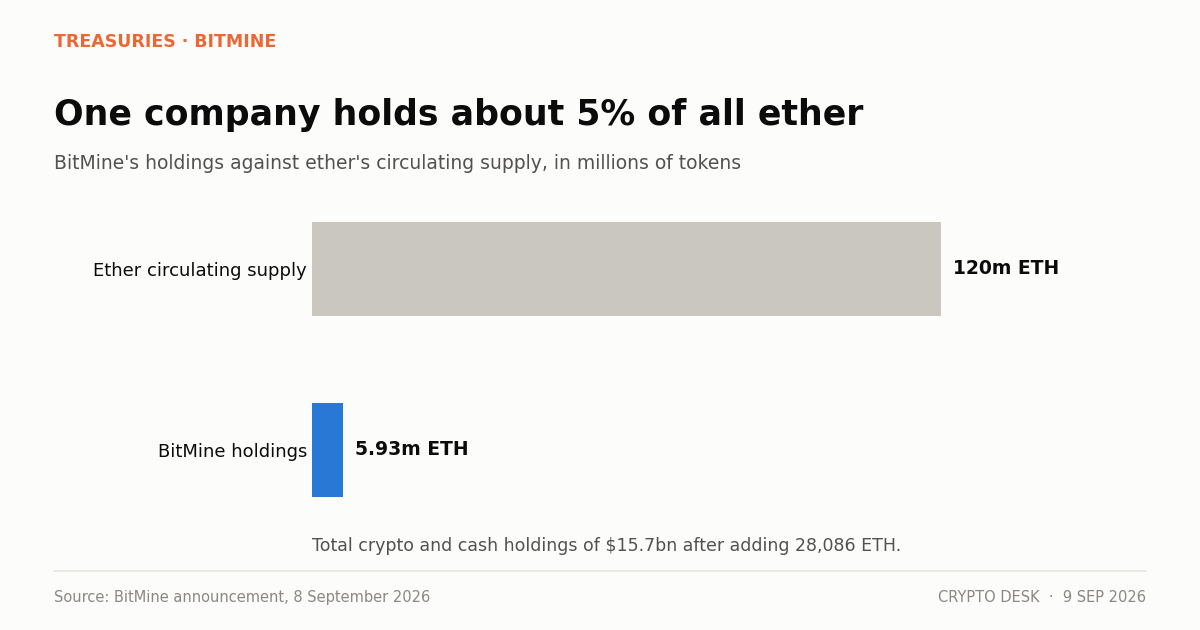
The BitMine Ethereum treasury now holds 5.93 million ETH after adding 28,086 tokens, inside total crypto and cash holdings of $15.7 billion.
On this page
- The BitMine Ethereum treasury in context
- Why ether and not bitcoin
- The concentration question
- What it does to the market
- The risk nobody discusses
- What to watch
- The comparison that frames the risk
BitMine Immersion Technologies added 28,086 ETH, taking its holdings to 5.93 million tokens. Combined crypto and cash holdings reached $15.7 billion.
Ether's circulating supply is roughly 120 million. One publicly traded company holds close to 5% of it.
The BitMine Ethereum treasury in context
| Figure | |
|---|---|
| ETH held | 5.93 million |
| Latest purchase | 28,086 ETH |
| Total crypto and cash | $15.7bn |
| Approximate share of ETH supply | ~5% |
| Value at $2,494.74 | ~$14.8bn |
For comparison on the bitcoin side, Strategy holds 845,050 BTC — roughly 4% of bitcoin's 21 million cap and about 4.2% of coins mined so far. BitMine's ether position is proportionally similar to the largest bitcoin treasury in existence, achieved in a fraction of the time.
The prior disclosure had holdings at 5.81 million ETH with $11.6 billion in total crypto and cash. The move to 5.93 million and $15.7 billion represents both accumulation and appreciation, and the two are not separable from the headline figures alone.
Why ether and not bitcoin
The structural case is different from bitcoin's, and it comes down to yield.
Ether can be staked. Bitcoin cannot. A treasury holding 5.93 million ETH and staking it captures the network's issuance — historically in the region of 3% to 5% annualised — which turns a static balance sheet asset into one that produces a return.
That distinction matters enormously for a public company. A bitcoin treasury is a bet on price with a financing cost attached. An ether treasury that stakes has a revenue line, which changes how auditors, lenders and equity analysts model it.
It is also why the SEC's Release 33-11426 review of crypto ETF rules matters beyond funds. If US regulated vehicles cannot stake, a corporate treasury that can stake holds a structural advantage over the ETF wrapper — an unusual inversion of how these things normally work.
The concentration question
Five percent of a network's token supply held by one entity raises a governance question that bitcoin treasuries do not.
Ethereum is proof-of-stake. Stake is voting weight on consensus. An entity holding 5% of supply, if fully staked, holds a corresponding share of validation influence. That is well below any threshold for unilateral action, but it is far from trivial, and it accumulates in one corporate balance sheet subject to one board.
Nobody has alleged misuse. The point is structural: bitcoin's largest holder can only sell, while ether's largest holders can also participate in consensus. The concentration therefore carries a different weight.
What it does to the market
BitMine's buying was cited as one reason ether showed relative resilience on 8 September, alongside the Ethereum Foundation's quantum-readiness announcement, while bitcoin fell 0.9%.
That is a real effect and a narrow one. Ether is down roughly 41% over twelve months and sits about 50% below its August 2025 record of $4,953.73. A single persistent buyer supports price at the margin; it does not reverse a drawdown of that size.
The more durable effect is on float. Coins held in a corporate treasury and staked are not on exchanges and are not available to sell quickly. Roughly 5% of supply moving into that state tightens the tradeable float, which raises volatility in both directions.
The risk nobody discusses
A treasury this large is a single point of failure for sentiment.
If BitMine ever needs to sell — a debt maturity, a financing squeeze, a strategy change — the market would be absorbing a position that took months to build. Strategy's equivalent problem in bitcoin has been discussed for years. The ether version is newer, less examined, and concentrated in a company with a shorter history at this scale.
The company's disclosure of a combined $15.7 billion in crypto and cash is worth noting for that reason. The cash portion is what determines whether it is ever a forced seller.
What to watch
Whether the ETH is staked, and how much. Disclosed in filings. It determines whether this is a yield business or a directional bet.
ETH per fully diluted share. The figure that separates a compounding treasury from a leveraged wrapper. Holdings can rise while share count rises faster.
The cash component. $15.7 billion combined tells you less than the split does.
Purchase cadence. 28,086 ETH in one disclosure is roughly 0.5% of the existing position. Sustained buying at that rate is a different market impact from a one-off.
The comparison that frames the risk
Strategy took roughly six years and $63.73 billion to accumulate 845,050 BTC — about 4% of mined supply. BitMine has reached roughly 5% of ether's circulating supply considerably faster.
Speed of accumulation matters for exit risk. A position built slowly across many market conditions has an average cost spread across those conditions. A position built quickly is concentrated in whatever prices prevailed during that window.
Strategy's average cost is roughly $75,412, close to bitcoin's current price after a 27% annual decline. That is what a long accumulation window buys.
BitMine has not disclosed a comparable average cost in the figures published. Until it does, the position's resilience to a further drawdown is unknown, and that is the single most important thing an investor in the equity would want to know.
About this report. Holdings, the purchase size and the total crypto and cash figure are from BitMine's announcement of 8 September 2026 as reported by PRNewswire, The Crypto Times and The Block. The supply share and position value are this desk's calculations using a circulating supply near 120 million and ether at $2,494.74. Prior-disclosure figures are from the company's earlier release.
Not investment advice. Concentrated treasury positions carry risks that direct ownership does not.
Frequently asked questions
How much ether does BitMine hold?
5.93 million ETH after adding 28,086 tokens, with total crypto and cash holdings of $15.7 billion. That is roughly 5% of ether's circulating supply of around 120 million, held by a single publicly traded company.
Why hold ether instead of bitcoin?
Ether can be staked and bitcoin cannot. A treasury holding 5.93 million ETH and staking it captures network issuance, historically around 3% to 5% annualised, which turns a static balance sheet asset into one producing a return that auditors and lenders can model.
Does a 5% holding raise governance concerns?
Structurally, yes. Ethereum is proof-of-stake, so stake is voting weight on consensus. An entity holding 5% of supply, if fully staked, holds a corresponding share of validation influence. That is well below any threshold for unilateral action and far from trivial.
What is the main risk?
Forced selling. A position that took months to build would take considerably longer to unwind, and the company has not disclosed an average cost basis in the published figures — which is the single most important number for judging resilience to a further drawdown.
Related reading
- Bitcoin Hashrate Stalls at 932 EH/s Below 1 Zettahash
- Bitcoin Hashprice Up 22% but Hashrate Stalls at 934 EH/s
- Bitcoin Hashrate 316 Days Below Peak as Miners Chase AI
- Mining Earns $113/MWh vs $1,213 for AI: The Miner Exodus
Sources
- BitMine Adds 28,086 ETH, Treasury Hits 5.93M Tokens Worth $15.7B — The Crypto Times
- BitMine Immersion Technologies Announces ETH Holdings Reach 5.93 Million Tokens — PRNewswire
- Bitmine Immersion Technologies Ethereum Holdings — The Block
- Crypto Market Today, Sept. 8 — The Motley Fool
Read next
- Sentiment Has Fallen for Three Sessions While Price Did Nothing. That Is the Momentum Draining Out. The crypto Fear and Greed Index slipped to 66 from 69 and 71 across three sessions while bitcoin barely moved…
- Stablecoins Turned Over $76 Billion in a Day on a $291 Billion Base The stablecoin market cap sits at $291.3 billion with $76.11 billion of daily volume — a turnover ratio no ot…
- IBIT Took $117 Million on a Friday Nobody Was Watching IBIT inflows of over $117 million on Friday extended a bitcoin ETF run of three consecutive positive weeks an…