We''re Back": Strategy Buys 4,603 Bitcoin After a Ten-Week Pause, and the Tranche Is Already Underwater
The latest Strategy bitcoin purchase was 4,603 BTC for $369.7 million at an average $80,318, ending a ten-week pause and lifting holdings to 845,050 BTC.
On this page
- The position now
- The detail that matters more than the purchase
- The mNAV question underneath it
- Everyone else was buying too
- The pattern in Remixpoint's decision
- What to watch
- The number that would settle the argument
- The pause deserves a second look
- One more comparison
Strategy acquired 4,603 bitcoin between 24 and 30 August for $369.7 million, an average of $80,318 per coin including fees. Michael Saylor announced it with a two-word post: "We're ₿ack."
It was the company's first disclosed purchase since 22 June — a ten-week gap, the longest pause in years. And with bitcoin closing the week at $77,024, the new tranche is already showing an unrealised loss of roughly $9 million.
The position now
| Metric | Value |
|---|---|
| Total holdings | 845,050 BTC |
| Aggregate cost basis | $63.73bn |
| Average cost per coin | $75,412 |
| Value at ~$78,316 | ~$66.2bn |
| Latest tranche | 4,603 BTC at $80,318 |
At an average cost of $75,412 against a weekly close of $77,024, the whole position sits marginally in profit — roughly 2%. After six years and $63.73 billion deployed, that is the entire result.
It is not a criticism of the execution. Bitcoin is down about 27% over twelve months and roughly 39% from its October 2025 record of $126,198.07. A position that is still green through a drawdown of that size reflects genuinely disciplined average-cost management over a long accumulation window.
But it does put a number on a thing that gets asserted rather than measured: the largest and longest-running corporate bitcoin accumulation programme in existence is, at present prices, up about two percent.
The detail that matters more than the purchase
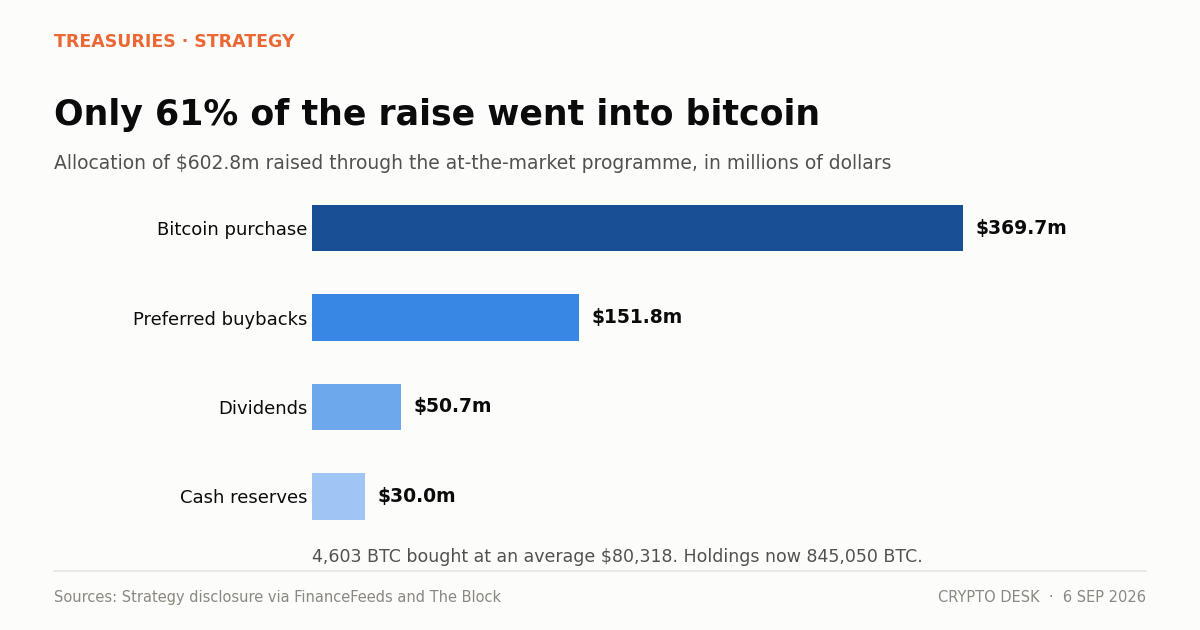
Strategy sold 4.53 million MSTR shares through its at-the-market programme, raising $602.8 million. Only $369.7 million of that went into bitcoin.
The rest went elsewhere:
- $151.8 million to preferred share repurchases
- $50.7 million to dividends
- $30 million to cash reserves
That allocation is the news. For most of the company's accumulation history, equity issuance flowed almost entirely into bitcoin. Now roughly 39% of a capital raise goes to servicing and managing the capital structure that funded the earlier purchases.
This is what a maturing leveraged strategy looks like. The preferred shares and convertible notes issued to buy bitcoin in earlier years carry dividends and, eventually, maturities. Those obligations compete with new purchases for every dollar raised. The flywheel has not stopped, but it now has friction.
The mNAV question underneath it
The engine of a bitcoin treasury company is the ratio of market capitalisation to the net asset value of the bitcoin held.
Above one, issuing equity to buy bitcoin is accretive: every share sold above NAV buys more bitcoin per existing share. Below one, the same action dilutes existing holders. The entire model depends on staying above the line.
The ten-week pause is the interesting data point here. A company that can issue accretively and wants more bitcoin does not stop buying for ten weeks. Either the terms were not there, the capital was needed elsewhere, or management judged the price unattractive. The company has not said which, and the ATM split suggests the second explanation carries weight.
Everyone else was buying too
Strategy was not alone. The same week produced a cluster of treasury activity.
Strive is purchasing 2,700 BTC, taking holdings to 24,050.
Metaplanet now holds 43,000 BTC at an aggregate acquisition cost of $4.41 billion — an average near $102,500, which puts it roughly 25% underwater at the weekly close.
DDC Enterprise increased holdings 145% in the first half of 2026 and now holds 2,899 BTC.
Remixpoint did something different and more revealing: it liquidated 901.44 ETH, 13,920 SOL, 1.19 million XRP and 2.8 million DOGE, and holds 1,506 BTC. That is a company consolidating a diversified crypto treasury into bitcoin alone.
The pattern in Remixpoint's decision
Consolidation into bitcoin is worth pausing on because it runs against the direction of the ETF market.
Over 2026, US spot products have launched for solana, XRP and now Zcash, each attracting real money — the solana and XRP complexes each reached roughly $1.5 billion in assets. The regulated wrapper market has been diversifying.
Corporate treasuries appear to be doing the opposite. The reasons are structural instead of ideological. Bitcoin has the deepest institutional custody arrangements, the clearest accounting treatment, the longest price history for auditors and boards to reference, and now the only asset counted alongside USDC in Fannie Mae mortgage reserve guidance. For a corporate balance sheet, those are the properties that matter, and no other digital asset has them yet.
What to watch
Whether the buying continues. One purchase after ten weeks is not a resumption. Two or three consecutive months would be.
The ATM allocation ratio. The proportion of raised capital going to bitcoin versus capital structure management is the cleanest signal of the model's health. This round: 61% to bitcoin.
Bitcoin per share. The figure that separates a compounding treasury company from a leveraged wrapper. It is disclosed quarterly and it is the only number that matters over a multi-year hold.
Debt maturities. Convertible notes from 2024 and 2025 come due on public schedules. Refinancing terms during a drawdown are the real stress test, and none of these companies has been through one at this scale.
The number that would settle the argument
There is one disclosure that would resolve most of the debate about bitcoin treasury companies, and it is published quarterly: bitcoin per fully diluted share.
If that figure rises quarter over quarter, the company is doing something a shareholder cannot do alone — converting access to capital markets into more bitcoin per unit of ownership. That is a business.
If it is flat or falling, the shareholder is paying for a management structure, a debt load and a corporate tax position to hold an asset they could own directly at no ongoing cost, or through a spot ETF at around 20 basis points. That is a wrapper with extra risk.
The headline holdings number — 845,050 BTC — tells you nothing about which of these is happening, because holdings can rise while shares rise faster. Almost all coverage leads with holdings. Almost none leads with the per-share figure.
Track it over four quarters and the question answers itself.
The pause deserves a second look
Ten weeks between purchases, ended with a two-word announcement, funded by a raise where 39% went somewhere other than bitcoin. Read those three facts together, not separately.
A company with unlimited accretive issuance capacity and an unchanged thesis does not produce that combination. Something in the capital stack is now demanding attention that it did not demand in 2024.
One more comparison
At an average cost of $75,412 across 845,050 coins, Strategy's entire position is roughly 2% in profit. A buyer who acquired bitcoin at the same average through a spot ETF, paying about 20 basis points a year, would be marginally behind that after fees and carry no debt, no preferred dividend obligation and no equity dilution.
The case for the corporate structure has to rest on the ability to compound bitcoin per share faster than that gap. Over the past ten weeks, with no purchases at all, it did not.
About this report. Purchase details, average prices, cost basis and ATM allocation are from Strategy's disclosure as reported by FinanceFeeds and The Block. Other treasury holdings are from the Bitcoin News Digest of 6 September 2026. The 2% position figure and Metaplanet's implied loss are this desk's calculations from the cited cost bases and the $77,024 weekly close.
Not investment advice. Leveraged treasury vehicles carry risks that direct ownership does not.
Frequently asked questions
How much bitcoin does Strategy hold?
845,050 BTC after the latest purchase, at an aggregate cost basis of $63.73 billion — an average of $75,412 per coin. Against the $77,024 weekly close the whole position sits roughly 2% in profit.
How much of the capital raise went into bitcoin?
About 61%. Strategy sold 4.53 million shares through its at-the-market programme raising $602.8 million, of which $369.7 million bought bitcoin, $151.8 million went to preferred buybacks, $50.7 million to dividends and $30 million to cash.
Which bitcoin treasury companies are underwater?
Metaplanet holds 43,000 BTC at an aggregate $4.41 billion, an average near $102,500, putting it roughly 25% underwater at the weekly close. Strategy, at $75,412 average, is marginally profitable.
Related reading
- Bitcoin Hashrate Stalls at 932 EH/s Below 1 Zettahash
- BitMine Ethereum Treasury Hits 5.93M ETH and $15.7bn
- Bitcoin Hashprice Up 22% but Hashrate Stalls at 934 EH/s
- Bitcoin Hashrate 316 Days Below Peak as Miners Chase AI
Sources
- "We're back": Strategy buys another 4,603 bitcoin for $369.7 million — The Block
- Strategy Buys 4,603 Bitcoin for $369.7M, Already Underwater — FinanceFeeds
- Strategy Buys 4,603 Bitcoin and Continues STRC Buybacks — BitcoinTreasuries.net
- Bitcoin News Digest, September 6, 2026 — Mike Richardson
Read next
- Sentiment Has Fallen for Three Sessions While Price Did Nothing. That Is the Momentum Draining Out. The crypto Fear and Greed Index slipped to 66 from 69 and 71 across three sessions while bitcoin barely moved…
- Stablecoins Turned Over $76 Billion in a Day on a $291 Billion Base The stablecoin market cap sits at $291.3 billion with $76.11 billion of daily volume — a turnover ratio no ot…
- IBIT Took $117 Million on a Friday Nobody Was Watching IBIT inflows of over $117 million on Friday extended a bitcoin ETF run of three consecutive positive weeks an…