Ten Companies Hold Nearly a Million Bitcoin. Their Cost Bases Tell Very Different Stories.
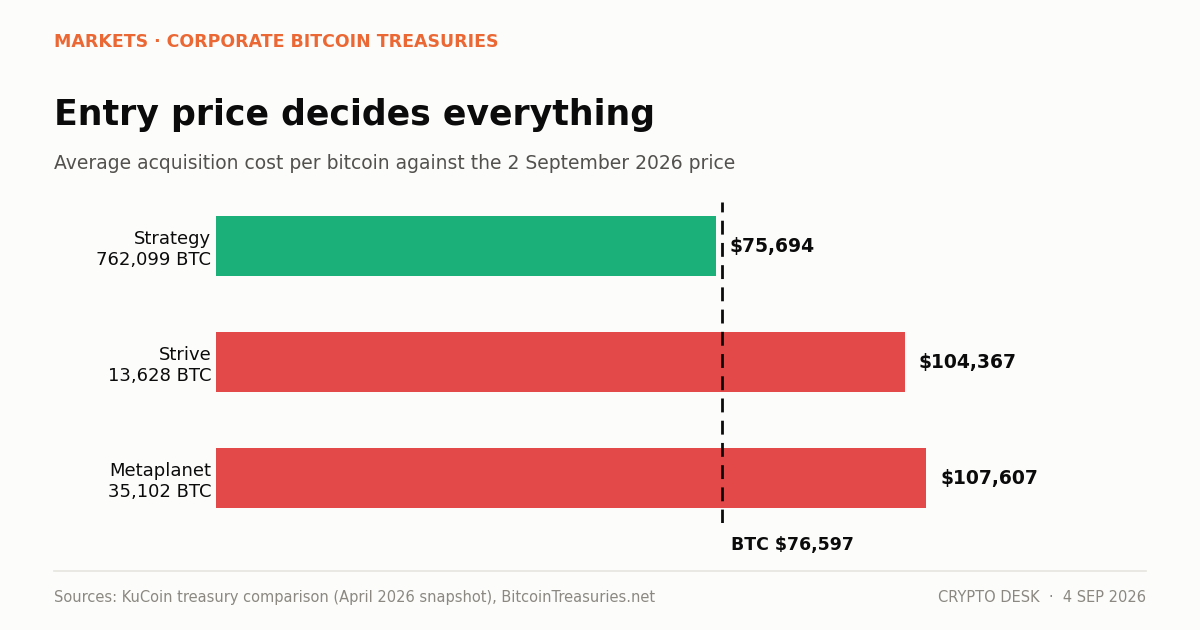
Bitcoin treasury companies hold roughly 992,000 BTC between the ten largest, and whether each position is profitable comes down almost entirely to when it bought.
The holdings
| Company | Ticker | BTC | Avg cost | Position vs cost |
|---|---|---|---|---|
| Strategy | MSTR | 762,099 | ~$75,694 | roughly breakeven |
| Twenty One Capital | XXI | 43,514 | not disclosed | — |
| Marathon Digital | MARA | 38,689 | not disclosed | — |
| Metaplanet | 3350 | 35,102 | ~$107,607 | ~29% underwater |
| Bitcoin Standard Treasury | CEPO | 30,021 | not disclosed | — |
| Bullish | BLSH | 24,300 | not disclosed | — |
| Riot Platforms | RIOT | 18,005 | not disclosed | — |
| Hut 8 | HUT | 13,696 | not disclosed | — |
| Strive | ASST | 13,627.9 | ~$104,367 | ~27% underwater |
| CleanSpark | CLSK | 13,363 | not disclosed | — |
Holdings from an April 2026 snapshot. Positions calculated by this desk against bitcoin at $76,597.13 on 2 September 2026. Companies acquire and sell between disclosures; treat holdings as approximate.
Strategy's position is the surprising one
Michael Saylor's company holds 762,099 BTC — more than the next nine combined, by a factor of about three — at an average cost of roughly $75,694.
Against bitcoin at $76,597, that position is worth approximately $58.4 billion against a cost of $57.7 billion. Roughly $700 million to the good, or about 1.2%.
After six years, more than $57 billion deployed, multiple convertible note issuances, a preferred share programme and the most aggressive corporate accumulation campaign in the history of any asset, Strategy is approximately flat.
That is not a criticism. Bitcoin is down about 29% over twelve months and 39% from its October 2025 high of $126,198. A position that is flat in that environment reflects disciplined average-cost management across a very long accumulation period. It is, however, a useful corrective to the idea that a bitcoin treasury strategy is a one-way trade.
The latecomers are the ones hurting
Metaplanet accumulated 35,102 BTC at an average of roughly $107,607. At current prices that position is worth about $2.69 billion against $3.78 billion of cost — a paper loss near $1.09 billion, or 29%.
Strive holds 13,627.9 BTC at approximately $104,367, producing an unrealised loss around $378 million, or 27%.
Both bought predominantly in the period around and after bitcoin's late-2025 high. Both are now carrying losses of a size that, for companies of their market capitalisation, is not a rounding error.
The difference between Strategy and these two is not strategy in any meaningful sense. Both followed the same playbook. The difference is that one started in 2020 and the other two started near the top.
The miners are a different category entirely
Marathon, Riot, Hut 8 and CleanSpark appear on this list, and their bitcoin holdings should be read differently from the others.
These companies did not raise capital to buy bitcoin. They produced it. Their coins arrived as mining output at whatever the production cost was at the time, and their treasury position is a decision not to sell rather than a decision to buy.
That distinction matters for how the position behaves. A miner holding unsold production has a natural hedge — its ongoing revenue is denominated in the same asset — and it can liquidate incrementally to fund operations without signalling a change in thesis. Marathon has been characterised as a strategic seller for exactly this reason.
It also matters because these companies are in the middle of a separate transformation. Bitcoin's network hashrate is running about 20% below its October 2025 peak, and miners including IREN have been redirecting power from mining to AI data centre contracts. Mining equities rose as much as 85% in 2026 while bitcoin fell 29%, which tells you the market is now valuing them on their power infrastructure instead of their coin holdings.
The mNAV problem
The metric that determines whether any of these companies can keep buying is mNAV — the ratio of market capitalisation to the net asset value of the bitcoin held.
The mechanism is straightforward. If a company trades above the value of its bitcoin, it can issue equity, buy more bitcoin, and increase bitcoin per share for existing holders. Every share sold above NAV is accretive. This is the engine that let Strategy compound its holdings for years.
Below NAV, the engine runs backwards. Issuing equity at a discount to the underlying bitcoin dilutes existing holders. The accumulation flywheel stops, and what remains is a leveraged holding company with debt service and no growth mechanism.
Companies with cost bases above $100,000 and a bitcoin price near $76,600 are the ones most exposed to this dynamic. Their bitcoin is worth less than they paid, their equity is more likely to trade at or below NAV, and their ability to average down is precisely the thing that has been removed.
What this says about the model
The corporate bitcoin treasury thesis rests on a claim that companies can be better long-term holders than individuals, because they do not face redemptions, margin calls or emotional selling.
The 2026 data offers a partial test. Strategy, with a five-year accumulation window, is flat through a 29% annual drawdown and has not been forced to sell. That supports the thesis.
Metaplanet and Strive, with concentrated buying near a cyclical high, are carrying losses of 27% to 29% and are much closer to the point where financing structures matter. That complicates it.
A bitcoin treasury strategy is not a strategy at all. It is leveraged directional exposure to bitcoin, and its outcome is determined by entry price and financing terms, which are the same two things that determine any leveraged position.
What to watch
Quarterly filings. Holdings, cost basis and any sales are disclosed. The companies that do not disclose cost basis are the ones worth asking about.
mNAV levels. Published by several trackers. A sustained reading below 1.0 signals that the accumulation model has stalled.
Debt maturities. Convertible notes issued in 2024 and 2025 come due on schedules that are public. Refinancing terms in a drawdown are the real stress test.
Whether the miners keep selling. Miner treasury behaviour is a function of hashprice and AI contract revenue, not conviction, and it is the most predictable of the four signals.
A test worth applying to any of these companies
There is a single question that separates a bitcoin treasury company with a viable model from one that is simply a leveraged holder: can it buy more bitcoin per share than it had last quarter, without new debt?
If the answer is yes, the accumulation mechanism works. Equity issued above net asset value converts directly into more bitcoin per existing share, and the company is doing something a shareholder could not do alone.
If the answer is no, the company is a wrapper. A shareholder is paying a management structure, a debt load and a corporate tax position for exposure they could get more cheaply through a spot ETF at 20 basis points, or by holding the asset directly at no ongoing cost.
The figure to look for in a quarterly report is bitcoin per fully diluted share, tracked over several quarters. Companies where it rises are compounding. Companies where it is flat or falling are not, whatever the headline holdings number says.
About this report. Holdings and cost-basis figures are from KuCoin's April 2026 treasury comparison and BitcoinTreasuries.net. Current position values are calculated by this desk using bitcoin at $76,597.13 as of 2 September 2026 and are labelled as calculations, not company disclosures. Holdings change between filings.
Not investment advice. Leveraged treasury vehicles carry risks that direct asset ownership does not.
Frequently asked questions
Which company holds the most bitcoin?
Strategy, with 762,099 BTC at an April 2026 snapshot — more than the next nine holders combined by a factor of about three — at an average cost near $75,694 per coin.
Are bitcoin treasury companies profitable?
It depends entirely on entry price. At $76,597 Strategy sits roughly breakeven, while Metaplanet at an average $107,607 is about 29% underwater and Strive at $104,367 about 27% underwater.
Related reading
- Bitcoin Hashrate Stalls at 932 EH/s Below 1 Zettahash
- BitMine Ethereum Treasury Hits 5.93M ETH and $15.7bn
- Bitcoin Hashprice Up 22% but Hashrate Stalls at 934 EH/s
- Bitcoin Hashrate 316 Days Below Peak as Miners Chase AI
Sources
- Top 10 Bitcoin Treasury Companies Compared: Stocks, Holdings, Costs, and Profitability in 2026 — KuCoin
- Strategy — Bitcoin Holdings & Analysis — BitcoinTreasuries.net
- Bitcoin Treasury Companies | BTC Holdings, mNAV, & Analysis — BitcoinQuant
- Bitcoin Hashrate Marks 316 Days Below Peak as Miners Redirect Power to AI — The Crypto Times
Read next
- Sentiment Has Fallen for Three Sessions While Price Did Nothing. That Is the Momentum Draining Out. The crypto Fear and Greed Index slipped to 66 from 69 and 71 across three sessions while bitcoin barely moved…
- Stablecoins Turned Over $76 Billion in a Day on a $291 Billion Base The stablecoin market cap sits at $291.3 billion with $76.11 billion of daily volume — a turnover ratio no ot…
- IBIT Took $117 Million on a Friday Nobody Was Watching IBIT inflows of over $117 million on Friday extended a bitcoin ETF run of three consecutive positive weeks an…