162,000 Jobs Against a 53,000 Forecast: The Print That Undid Crypto''s Dovish Morning
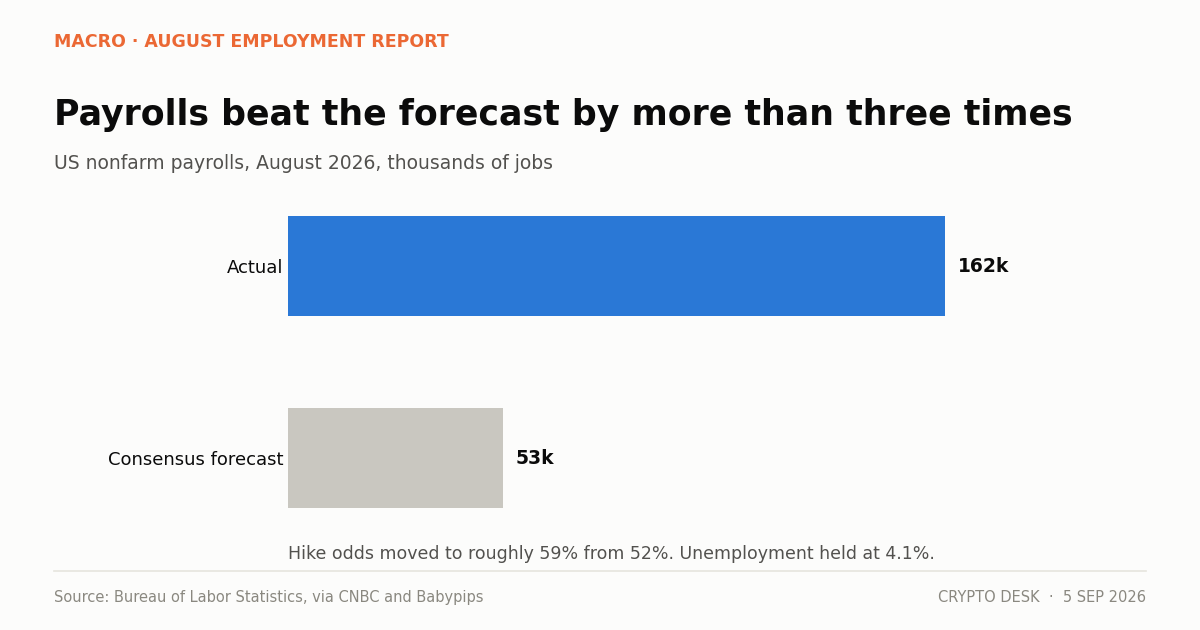
The August jobs report crypto reaction landed on 4 September: payrolls came in at 162,000 against a 53,000 forecast, pushing rate-hike odds to 59% and reversing the dovish read crypto had rallied on hours earlier.
On this page
- The numbers
- What it did to rate expectations
- Why crypto cares this much about a jobs number
- The inflation complication
- What is priced and what is not
- How this interacts with crypto's own calendar
- What to watch
- The summary
- Why the forecast was so wrong
The US economy added 162,000 jobs in August. Economists had forecast around 53,000. The report landed on Friday 4 September, hours after crypto had rallied 5% on a Federal Reserve governor's dovish remarks, and it moved rate expectations straight back the other way.
For anyone trying to work out why bitcoin is up 5% on the day and only 1.3% on the week, this is the answer.
The numbers
| Measure | August 2026 | Expected |
|---|---|---|
| Nonfarm payrolls | +162,000 | ~+53,000 |
| Unemployment rate | 4.1% | 4.1% |
| Average hourly earnings, monthly | +0.3% | — |
| Average hourly earnings, annual | +3.1% | — |
| June–July revisions | +55,000 combined | — |
It was the strongest monthly gain since March. The revisions matter as much as the headline: July was originally reported as a job loss and has been revised to a gain of 21,000, which changes the shape of the summer entirely. What looked like a labour market rolling over now looks like a labour market that had one weak month of data collection.
Average hourly earnings reached $37.75, up 3.1% over twelve months. That is above the roughly 2% pace consistent with the Fed's inflation target once productivity is accounted for, though not dramatically so.
What it did to rate expectations
Market-implied odds of a quarter-point hike at the next meeting rose to roughly 59% from 52%. The dollar index gained 0.3%. Short-term Treasury yields jumped.
The sequence over a single trading day was unusual enough to be worth laying out.
Thursday and early Friday. Fed Governor Christopher Waller signalled support for holding rates if inflation continues cooling. Hike odds fell from about 63% to roughly 50%. Bitcoin ETFs took in $730.9 million, their largest day since January. Bitcoin reclaimed $81,000.
Friday morning. Payrolls beat by more than three times the forecast. Hike odds moved to 59%.
Two opposing signals about the same decision, twenty-four hours apart. The rally happened on the first and had not yet fully unwound by the time of writing.
Why crypto cares this much about a jobs number
The transmission runs through rates, and rates matter to bitcoin more than to almost any other asset because bitcoin has no cash flow to fall back on.
An equity has earnings. A bond has coupons. When the discount rate rises, both fall, but there is a floor set by what the asset actually produces. Bitcoin produces nothing. Its entire value is a claim on future price, so a change in the discount rate applied to that future price passes through with almost no dampening.
This is why bitcoin has traded with a high correlation to the Nasdaq and an inverse correlation to real yields for three years, and why every attempt to describe it as an inflation hedge has failed on contact with the data. Two days before this jobs report, US strikes on Iran pushed oil to a three-month high — a textbook inflation shock — and bitcoin fell.
The inflation complication
There is a second channel worth noting, and it points the other way.
The US-Iran escalation has kept oil elevated. Higher energy costs feed headline inflation with a lag of roughly one to three months. A strong labour market alongside rising energy prices is the combination that most constrains a central bank, because it removes the argument that inflation is transitory and removes the argument that the economy needs support.
If the September inflation prints confirm energy pass-through while payrolls stay near 160,000, the case for a hold becomes considerably harder to make. That is the scenario crypto is least positioned for after a week of rallying on dovish expectations.
What is priced and what is not
At 59% odds of a hike, the market is close to a coin flip with a hawkish lean. That is an uncomfortable place to be positioned in either direction, and it explains the volatility: any incremental data point moves a near-even probability meaningfully.
What is clearly priced: a single quarter-point move, or the absence of one.
What is not priced: a sequence. Markets are trading the September meeting, not the path. If the labour market holds at this level into the autumn, the question stops being whether the Fed hikes once and becomes how many times — and that is a different repricing altogether for long-duration assets.
How this interacts with crypto's own calendar
September is unusually dense for the sector regardless of macro.
The Senate votes on cloture for the CLARITY Act at 2:15 p.m. Eastern on 15 September, needing sixty votes to advance the market structure bill. The SEC's Regulation Crypto Assets proposal, published 18 August, is inside its comment period. GENIUS Act stablecoin rules move toward January 2027 enforcement.
None of that is affected by payrolls. All of it competes for attention with a Fed meeting that has become genuinely uncertain. In a month where a single macro release can move the entire complex 5%, sector-specific catalysts get drowned out — which is a recurring frustration for anyone who thinks the regulatory news is the more consequential development.
What to watch
The September inflation prints. Whether oil is passing through to headline and core.
Fed speakers before the meeting. Waller's remarks moved the market thirteen points in an afternoon. Others will speak, and the range of views inside the committee is visibly wide right now.
Payroll revisions. This report revised June and July up by 55,000 combined. Revisions of that scale mean the initial print carries less information than its precision implies, and the next report will restate this one too.
Whether crypto's correlation holds. Every cycle produces an argument that bitcoin has finally decoupled from rates. The evidence from this week — a 5% rally on a Fed governor's remarks and a reversal on a jobs number — does not support it.
The summary
Crypto rallied on a dovish Fed governor and gave part of it back on a strong jobs report, inside twenty-four hours. Hike odds went 63% to 50% to 59% over the same window.
That is not a market with a view on bitcoin. It is a market with a view on the Federal Reserve, expressed through bitcoin.
Why the forecast was so wrong
A 162,000 print against a 53,000 consensus is a miss of more than three times. Misses that large usually say something about the forecasting process rather than the economy.
Two mechanical factors are worth knowing. Establishment survey response rates have declined materially over the past decade, which means initial prints are built on less complete data and get revised more. And the birth-death model, which estimates jobs created by businesses too new to appear in the survey, contributes a larger share of the headline than it did historically.
Both push in the same direction: initial payroll prints carry less information than their precision implies, and the revision in the following month is often as significant as the original release. This report revised June and July up by a combined 55,000 — enough to flip July from a reported loss to a gain of 21,000.
Which means the correct response to a large surprise in either direction is to wait for the revision. Markets do not have that luxury, and rate expectations moved seven points on a number that will be restated.
About this report. Employment figures are from the BLS August 2026 release as reported by CNBC and Babypips, including the consensus forecast and revision detail. Rate-odds figures are market-implied probabilities as cited in that coverage and in KuCoin's daily market report. Crypto price data is from Yahoo Finance for 4 September 2026.
Not investment advice. Macroeconomic forecasting is uncertain and rate expectations change with every release.
Related reading
- Fed Hike Odds Pass 60% and Bitcoin Holds $78,900
- Bitcoin $82,000 Resistance: Three Rejections in Two Weeks
- Bitcoin Dominance at 56.9% Leaves Altcoins 32% of the Market
- Crypto Fear and Greed Index Falls to 66 on a Flat Tape
Sources
- U.S. payrolls rose 162,000 in August, much more than expected — CNBC
- U.S. Payrolls Crush August 2026 Forecast — Babypips
- Employment Situation Summary, August 2026 — Bureau of Labor Statistics
- Crypto Daily Market Report – September 4, 2026 — KuCoin
Read next
- The Fed Chair Says Financial Conditions Are Not Restrictive. Crypto Should Read That Twice. Chairman Kevin Warsh called inflation the Fed's predominant focus with PCE at 3.7%, and said he would be hard…
- Crypto Spent Monday Waiting. Next Week's CPI Print Decides Whether the Fed Hikes. Bitcoin held near $79,350 on 7 September as traders waited on the August CPI report, which economists say cou…
- The 30-Year Yield Hit 5.26% and US Debt Passed $40 Trillion. Crypto Is Trading Inside That. The 30-year Treasury yield reached a cycle high of 5.26% and US sovereign debt passed $40 trillion, with Bren…