Tokenized Apple Stock Needs a Custodian. That Is Why HSBC and Standard Chartered Are In.
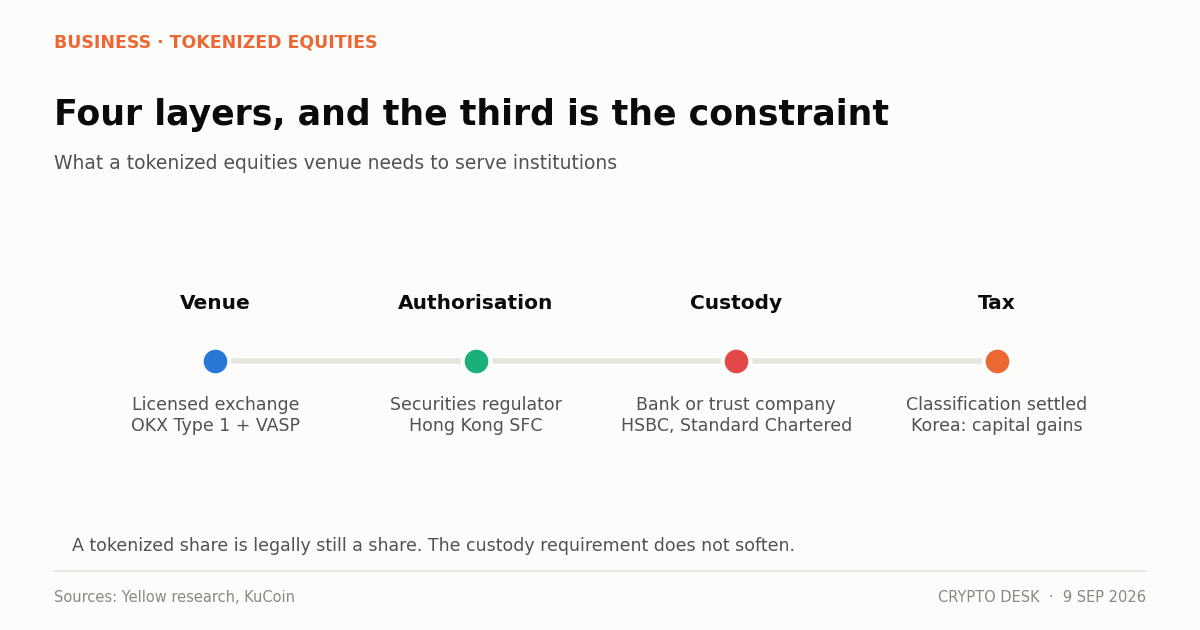
Tokenized equities need bank-grade custody before institutions can touch them, which is why HashKey pairs its Hong Kong licence with co-custody from HSBC and Standard Chartered.
On this page
- Why custody is the binding constraint for tokenized equities
- What the licensing stack looks like
- The tax question Korea answered
- What tokenization actually improves
- What it does not solve
- What to watch
- What would make this a real market
HashKey Exchange operates under a Hong Kong Virtual Asset Service Provider licence with co-custody infrastructure provided by HSBC and Standard Chartered.
That second half is the part that makes tokenized equities institutionally viable, and it is the part almost every announcement leaves out.
Why custody is the binding constraint for tokenized equities
An institution cannot hold an asset it cannot custody to standard.
Pension funds, insurers, endowments and regulated asset managers operate under rules requiring assets to be held by a qualified custodian with specified capital, segregation and audit arrangements. Those rules exist because the alternative is what happened repeatedly in crypto's first decade.
A tokenized share of a listed company is, legally, a share. The custody requirement does not soften because the record moved to a different ledger. If anything it hardens, because the operational risk is less familiar.
This is why a crypto exchange offering tokenized equities without a bank behind the custody has a retail product, not an institutional one. And retail is not where the volume in equities is.
What the licensing stack looks like
| Layer | Who provides it | Example |
|---|---|---|
| Trading venue | Licensed exchange | OKX Type 1 dealer + VASP |
| Securities authorisation | Regulator | Hong Kong SFC |
| Custody | Bank or trust company | HSBC, Standard Chartered |
| Tax treatment | Government | Korea: capital gains on tokenized stocks |
OKX holds a Type 1 securities dealer licence alongside a VASP licence — the first exchange globally with both in one jurisdiction, allowing crypto, tokenized equities and Hong Kong-listed stocks on one venue.
Coinbase has filed for broker-dealer expansion with FINRA and describes itself as an "everything exchange," with tokenized securities among the products. It already operates Coinbase Custody Trust Company, which is the equivalent piece of the stack built in-house rather than partnered.
The tax question Korea answered
South Korea will apply capital gains tax to tokenized stocks, treating tokenized equities as investable securities.
That sounds administrative and is the most consequential decision on this list.
Tax treatment is the clearest statement a government makes about what something is. Taxing a tokenized share the same way as the share it represents closes an arbitrage before the market opens. If the two were taxed differently, capital would move to the cheaper wrapper for reasons unrelated to the investment, and the resulting flows would tell you nothing about demand for the technology.
It also settles the classification question that the United States is still working through the SEC's Regulation Crypto Assets proposal and a stalled market structure bill.
What tokenization actually improves
Being precise here matters, because the claims made for it are often larger than the reality.
Settlement. Equity settlement runs on a delayed cycle. Token settlement is closer to immediate, which frees working capital.
Hours. Listed equities trade during exchange hours. A tokenized representation can trade continuously, though liquidity outside primary hours is thin and pricing correspondingly worse.
Composability. A tokenized share can serve as collateral programmatically. This is the genuinely new capability and it is currently used by a small number of sophisticated participants.
Fractionalisation. Available already through most brokers without any blockchain.
Three of those four are incremental. The composability case is the one with no traditional equivalent.
What it does not solve
The share is still a claim on a company, subject to the same corporate actions, the same disclosure regime and the same market risk. Tokenization changes the plumbing, not the asset.
It also introduces a new dependency. A tokenized share is only as good as the custody arrangement backing it, which returns to why HSBC and Standard Chartered matter more than the exchange's technology.
What to watch
Volume, not listings. Announcing tokenized equities is easy. Sustained volume is the test, and almost nobody publishes it.
Whether more banks provide co-custody. Two large Asian banks is a start. The model spreads or it does not.
Korea's rate and effective date. Neither has been specified, and a punitive rate would defeat the classification.
Coinbase's FINRA outcome. Whether tokenized securities are included in the approved scope, and on what conditions.
What would make this a real market
Volume, and it is not there yet in any public disclosure.
Every participant in tokenized equities publishes licences, partnerships and product launches. Almost none publishes traded volume, average trade size, or the spread against the underlying listed security.
Those three numbers would settle the question immediately. A tokenized share trading at a persistent discount to its listed equivalent is a product nobody wants at par. One trading at a tight spread on meaningful volume is a genuine parallel market.
The reason the numbers are absent is almost certainly that they are small. That is normal for a category this new and it is not a criticism.
It does mean that every claim made for tokenized equities today rests on the infrastructure being built instead of on demonstrated demand, and readers should hold those claims accordingly.
About this report. Licence types, custody partnerships and product scope for HashKey, OKX and Coinbase are from Yellow's research on exchange licensing strategies. South Korea's tax treatment of tokenized stocks is from KuCoin's regional summary, which does not specify the rate or effective date. US regulatory context is from SEC releases and Bitcoin Foundation reporting.
Not legal, tax or investment advice. Tokenized securities carry custody and operational risks distinct from the underlying instruments.
Related reading
- Asia Stablecoin Regulation: Japan, Hong Kong and Korea Move
- Crypto Exchange Bank Charters: Three Very Different Routes
- ESMA MiCA to MiFID II: Europe's Dual Licensing Pathway
- CLARITY Act Vote on 15 September Is Barely Priced
Sources
- Binance, Coinbase, And Kraken Are Becoming Full Banks — Yellow
- Asia's Stablecoin Acceleration: Japan Banks, Hong Kong Rules, and South Korea Tax Tokenized Assets — KuCoin
- RWA categories in 2026: tokenized Treasuries, equities, credit — MetaMask
- SEC Proposes New Regulation Crypto Assets — SEC press release 2026-76
Read next
- BlackRock's Tokenized Fund Passed $2.5 Billion. The Interesting Number Is What It Is Used For. RWA tokenization has pushed BlackRock's BUIDL past $2.5bn as the wider tokenized real-world asset market move…
- Visa Will Pay Gig Workers in Stablecoins in Under Thirty Minutes. The Rails Are the Product. Visa stablecoin payouts let platforms pay gig workers and creators in USDC, PYUSD and USDG through Visa Direc…
- Twenty-One Banks Are Building a Stablecoin. The Token Is Not What They Are Competing For. A bank stablecoin consortium including Goldman, Citi, BofA and UBS plans a USD token for H1 2027, competing w…