Twenty-One Banks Are Building a Stablecoin. The Token Is Not What They Are Competing For.
A bank stablecoin consortium of twenty-one institutions including Goldman Sachs, Citi, Bank of America and UBS is forming a joint company in late 2026, with a US dollar token targeted for the first half of 2027.
On this page
- What the bank stablecoin consortium is really competing for
- The competing consortia
- Tokenised deposits versus stablecoins
- The regulatory clock they are working against
- What it means for Tether and Circle
- The caveat about consortia
- What to watch
- The precedent worth remembering
Twenty-one banks — Bank of America, Goldman Sachs, Citi, Wells Fargo, UBS, Deutsche Bank, Santander and MUFG among them — are forming a joint company to issue a stablecoin. The entity is due to be established in late 2026, with a US dollar token targeted for the first half of 2027 and euro and other G7 currencies to follow.
The token is the least interesting part of this.
What the bank stablecoin consortium is really competing for
A stablecoin is not technically difficult. Tether and Circle demonstrated a decade ago that the hard parts are reserve management, redemption reliability and distribution — not the smart contract.
What these banks are building is a claim on the layer underneath: who manages issuance, who holds the backing, who operates settlement, and whose rails the money moves on. A consortium that controls those functions controls the economics of digital dollar movement regardless of which brand appears on the token.
That is why twenty-one competitors who agree on very little are willing to form a joint venture. Individually, each would be a minor issuer competing against incumbents with enormous network effects. Collectively they represent a distribution network that already touches most of the world's institutional payment flow.
The competing consortia
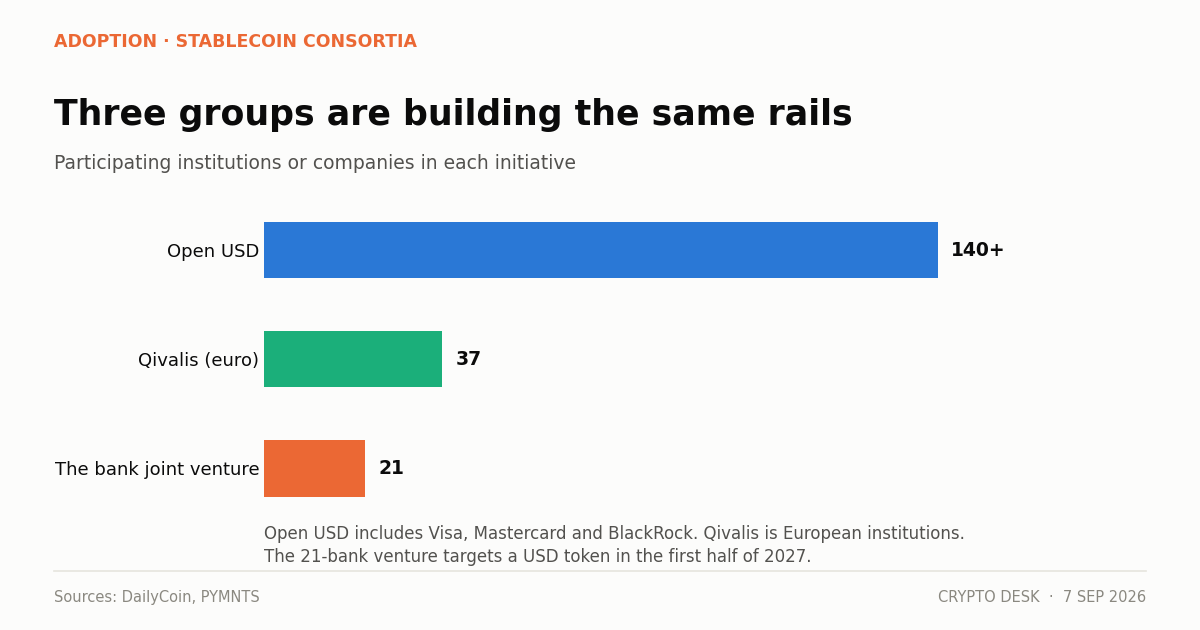
They are not first, and they are not alone.
| Initiative | Participants | Focus |
|---|---|---|
| The 21-bank joint venture | 21 global banks | USD first, then euro and G7 |
| Qivalis | 37 European institutions | Euro stablecoin |
| Open USD | 140+ companies incl. Visa, Mastercard, BlackRock | USD |
| Tether / Circle | Incumbent issuers | USDT and USDC |
Open USD is the one to watch. A network including Visa, Mastercard and BlackRock covers card rails, merchant acceptance and reserve asset management — the three things a bank consortium would otherwise have to build. BlackRock's tokenised Treasury products already provide the backing layer that any dollar token needs.
Qivalis, with 37 European institutions behind a euro token, is solving a different problem: Europe has MiCA in enforcement and no euro stablecoin of meaningful scale, which is a strategic gap the ECB has been vocal about.
Tokenised deposits versus stablecoins
There is a distinction running underneath this that most coverage collapses, and it matters.
A stablecoin is a bearer instrument. Whoever holds it owns it, transfers are peer-to-peer, and the issuer holds reserves against the float.
A tokenised deposit is a claim on a specific bank, recorded on a ledger. It stays inside the banking system, carries deposit insurance where applicable, and moves between accounts rather than between wallets.
Banks prefer tokenised deposits because they keep funding on the balance sheet. Stablecoins move deposits off it — which is precisely the deposit-flight argument the banking lobby has made against yield-bearing stablecoins in the CLARITY Act negotiations, where the question of whether issuers may pass returns to holders remains one of four unresolved issues before the 15 September Senate cloture vote.
A consortium building both is hedging. If regulation favours tokenised deposits, they have one. If the market prefers bearer instruments, they have that too.
The regulatory clock they are working against
The GENIUS Act was signed on 18 July 2025, with final rules due 18 July 2026 and full enforcement beginning January 2027 — or 120 days after rules finalise, whichever is earlier.
A consortium establishing its company in late 2026 and launching in the first half of 2027 arrives immediately after enforcement begins. That timing is not accidental. Launching into a settled rulebook, as a regulated bank with an existing charter, is a materially different proposition from an offshore issuer retrofitting compliance.
It is also the consortium's clearest structural advantage. The GENIUS Act classifies stablecoin issuers as financial institutions under the Bank Secrecy Act, requiring risk-based AML programmes, suspicious activity reporting and examination. Banks have all of that already. For them it is a marginal cost; for a mid-sized independent issuer it is a new function costing an estimated 11% to 15.5% of payroll.
What it means for Tether and Circle
Less than the headlines suggest, at least initially.
The stablecoin market sits around $291 billion by current measures, and Tether and Circle hold the large majority of it. That position rests on liquidity and integration — USDT is the quote currency across most offshore exchanges, and USDC is embedded across DeFi. Neither advantage transfers to a new entrant because a bank consortium says so.
Where the banks can win is in flows that never touched crypto exchanges: corporate treasury, cross-border settlement, institutional payment. That market is far larger than crypto trading and it is currently served by correspondent banking, which is slow and expensive.
The realistic outcome is segmentation instead of displacement. Bank tokens for institutional settlement, existing stablecoins for trading and DeFi, with the boundary moving slowly.
The caveat about consortia
Bank consortia have a poor delivery record. Blockchain-based trade finance and interbank settlement ventures were announced repeatedly between 2016 and 2022, and most were quietly wound down.
What is different this time is that the regulatory framework now exists, the demand is demonstrated by a $291 billion market that grew without them, and the competitive threat is concrete, not hypothetical. Those are better conditions than any previous attempt had.
Whether twenty-one banks can agree on governance fast enough to hit a first-half-2027 launch remains the open question. Consortium governance is where these ventures usually die.
What to watch
The joint company's formation in late 2026. Named executives and a legal entity would signal this is real.
Whether tokenised deposits or a stablecoin ships first. Tells you which way the participants read the regulation.
The CLARITY Act yield provision. If issuers may pass yield to holders, bank tokens compete directly with deposits — including their own.
Open USD's progress. With Visa, Mastercard and BlackRock, it has the stronger starting hand on rails and reserves.
The precedent worth remembering
In 2017 a group of the world's largest banks announced a consortium to build a blockchain settlement network. In 2018 another group announced a trade finance platform. In 2019 a third announced a digital cash settlement token. Nearly all of it was quietly discontinued within four years.
The pattern was consistent: the technology worked, the pilots succeeded, and the ventures died in governance. Twenty institutions who compete for the same clients could not agree on fee structures, membership rules or who ran the entity.
What is different now is that the alternative is not "do nothing." It is watching Tether, Circle and a 140-member network including Visa and Mastercard build the rails instead. Competitive pressure has resolved consortium deadlock before where a shared interest in doing nothing had not.
Late 2026 is when the entity is supposed to exist. That deadline is the first real test.
About this report. Participating institutions, timeline and the set of competitors are as reported by DailyCoin and PYMNTS. Stablecoin market size is from CoinGabbar's 7 September summary; other trackers using different inclusion criteria have reported $314.68 billion as of June 2026. GENIUS Act dates and compliance cost estimates are from Value Add VC's regulatory analysis.
Not legal or investment advice. Announced consortium timelines frequently slip.
Related reading
- Visa Stablecoin Payouts Settle in Under 30 Minutes
- Visa Mastercard Stripe Stablecoin Platform Takes Shape
- RWA Tokenization: BUIDL Past $2.5bn, Market Above $20bn
- Crypto VC Funding: 93% of $292M Went to Payments
Sources
- 21 Banks Are Not Just Building a Stablecoin. They're Fighting for Control — DailyCoin
- How 21 Banks Changed the Conversation Around Stablecoins and Tokenized Deposits — PYMNTS
- Banks Rush to Tokenize Deposits as Stablecoin Networks Beat Them to Shared Payment Rails — TechTimes
- Stablecoin Regulation 2026: GENIUS Act Rules on a $314B Market — Value Add VC
Read next
- Tokenized Apple Stock Needs a Custodian. That Is Why HSBC and Standard Chartered Are In. Tokenized equities need bank-grade custody to reach institutions, which is why HashKey pairs its Hong Kong VA…
- BlackRock's Tokenized Fund Passed $2.5 Billion. The Interesting Number Is What It Is Used For. RWA tokenization has pushed BlackRock's BUIDL past $2.5bn as the wider tokenized real-world asset market move…
- Visa Will Pay Gig Workers in Stablecoins in Under Thirty Minutes. The Rails Are the Product. Visa stablecoin payouts let platforms pay gig workers and creators in USDC, PYUSD and USDG through Visa Direc…