Visa Will Pay Gig Workers in Stablecoins in Under Thirty Minutes. The Rails Are the Product.
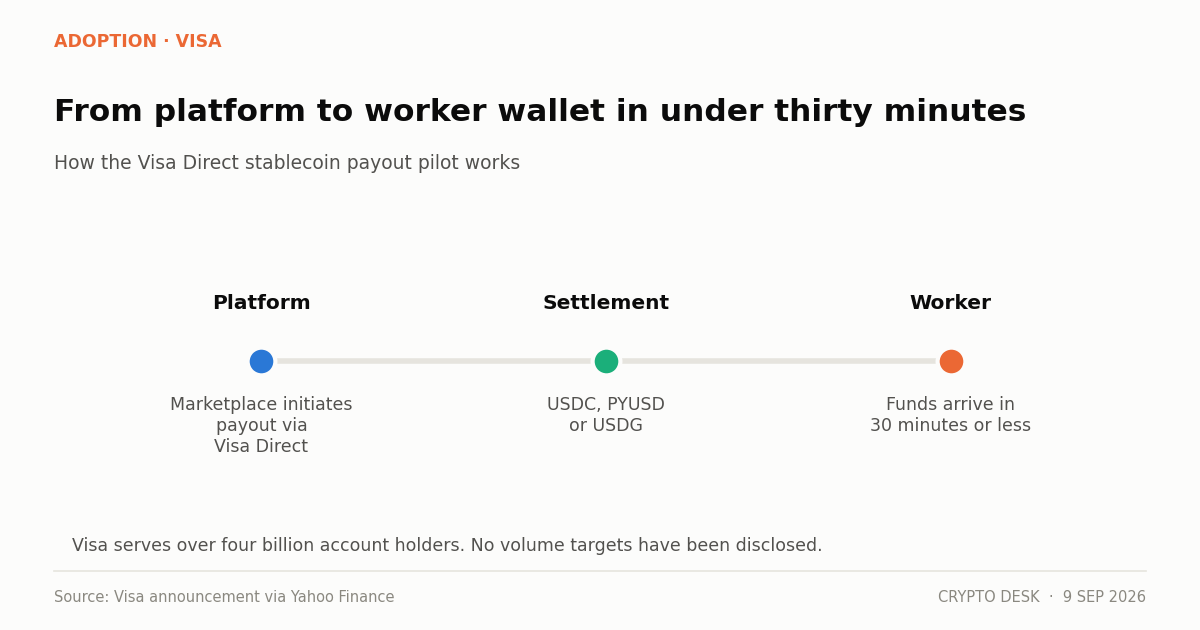
Visa stablecoin payouts let platforms pay gig workers, creators and freelancers into USDC, PYUSD or USDG wallets through Visa Direct, settling in thirty minutes or less.
On this page
- Why this is different from a crypto product
- The scale behind Visa stablecoin payouts
- Where the money is going
- The competitive picture
- What could go wrong
- What to watch
- The measure that would prove it works
Visa's stablecoin payout pilot lets marketplace platforms pay gig workers, creators and freelancers directly into stablecoin wallets through Visa Direct, with funds settling in thirty minutes or less.
Supported assets are Circle's USDC and the Paxos-issued PYUSD and USDG. The pilot opened in the United States with global expansion expected through 2026, and Visa is recruiting partner platforms.
Why this is different from a crypto product
The worker does not need to care that a stablecoin is involved.
That sentence is the whole strategy. Visa is not selling crypto exposure or asking anyone to hold a volatile asset. It is using stablecoins as settlement infrastructure behind a payout that arrives faster and reaches places a bank transfer does not.
Chris Newkirk, Visa's president of commercial and money movement solutions, framed it as "enabling truly universal access to money in minutes — not days — for anyone, anywhere in the world."
The comparison that matters is not against holding bitcoin. It is against an international wire, which takes days, costs meaningfully more, and requires the recipient to have a bank account.
The scale behind Visa stablecoin payouts
Visa serves over four billion account holders and more than 130 million participating merchants. It added stablecoin capabilities to Visa Direct in September 2025 and announced this payout pilot in November 2025.
No volume targets or transaction figures have been disclosed.
That absence is worth noting instead of glossing. A pilot with no published volume is a pilot, and payments companies announce many of those. What distinguishes this one is that the underlying rail already carries enormous volume — Visa Direct is an existing product with existing platform integrations, and stablecoin payouts are a new destination on it, not a new system.
Where the money is going
The venture funding data says this is where the sector's capital has moved. In the week of 31 August to 5 September, crypto startups raised $292.35 million across ten disclosed deals, and payments and banking infrastructure took $270.5 million — 93%.
The largest round was Félix, a WhatsApp-based stablecoin remittance platform, at $200 million: an $87 million equity round led by Andreessen Horowitz plus a $113 million credit facility from General Catalyst.
Visa's pilot and Félix's funding are the same bet made from opposite ends. One is an incumbent adding a rail; the other is a startup building a product on rails that already exist.
The competitive picture
Visa is not doing this alone, and it is not doing it only with Circle and Paxos.
Visa and Mastercard have joined a stablecoin platform backed by Stripe, with Coinbase reported to be considering participation. Separately, twenty-one banks including Goldman Sachs, Citi, Bank of America and UBS are forming a joint venture to issue a stablecoin, targeting a US dollar token in the first half of 2027. Qivalis has 37 European institutions behind a euro token, and Open USD counts more than 140 companies including Visa, Mastercard and BlackRock.
Every serious payments incumbent is now in at least one consortium. What they are competing for is not the token — it is who operates issuance, reserves and settlement.
What could go wrong
Regulatory timing. GENIUS Act enforcement begins January 2027, or 120 days after final rules, whichever is earlier. A pilot expanding globally through 2026 arrives just before the American rulebook binds.
Recipient friction. A stablecoin payout is only useful if the recipient can spend it. In markets with deep stablecoin acceptance that is solved; in others the worker still needs an off-ramp, and the thirty-minute settlement ends at a local exchange with its own delays and fees.
Which stablecoin wins. Supporting USDC, PYUSD and USDG hedges the question. It also means Visa is not committed to any of them, and neither are the platforms integrating.
What to watch
Named platform partners. Recruitment was in progress at announcement. Actual integrations are the milestone.
Any published volume. The single number that separates a pilot from a product.
Whether bank consortium tokens get added. If a 21-bank stablecoin launches in 2027 and Visa Direct supports it, the incumbents have closed the loop entirely.
Corridor coverage. Which countries the global expansion reaches determines whether this competes with remittance operators or only with domestic bank transfers.
The measure that would prove it works
Pilots get announced. Corridors get opened. What almost never gets published is cost per transaction against the incumbent.
A remittance from the United States to the Philippines costs, through traditional channels, several percent of the amount sent and takes days. A stablecoin payout settling in under thirty minutes is faster by an order of magnitude, and the fee comparison depends entirely on what the recipient pays to convert into local currency.
That last step is where most of the cost sits, and it is the step Visa does not control.
Until someone publishes end-to-end cost including the off-ramp, the thirty-minute figure describes one leg of a journey. It is a real improvement to that leg and an incomplete answer to the question a worker actually asks, which is how much of the money arrives.
About this report. Pilot details, supported stablecoins, settlement time, the Visa Direct timeline and the executive quote are from Visa's announcement as reported by Yahoo Finance. Visa's account holder and merchant figures are as stated there. No volume targets were disclosed. Venture funding figures are from Cryptonomist's week-of-5-September summary. Consortium details are from DailyCoin, PYMNTS and CoinDesk reporting.
Not investment advice. Announced pilots frequently do not reach general availability.
Frequently asked questions
How do Visa stablecoin payouts work?
Marketplace platforms pay workers directly into stablecoin wallets through Visa Direct, with funds settling in thirty minutes or less. Supported assets are Circle's USDC and the Paxos-issued PYUSD and USDG. The pilot opened in the United States with global expansion expected through 2026.
Does the recipient need to understand crypto?
No, and that is the design. Visa is using stablecoins as settlement infrastructure behind a payout that arrives faster and reaches places a bank transfer does not. The comparison is against an international wire, not against holding a volatile asset.
How large is Visa's reach?
Over four billion account holders and more than 130 million participating merchants. Visa added stablecoin capabilities to Visa Direct in September 2025 and announced this payout pilot that November. No volume targets have been disclosed.
What is the remaining friction?
The off-ramp. A stablecoin payout is only useful if the recipient can spend it, and in markets without deep stablecoin acceptance the worker still needs a conversion step with its own delays and fees.
Related reading
- Visa Mastercard Stripe Stablecoin Platform Takes Shape
- RWA Tokenization: BUIDL Past $2.5bn, Market Above $20bn
- Crypto VC Funding: 93% of $292M Went to Payments
- Stablecoin Market Cap $291bn With $76bn Daily Volume
Sources
- Visa launches stablecoin payout pilot for gig workers, creators and freelancers — Yahoo Finance
- Payment giants Stripe, Visa, Mastercard said to be among backers of soon-to-debut stablecoin platform — CoinDesk
- Crypto VC Funding Highlights $292M in Payments and Banking — Cryptonomist
- 21 Banks Are Not Just Building a Stablecoin. They're Fighting for Control — DailyCoin
Read next
- Tokenized Apple Stock Needs a Custodian. That Is Why HSBC and Standard Chartered Are In. Tokenized equities need bank-grade custody to reach institutions, which is why HashKey pairs its Hong Kong VA…
- BlackRock's Tokenized Fund Passed $2.5 Billion. The Interesting Number Is What It Is Used For. RWA tokenization has pushed BlackRock's BUIDL past $2.5bn as the wider tokenized real-world asset market move…
- Twenty-One Banks Are Building a Stablecoin. The Token Is Not What They Are Competing For. A bank stablecoin consortium including Goldman, Citi, BofA and UBS plans a USD token for H1 2027, competing w…