BlackRock's Tokenized Fund Passed $2.5 Billion. The Interesting Number Is What It Is Used For.
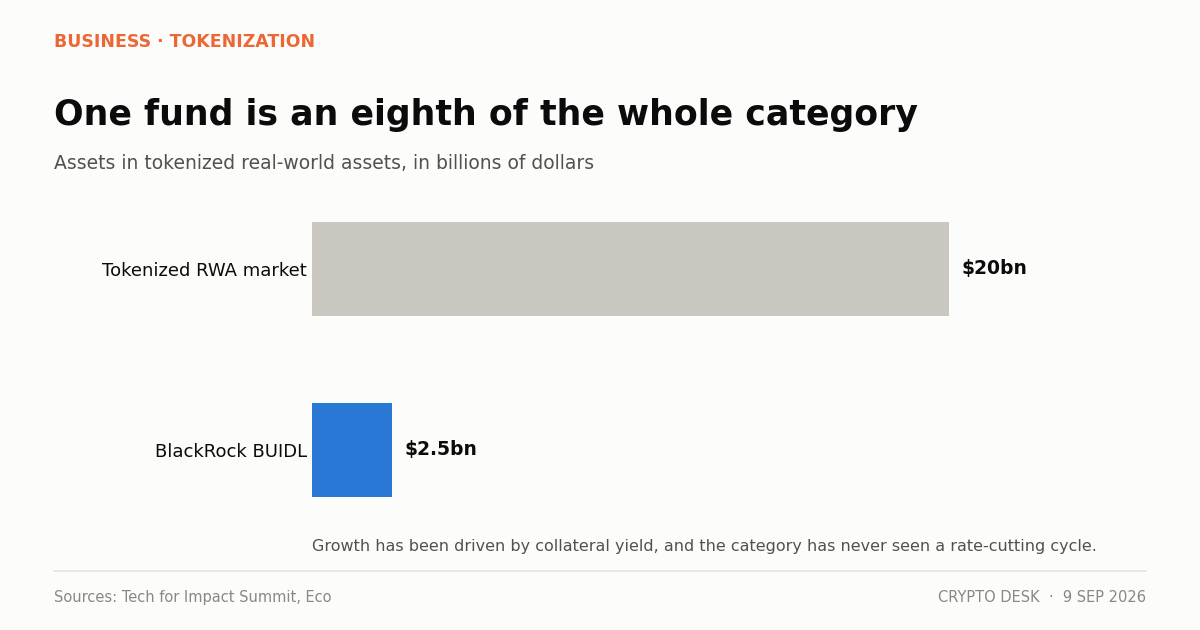
RWA tokenization has taken BlackRock's BUIDL past $2.5 billion, with the wider tokenized real-world asset market tracking toward $20 billion and above.
On this page
- What a tokenised Treasury fund actually is
- The use case that explains RWA tokenization growth
- Where it fits against stablecoins
- Who else is building it
- Three limits worth stating
- What to watch
- The question the category has not answered
BlackRock's BUIDL, a tokenised money market fund holding short-term US Treasuries, has passed $2.5 billion in assets. The wider tokenised real-world asset market has been tracking toward $20 billion and above.
Those figures are small next to the $103 billion in US spot bitcoin ETFs. They matter for a different reason: this is the first crypto product category whose growth has nothing to do with anyone's view on crypto.
What a tokenised Treasury fund actually is
It is a money market fund whose shares are recorded on a blockchain instead of in a transfer agent's database.
The underlying assets are short-dated US government debt. The yield is whatever Treasuries pay — currently meaningful, with the five-year at 4.5% and the 30-year at a cycle high of 5.26%. The risk is the credit of the United States and the operational risk of the fund structure.
What tokenisation changes is settlement and composability. Shares move in minutes instead of through a redemption cycle, they can move outside market hours, and they can be used programmatically as collateral by a smart contract that does not need to ask anyone's permission.
The use case that explains RWA tokenization growth
Collateral.
A DeFi protocol, a crypto market maker or a trading firm needs to post collateral. Historically that meant stablecoins, which pay the holder nothing while the issuer earns the reserve yield. Circle and Tether have built substantial businesses on precisely that spread.
A tokenised Treasury fund pays the yield to the holder instead. For anyone holding meaningful balances as collateral, the difference is direct revenue. At current rates, $1 billion of idle stablecoin collateral forgoes roughly $40 million a year that the issuer keeps.
That is why this category grew while crypto prices fell. It is not a bet on the market; it is a treasury management decision that happens to settle on a blockchain.
Where it fits against stablecoins
The stablecoin market sits near $291 billion. Tokenised RWAs are a fraction of that, and the two are converging from opposite directions.
Stablecoins are moving toward yield — whether issuers may pass returns to holders is one of four unresolved issues holding up the CLARITY Act before its 15 September Senate cloture vote, with banks arguing it constitutes deposit flight.
Tokenised funds already pay yield and are moving toward usability as payment instruments.
If stablecoins are permitted to pay yield, the categories largely merge. If they are not, tokenised Treasuries take the institutional collateral business and stablecoins keep transactional use. The legislative outcome decides a market structure question worth tens of billions.
Who else is building it
BlackRock is the largest but not the only participant. Ondo and Centrifuge are among the named platforms in this category, and the broader tokenisation push includes tokenised equities — where South Korea has already decided to apply capital gains tax, treating them as investable securities, and where OKX holds a Hong Kong Type 1 dealer licence allowing it to offer them alongside crypto.
Cari, a tokenised bank deposit company, raised $32.5 million funded entirely by seven US banks with no crypto fund participating.
That last detail is the tell. When incumbents fund the infrastructure directly, not through venture intermediaries, they are buying something they intend to use.
Three limits worth stating
$2.5 billion is small. BlackRock manages trillions. BUIDL is a successful experiment, not a business line that moves the parent.
The yield is the product. If rates fall substantially, the case for a tokenised Treasury fund over a stablecoin weakens considerably.
Composability is mostly potential. The programmatic collateral use case is real but concentrated among a small number of sophisticated participants. Retail has no reason to prefer this to a money market fund.
What to watch
Whether BUIDL's growth continues at falling rates. The clearest test of whether tokenisation or yield is doing the work.
The CLARITY Act's stablecoin yield provision. It determines whether these two categories merge or divide.
Tokenised equities volume. Korea's tax decision and Hong Kong's licensing have removed two obstacles. Volume is the next question.
Bank-funded infrastructure rounds. Seven US banks funding Cari directly is a template, not an outlier.
The question the category has not answered
Tokenised Treasuries have grown because rates are high. Nobody has tested what happens when they are not.
At current yields the case is obvious: hold collateral that pays 4% instead of collateral that pays nothing. At 1%, the yield advantage over a stablecoin narrows to something that may not justify the additional operational complexity, the fund structure's fees, or the redemption mechanics.
That is not a hypothetical concern. The category is roughly two years old and has existed entirely within a high-rate environment.
The counterargument is composability — programmatic collateral use that a stablecoin cannot provide regardless of rates. If that turns out to be the durable driver, the category survives a rate cycle. If yield was doing the work, it does not.
About this report. BUIDL's asset figure and the wider market trajectory are from tokenisation market analyses published by Tech for Impact Summit, Eco and WazirX. Treasury yield levels are from the Bitcoin News Digest of 6 September 2026. Stablecoin market size is from CoinGabbar's 9 September summary. The forgone-yield calculation is this desk's arithmetic at a 4% assumed rate. Cari's funding detail is from Cryptonomist.
Not investment advice. Tokenised fund structures carry operational risks distinct from their underlying assets.
Frequently asked questions
What is BlackRock's BUIDL fund?
A tokenised money market fund holding short-term US Treasuries, with shares recorded on a blockchain rather than in a transfer agent's database. It has passed $2.5 billion in assets within a tokenised RWA market tracking toward $20 billion.
Why are tokenized Treasuries growing while crypto prices fell?
Because the driver is collateral economics, not market direction. A stablecoin pays the holder nothing while the issuer earns the reserve yield. A tokenised Treasury fund pays that yield to the holder — worth roughly $40 million a year on $1 billion of otherwise idle collateral.
What does tokenization actually improve?
Settlement speed, trading hours and programmatic composability. Fractionalisation is already available through ordinary brokers. Of the four, composability — a fund share used as collateral by a smart contract without permission — is the only genuinely new capability.
What is the main risk to the category?
Rates. The case for a tokenised Treasury fund over a stablecoin rests substantially on yield, and the category has existed entirely within a high-rate environment. Whether composability alone sustains it through a rate cycle is untested.
Sources
- RWA Tokenization 2026: BlackRock BUIDL Passed $2.5B — Tech for Impact Summit
- Tokenized RWA Market Size 2026: $20B+ AUM Growth Trajectory — Eco
- RWA categories in 2026: tokenized Treasuries, equities, credit — MetaMask
- Crypto VC Funding Highlights $292M in Payments and Banking — Cryptonomist
Read next
- Tokenized Apple Stock Needs a Custodian. That Is Why HSBC and Standard Chartered Are In. Tokenized equities need bank-grade custody to reach institutions, which is why HashKey pairs its Hong Kong VA…
- Visa Will Pay Gig Workers in Stablecoins in Under Thirty Minutes. The Rails Are the Product. Visa stablecoin payouts let platforms pay gig workers and creators in USDC, PYUSD and USDG through Visa Direc…
- Twenty-One Banks Are Building a Stablecoin. The Token Is Not What They Are Competing For. A bank stablecoin consortium including Goldman, Citi, BofA and UBS plans a USD token for H1 2027, competing w…