Coinbase Wants to Be an Everything Exchange. Kraken Bought a Futures Broker. Binance Rented One.
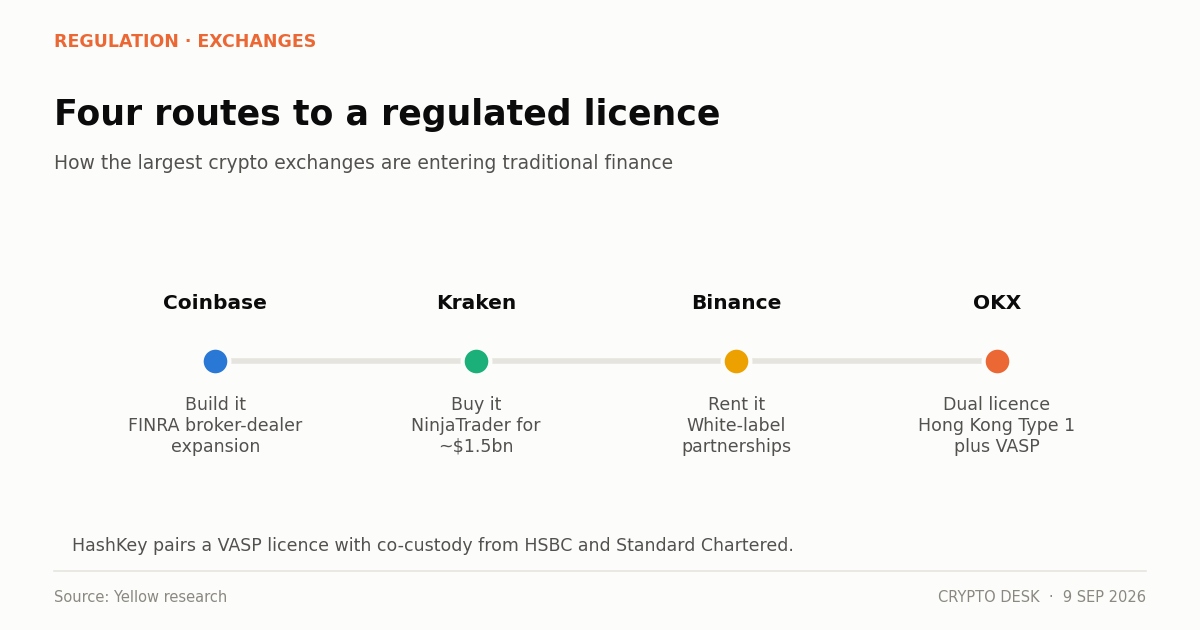
Crypto exchange licences are diverging into four routes: Coinbase is building one with FINRA, Kraken bought one for $1.5 billion, Binance rents partners, and OKX holds dual licences in Hong Kong.
On this page
- The four routes to crypto exchange licences
- Coinbase: build the licence
- Kraken: buy the licence
- Binance: rent the licence
- Hong Kong: the dual-licence experiment
- Europe's expedited pathway
- What it means for users
- What to watch
- The route that ages best
Five major crypto exchanges are pursuing regulated status in traditional finance, and they have chosen four different routes. The routes tell you more about each firm's strategy than any product announcement.
The four routes to crypto exchange licences
| Exchange | Route | Regulator | Timing |
|---|---|---|---|
| Coinbase | Broker-dealer expansion | FINRA, SEC | Q1 2026 onward |
| Kraken | Acquired a CFTC introducing broker | CFTC | 2025 purchase, Q1 2026 integration |
| Binance | White-label partnerships | Varies by jurisdiction | June 2026 onward |
| OKX | Type 1 dealer + VASP | Hong Kong SFC | Early 2026 |
| HashKey | VASP + securities custody partnership | Hong Kong SFC | Ongoing |
Coinbase: build the licence
Coinbase filed for broker-dealer expansion with FINRA and has described itself as an "everything exchange" — equities, foreign exchange, commodities, prediction markets and tokenized securities alongside crypto. It already holds a New York BitLicense and operates Coinbase Custody Trust Company.
Building a licence is the slowest route and produces the most durable position. A registered broker-dealer can do things no partnership arrangement can, and the compliance infrastructure becomes a competitive moat instead of a cost.
It is also the route only a US-listed company with a large balance sheet can realistically take.
Kraken: buy the licence
Kraken acquired NinjaTrader for approximately $1.5 billion, gaining a CFTC-registered introducing broker, 1.7 million users, and what the company described as advanced charting and order-routing capabilities.
At $1.5 billion for 1.7 million users, that is roughly $880 per user before assigning any value to the licence or the technology. Expensive by consumer fintech standards, and cheap relative to the years a de novo CFTC registration would take.
The acquired capability is futures, commodities and equity-index futures. That is a different customer from a spot crypto trader — more sophisticated, higher volume, and already accustomed to a regulated venue.
Binance: rent the licence
Rather than acquiring securities licences directly, Binance signed infrastructure-sharing agreements with licensed institutions across Pakistan, Turkey, Brazil and Southeast Asia, offering equity-adjacent products through partnerships.
This avoids direct regulatory burden and carries arbitrage risk. A white-label arrangement means the partner holds the licence and therefore the relationship with the regulator. If that regulator's view changes, the product stops, and Binance has built no standing of its own.
It is the fastest route to market and the least defensible position.
Hong Kong: the dual-licence experiment
OKX holds a Type 1 securities dealer licence alongside a Virtual Asset Service Provider licence — the first exchange globally with both in one jurisdiction. It can offer crypto trading, tokenized equities and Hong Kong-listed stocks on one venue.
HashKey Exchange operates under a VASP licence with co-custody infrastructure from HSBC and Standard Chartered.
That second detail is the one worth noting. Bank co-custody is what institutional allocators require and what most crypto venues cannot offer. Two of the largest banks in Asia providing it changes the counterparty conversation entirely.
Europe's expedited pathway
ESMA guidance from March 2026 enabled expedited pathways for MiCA-licensed crypto firms to obtain MiFID II investment firm status. OKX and four other exchanges are pursuing dual licensing, expected late 2026.
That is a regulator explicitly building a bridge between the crypto regime and the securities regime, which is the thing the United States has not managed. The CLARITY Act, which would allocate jurisdiction between the SEC and CFTC, faces a Senate cloture vote on 15 September requiring sixty votes.
What it means for users
Consolidation. Holding crypto, equities, futures and tokenized securities in one account with one custodian removes switching costs that currently split portfolios across three or four platforms.
The corollary is that decentralised exchanges cannot follow. Compliance infrastructure is precisely what a permissionless protocol does not have, and the customer segment that wants tokenized Apple stock in a tax-advantaged account with trusted custody is not a segment a DEX can serve.
That is a real divergence, and it has been arriving for two years.
What to watch
Whether Coinbase's FINRA expansion is approved, and its scope. Prediction markets and tokenized securities are the contentious parts.
Kraken's NinjaTrader integration metrics. 1.7 million users acquired is not 1.7 million users retained.
Whether any Binance partner regulator objects. The white-label model's failure mode is external and abrupt.
The first dual-licensed EU firm. Late 2026 is the expectation. Slippage would say the expedited pathway is not.
The route that ages best
Each of these strategies has a different failure mode, and they arrive on different timescales.
Coinbase's built licence is slow and expensive, and it cannot be taken away by a counterparty. Its risk is regulatory: an approval that does not come, or comes with conditions that gut the product.
Kraken's acquired licence transferred immediately and carries integration risk. Acquisitions of this size fail on culture and technology more often than on strategy, and 1.7 million acquired users is not 1.7 million retained users.
Binance's rented licence works today and rests entirely on partners. Its failure mode is external, abrupt, and outside its control.
Over a decade, the built licence almost certainly wins. Over the next two years, the rented one probably captures more revenue. Which matters depends on whether a firm is optimising for the cycle or for the franchise.
About this report. Licence types, regulators, timing, products and the NinjaTrader purchase price and user count are from Yellow's research on exchange bank-charter strategies. The per-user figure is this desk's calculation from the cited purchase price and user count. ESMA guidance timing is as cited in that research.
Not legal or investment advice. Licence applications and approvals are subject to regulator discretion.
Frequently asked questions
Which crypto exchanges are getting regulated licences?
Coinbase filed for broker-dealer expansion with FINRA. Kraken acquired NinjaTrader, a CFTC-registered introducing broker, for about $1.5 billion. OKX holds a Hong Kong Type 1 dealer licence plus a VASP licence. HashKey operates under a VASP licence with bank co-custody. Binance uses white-label partnerships.
What did Kraken buy with NinjaTrader?
A CFTC-registered introducing broker, 1.7 million users, and futures and equity-index futures capability, for approximately $1.5 billion. That works out to roughly $880 per user before assigning any value to the licence or the technology.
Why is Binance's approach different?
It signed infrastructure-sharing agreements with licensed institutions in Pakistan, Turkey, Brazil and Southeast Asia instead of acquiring securities licences directly. That is the fastest route to market and the least defensible position, since the partner holds the regulator relationship.
What does this mean for decentralised exchanges?
They cannot follow. Compliance infrastructure is precisely what a permissionless protocol lacks, and the customer wanting tokenized equities in a tax-advantaged account with trusted custody is not a segment a DEX can serve.
Sources
- Binance, Coinbase, And Kraken Are Becoming Full Banks — Yellow
- Asia's Stablecoin Acceleration: Japan Banks, Hong Kong Rules, and South Korea Tax Tokenized Assets — KuCoin
- CLARITY Act Hits a September 15 Deadline — Bitcoin Foundation
- Crypto Exchange Deadlines: Seven Dates Before August 31 — CryptoTicker
Read next
- The CLARITY Act Vote Lands on 15 September, and the Rate Market Is Louder Than the Senate The CLARITY Act vote on 15 September needs sixty Senate votes, but crypto is trading Fed hike odds above 60% …
- The SEC Asked 27 Questions About Crypto ETFs. The Answers Decide Whether Staking Funds Can Exist. The SEC's crypto ETF rules review closed to comment on 31 August. Release 33-11426 asks 27 questions on Rule …
- Japan's Banks Can Issue Stablecoins, Hong Kong Is Licensing, and Korea Will Tax Tokenized Stocks Asia stablecoin regulation is accelerating: Japan''s Payment Services Act lets banks issue, Hong Kong is lice…