Ether ETFs Break a Twelve-Day Streak on the Day Bitcoin Funds Had Their Best Session Since January
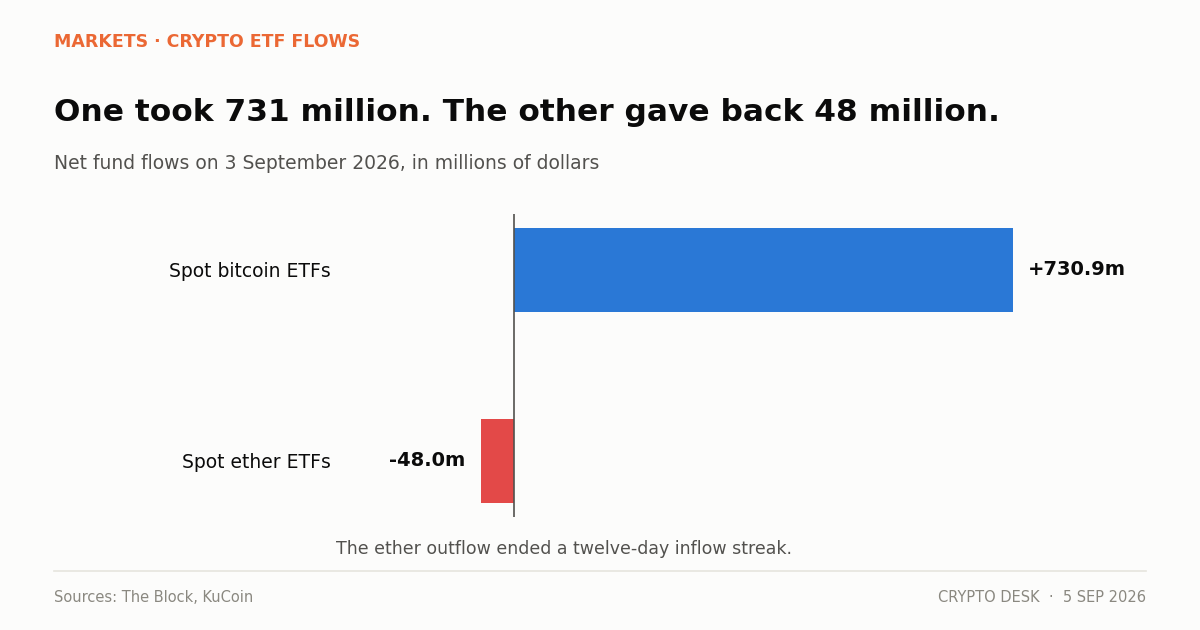
An ether ETF outflow of roughly $48 million on 3 September 2026 ended a twelve-day inflow streak, on the same session bitcoin funds posted their largest day since January.
On this page
- The streak that just ended
- Why rotation is the more likely explanation
- The prices did not follow the flows
- The twelve-month picture nobody should skip
- What has changed structurally for ether
- What to watch
- The summary
- The ratio nobody publishes
Spot ether ETFs recorded roughly $48 million of net outflows on 3 September, ending twelve consecutive days of inflows. On the same session, US spot bitcoin ETFs took in $730.9 million — their largest day since 14 January.
A $48 million outflow is small. The timing is what makes it interesting.
The streak that just ended
Ether products had been quietly outperforming for weeks. The twelve-day inflow run pushed ether ETF assets to approximately $15.6 billion, and ether's price gained 35% over the month against bitcoin's 28.1%.
That is a genuine reversal of the pattern that held through most of 2025 and early 2026, when ether products struggled for attention and bitcoin absorbed nearly all of the institutional flow. Twelve consecutive positive sessions is not noise.
Breaking it on the same day bitcoin posts its biggest inflow since January suggests something specific: rotation, not exit.
Why rotation is the more likely explanation
Consider what happened that day. Fed Governor Christopher Waller signalled support for holding rates if inflation continues cooling, and September hike odds fell from about 63% to roughly 50%.
That is a macro catalyst. It applies to bitcoin and ether identically — both are long-duration, non-yielding assets whose valuation is sensitive to the discount rate. A dovish surprise should lift both.
Instead one took $730.9 million and the other gave back $48 million. When a shared catalyst produces opposite flows, the usual explanation is that allocators are choosing between the two instead of sizing exposure to the asset class.
The concentration data supports it. BlackRock's IBIT took roughly $454 million of the bitcoin total — about 62%. IBIT is the wrapper institutions use for size. As BTC Markets analyst Rachael Lucas put it: "That is the wrapper institutions use for size, which points to allocation flow rather than tactical positioning."
An institution acting on a macro signal, choosing the largest and most liquid crypto exposure available, is exactly the behaviour that produces this flow split. Ether becomes the funding source instead of the target.
The prices did not follow the flows
Here is the part that complicates the story. On 4 September, ether rose 4.9% while bitcoin rose 5.1%. Over the month ether is up 35% against bitcoin's 28.1%.
So flows rotated toward bitcoin while prices moved in near lockstep and ether's monthly performance stayed ahead.
That gap tells you something about how much of ether's price is set by ETF flows: not much. Ether ETF assets are approximately $15.6 billion against bitcoin ETF net assets around $99 billion. Ether has a far larger share of its float held directly, staked, or locked in DeFi protocols than bitcoin does, and its price responds to a wider set of inputs.
For bitcoin, the ETF complex is close to the marginal buyer. For ether, it is one buyer among several.
The twelve-month picture nobody should skip
| Bitcoin | Ether | |
|---|---|---|
| Price, 4 Sept 2026 | $81,240.29 | $2,522.14 |
| Month | +28.1% | +35.0% |
| Year | -27.3% | -43.6% |
| All-time high | $126,198.07 (Oct 2025) | $4,953.73 (Aug 2025) |
| Below high | 35.6% | 49.1% |
Ether is down 43.6% over twelve months and sits 49.1% below its August 2025 record. A strong month and a twelve-day inflow streak have not changed that.
Anyone reading the recent outperformance as ether catching up should note that it is catching up from considerably further behind. Ether needs to roughly double to reclaim its high. Bitcoin needs about 55%.
What has changed structurally for ether
Two things are worth tracking beyond the flow numbers.
The staking question. A spot ether ETF that cannot stake its holdings forgoes the network's staking yield. An investor holding ether directly and staking earns that; an ETF holder does not. Over a multi-year hold this compounds into a meaningful performance gap against the underlying asset. How US regulators treat staking inside a registered fund is the single largest unresolved factor in these products' competitiveness.
The Glamsterdam upgrade. Ethereum's next mainnet upgrade targets Q4 2026, bringing enshrined proposer-builder separation and block-level access lists — the latter enabling a gas limit increase from 60 million toward 200 million. It is substantive infrastructure work with a multi-year payoff, and protocol upgrades have historically been poor short-term price catalysts.
Neither will show up in a daily flow number. Both matter more than one.
What to watch
Whether the ether streak resumes. Twelve days was the standout statistic of late August. A return to inflows within a week would confirm the $48 million was a rotation artefact, not a turn.
The ratio, not the absolutes. Bitcoin ETF flows divided by ether ETF flows, tracked weekly, is a cleaner read on relative institutional preference than either series alone.
Whether bitcoin's flows hold. A $730.9 million day driven by a Fed governor's comments met a contradicting jobs report the following morning — 162,000 payrolls against a 53,000 forecast, pushing hike odds back to roughly 59%. Flows that arrive on a macro read can leave on one.
Staking approvals. The change that would most alter the ether product's value proposition.
The summary
A $48 million outflow against a twelve-day streak and $15.6 billion in assets is a small number that would not normally merit coverage. It merits it here because of what it sat next to: the largest bitcoin ETF day since January, driven by the same catalyst, concentrated in the wrapper institutions use when they are making allocation decisions rather than trades.
One session is not a trend. But if allocators are choosing bitcoin over ether when a macro signal arrives, that is a pattern worth catching early.
The ratio nobody publishes
There is a simple derived number that would tell readers more than either flow series alone: bitcoin ETF net flow divided by ether ETF net flow, tracked as a rolling average.
When that ratio compresses, allocators are treating the two as a single asset-class exposure and sizing both. When it expands, they are choosing. And when it goes negative on one side, as it did on 3 September, one is funding the other.
On the raw figures for that session, bitcoin took $730.9 million while ether gave back $48 million. The relationship between those two numbers is the information; the individual prints are noise around it.
Over August the relationship was much closer. Bitcoin funds gathered roughly $3.5 billion for the month while ether products ran an eleven- then twelve-day inflow streak that reached about $1 billion over one seven-day stretch. That is a ratio of roughly three to one, against a market-capitalisation ratio considerably wider than that — which is to say ether was punching above its weight for most of August.
One session reversed it. Whether that persists is the question.
About this report. Ether ETF flow figures are from KuCoin's 4 September market report. Bitcoin ETF figures and the IBIT breakdown are from The Block's reporting of 3 September data. Price data is from Yahoo Finance at 7:21 a.m. ET on 4 September 2026. Percentages below all-time highs are this desk's calculations from the cited prices.
Not investment advice. Daily flow figures are provisional and subject to revision.
Frequently asked questions
How big was the ether ETF outflow?
Roughly $48 million on 3 September 2026, ending twelve consecutive days of net inflows that had pushed ether ETF assets to approximately $15.6 billion.
Why did bitcoin and ether ETF flows diverge?
Both respond to the same macro catalyst, so opposite flows on a shared signal usually mean allocators are choosing between them. Bitcoin funds took $730.9 million the same day, with about $454 million into BlackRock's IBIT.
Related reading
- IBIT Inflows Reach $117M as Bitcoin ETF Streak Extends
- XRP ETF Inflows Hit $1.68bn Across Eight Green Weeks
- ETFs vs Corporate Treasuries: Two Very Different Bids
- Zcash Price Up 38.5% in a Week as ZCSH ETF Draws Money
Sources
- Crypto Daily Market Report – September 4, 2026 — KuCoin
- US bitcoin ETFs report the largest inflow day since January, worth $731 million — The Block
- Bitcoin and ethereum prices today, Friday, September 4, 2026 — Yahoo Finance
- Ethereum Glamsterdam: Upgrade Overview and EIPs Explained — Everstake
Read next
- Sentiment Has Fallen for Three Sessions While Price Did Nothing. That Is the Momentum Draining Out. The crypto Fear and Greed Index slipped to 66 from 69 and 71 across three sessions while bitcoin barely moved…
- Stablecoins Turned Over $76 Billion in a Day on a $291 Billion Base The stablecoin market cap sits at $291.3 billion with $76.11 billion of daily volume — a turnover ratio no ot…
- IBIT Took $117 Million on a Friday Nobody Was Watching IBIT inflows of over $117 million on Friday extended a bitcoin ETF run of three consecutive positive weeks an…