Solana and XRP ETFs Both Near $1.5 Billion. The Altcoin Fund Era Is No Longer Theoretical.
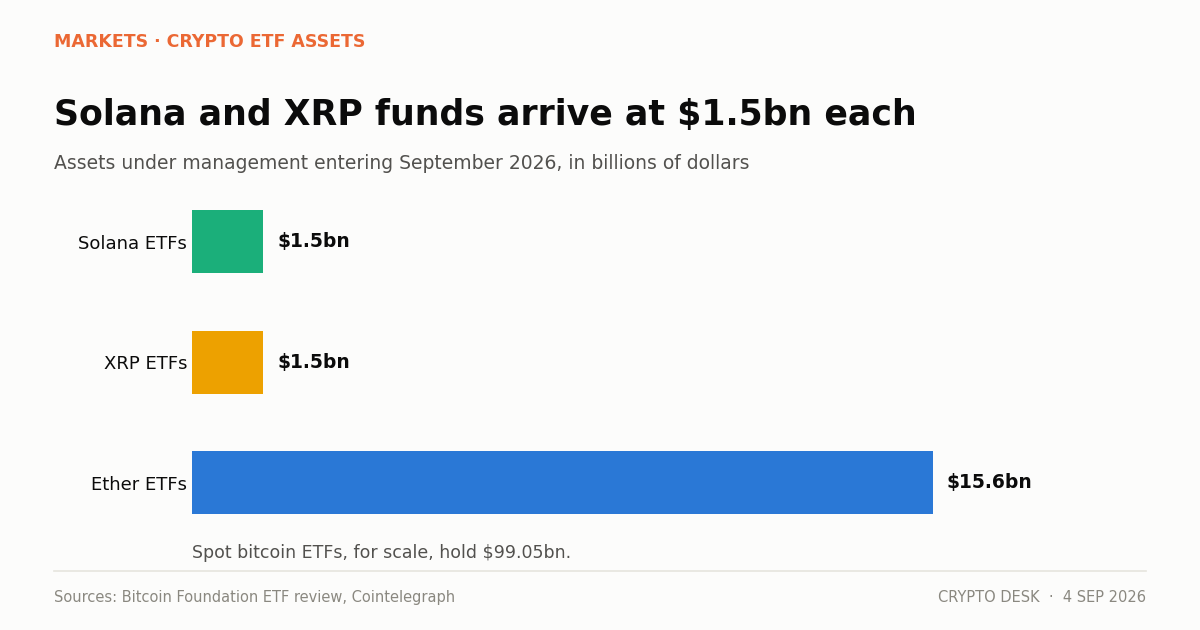
Solana ETF assets approached $1.5 billion entering September 2026, matched almost exactly by XRP funds, with one XRP product alone passing $500 million.
On this page
- Where the money actually is
- The pattern in the inflows tells you who is buying
- Why this took so long
- What a Solana ETF does and does not buy
- The staking question
- Reading these numbers honestly
- What to watch
- The cost of the wrapper
Two years ago the question was whether the SEC would ever approve a spot ETF for anything other than bitcoin. Entering September 2026, Solana funds hold close to $1.5 billion and XRP funds hold roughly the same. One XRP product on its own has passed $500 million.
These are not the numbers that reshape a market. They are the numbers that prove a channel exists.
Where the money actually is
Solana products approached $1.5 billion in combined assets by late August, built on cumulative inflows of about $1.3 billion. August alone contributed over $170 million in net flows.
XRP products entered September near $1.5 billion in total assets. August inflows exceeded $150 million, concentrated heavily in the week of 24 to 28 August, which alone drew around $110 million. Bitwise's XRP fund crossed $500 million in assets, making it the largest single product in the category.
For scale, spot ether ETFs hold approximately $15.6 billion and spot bitcoin ETFs hold $99.05 billion. The altcoin funds are roughly one-tenth of ether's footprint and about one-sixty-sixth of bitcoin's.
The pattern in the inflows tells you who is buying
Solana's $170 million and XRP's $150 million arrived over a month in which both assets rallied along with the rest of the market. That is unsurprising. What is more interesting is the concentration.
XRP's August flows clustered into a single week. Roughly 73% of the month's inflows landed between 24 and 28 August. Flow that lumpy usually means a small number of large tickets instead of a broad retail bid — a platform adding the fund to an approved list, or one or two allocators establishing a position.
Solana's flows were steadier across the month, which reads more like ongoing accumulation. Neither pattern is better; they describe different buyer bases.
Why this took so long
The regulatory sequence explains the timing. Spot bitcoin ETFs launched in January 2024 after a court loss forced the SEC's hand. Ether followed later that year. Everything else waited on a workable process for listing commodity-based trust shares without a bespoke rule filing for each asset.
Once that process settled, the pipeline moved quickly — and it kept moving through 2026 into other assets beyond SOL and XRP. The Commission's August proposal of Regulation Crypto Assets, its first purpose-built offering framework for tokens, points in the same direction: an agency building repeatable processes instead of adjudicating one asset at a time.
What a Solana ETF does and does not buy
What it does. It creates a regulated access point for money that cannot or will not hold tokens directly. Registered investment advisors operating under fiduciary standards, retirement accounts, and institutions with custody restrictions can all buy an ETF share when they cannot buy SOL on an exchange. That constituency is large and it was previously locked out.
It also creates a daily, public, auditable flow number for each asset. Before these products, demand for SOL from US institutions was invisible. Now it prints every afternoon.
What it does not. It does not meaningfully change the float of either asset. Solana's circulating supply and XRP's are both large enough that $1.5 billion of held assets is a small fraction of market capitalisation. Anyone arguing that ETF demand alone will drive a supply squeeze in these assets is doing arithmetic that does not work.
It also does not confer the legitimacy premium bitcoin received. Bitcoin's ETF launch was a singular event with years of anticipation. The tenth altcoin ETF launch is a product listing.
The staking question
The most consequential unresolved issue for Solana products specifically is staking.
A spot SOL ETF that does not stake its holdings forgoes the network's staking yield, which has run in the region of 6% to 7% annualised. An investor holding SOL directly and staking it earns that; an investor holding the ETF does not, unless the fund is permitted to stake. Over a multi-year hold, that gap compounds into a meaningful performance difference against the underlying asset.
The same logic applies to ether products. How US regulators ultimately treat staking inside a registered fund wrapper will do more to determine the long-run competitiveness of these products than any flow figure this quarter.
Reading these numbers honestly
There is a temptation, when a new product category reaches a round number, to treat it as a validation of the underlying asset. It is not.
ETF assets measure the demand for regulated exposure. They do not measure network usage, developer activity, transaction throughput or any fundamental property of Solana or the XRP Ledger. A fund can gather assets while its underlying network stagnates, and a network can grow while nobody buys its ETF.
What the flow data does measure well is a specific, previously unobservable thing: how much American institutional money wants exposure to non-bitcoin digital assets through a compliant vehicle. As of early September, the answer is about $3 billion across SOL and XRP combined, growing at roughly $300 million a month.
That is a real number. It is also, at current pace, roughly one month of bitcoin ETF flows spread across two assets over a much longer period.
What to watch
Whether September flows hold. August was a strong month for the whole complex, including a $3.5 billion bitcoin ETF haul. The test is whether altcoin products keep gathering when bitcoin's flows turn negative, as they did in the first week of September.
Fee competition. Expense ratios in the bitcoin ETF category collapsed within eighteen months of launch. The same dynamic will arrive here, and it will determine which issuers survive.
Staking approvals. The single biggest potential change to the value proposition of a Solana or ether fund.
Consolidation. Not every product in a category this crowded reaches viable scale. Closures are normal and should not be read as a verdict on the asset.
The cost of the wrapper
There is a second-order point worth making about all of these products, and it applies to bitcoin funds as much as to the newer ones.
An ETF share is a claim on an asset held by a custodian, wrapped in a fund structure that charges a management fee every year. Over a one-year hold at 20 to 50 basis points, that fee is immaterial next to the volatility of the underlying. Over a ten-year hold it compounds into a meaningful drag, and for a self-custodying holder it is a drag that simply does not exist.
That trade is worth it for an institution that cannot custody tokens, for a retirement account that cannot hold them at all, and for anyone who values not being responsible for a private key. It is a poor trade for someone who was going to hold the asset directly anyway and is choosing the ETF for convenience.
Neither choice is wrong. But the fee is a real cost of the wrapper, and it is rarely mentioned in coverage of fund inflows.
About this report. Asset and flow figures are drawn from the Bitcoin Foundation's September ETF review and coverage of Bitwise's XRP product. Comparative bitcoin and ether figures come from Cointelegraph's daily ETF reporting. Percentages calculated by this desk from the underlying figures are labelled as such.
Not investment advice. ETF assets under management describe fund size, not asset quality.
Sources
- Crypto ETFs Enter a New Phase in September — Bitcoin Foundation
- 6 Best Altcoins To Buy Now as Bitwise's XRP ETF Tops $500M — openPR
- Altcoin ETFs 2026: Solana, XRP, Worldcoin & What's Coming Next — BlockchainReporter
- Spot Bitcoin ETFs Add $314M as August Inflows Top $3B — Cointelegraph
Read next
- Sentiment Has Fallen for Three Sessions While Price Did Nothing. That Is the Momentum Draining Out. The crypto Fear and Greed Index slipped to 66 from 69 and 71 across three sessions while bitcoin barely moved…
- Stablecoins Turned Over $76 Billion in a Day on a $291 Billion Base The stablecoin market cap sits at $291.3 billion with $76.11 billion of daily volume — a turnover ratio no ot…
- IBIT Took $117 Million on a Friday Nobody Was Watching IBIT inflows of over $117 million on Friday extended a bitcoin ETF run of three consecutive positive weeks an…