600 Bitcoin Mined in March 2010 Just Moved. Nobody Knows Who Owns Them.
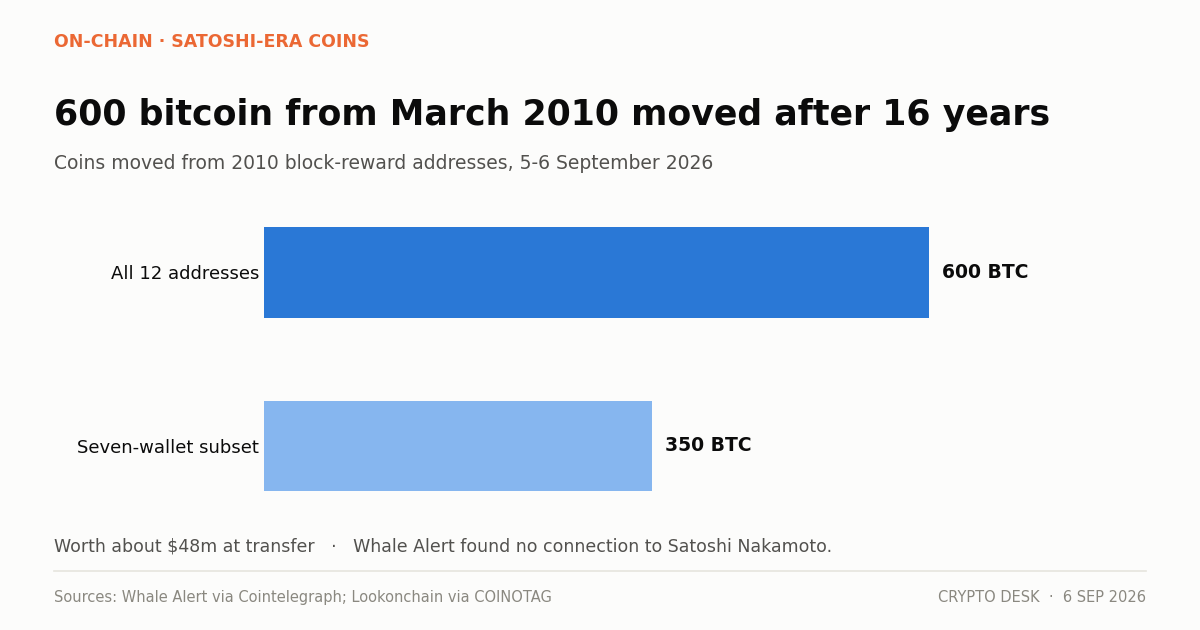
Satoshi-era bitcoin moved again this week: 600 BTC from twelve March 2010 block-reward addresses shifted after more than sixteen years, worth roughly $48 million.
On this page
- Why Satoshi-era bitcoin gets attention when it moves
- The test transaction is the interesting detail
- What it does not mean
- The supply question underneath
- Why the price context matters here
- What to watch
- The one thing worth tracking after an event like this
- A small correction to how this gets reported
Between 5 and 6 September, 600 bitcoin moved out of twelve addresses. Every coin was a block reward mined in March 2010, when the subsidy was 50 BTC per block. The coins had not moved in more than sixteen years. At the time of transfer they were worth roughly $48 million.
Whale Alert investigated and found no link to Satoshi Nakamoto. A spokesperson was direct: "None of the blocks can be connected to Satoshi based on our research."
Lookonchain separately flagged seven of those wallets moving 350 BTC, worth about $28 million, after 16.5 years.
Why Satoshi-era bitcoin gets attention when it moves
Bitcoin's earliest blocks were mined by a very small number of people on ordinary CPUs. In March 2010 there was no exchange with meaningful volume, no price to speak of, and a network small enough that a laptop could win blocks regularly.
Coins from that period are therefore in one of three states. Held by an early participant who never sold. Lost, because a hard drive failed or a key was discarded when the coins were worth nothing. Or belonging to Satoshi, who is estimated to have mined roughly a million coins across 2009 and 2010 and has never moved any of them.
Any movement from that era tests which category a given set of coins was in, and the answer here is the first one. Someone had the keys, kept them for sixteen and a half years, and used them this month.
The test transaction is the interesting detail
Whale Alert noted that one block reward transferred before the others, in a pattern consistent with a test transaction preceding the remaining transfers.
That is a small observation with real information in it. Someone moving coins they have held since 2010 is dealing with a wallet format and key management approach that predates almost every tool in use today. Sending one reward first, confirming it arrives, then moving the rest is exactly what a careful person does when they are not certain their key derivation still works.
It suggests deliberate, competent action by an owner, not a compromise. A thief with the keys has less reason to be careful and more reason to be fast.
What it does not mean
Three readings circulate whenever this happens, and all three are weaker than they appear.
"Satoshi is moving coins." Whale Alert checked and found no connection. Satoshi mined during this period, but so did others. Early-era coins are not Satoshi coins by default, and treating them as such has produced a long history of false alarms.
"An old whale is selling." A movement is not a sale. Coins can move to a new wallet for security reasons, to a custodian, to an heir, into an estate, or as part of a collateral arrangement. Determining whether these coins reached an exchange requires following them further, and the initial transfer says nothing on its own.
"600 BTC will crash the market." Bitcoin's daily spot volume across major venues runs into the billions. Six hundred coins at roughly $77,000 is around $46 million. If sold gradually it would be invisible; if dumped in one block it would move price for minutes.
The supply question underneath
The genuinely interesting thing about this event is what it says about a number nobody can measure precisely: how much bitcoin is permanently lost.
Estimates commonly range from three to four million coins — somewhere between 15% and 20% of the 21 million cap. Those estimates are built largely on the assumption that coins untouched for a very long time are gone.
Every time sixteen-year-old coins move, that assumption weakens slightly. It establishes that at least some of the dormant supply is dormant by choice rather than by accident, and that the effective float is larger than the lost-coin estimates imply.
Six hundred coins do not change the estimate materially. But this is not an isolated event — dormant-era movements have recurred through 2026 — and each one is evidence that the "lost forever" bucket is somewhat smaller than the models assume.
There was a related story the same week: a British investor recovered 61 BTC, worth roughly $4.5 to $5 million, connected to the defunct Intersango exchange. Also coins presumed gone. Also not gone.
Why the price context matters here
Bitcoin closed the week at $77,024, below its 50-week moving average of $80,300, after peaking at $82,281 on 3 September.
Someone who mined 50 BTC in March 2010 acquired coins that had no established market price. Holding them to today produced a return that has no meaningful percentage expression. Choosing to act now, at a price 39% below the October 2025 record of $126,198.07 instead of at that record, is a decision worth noting even if the reason is unknowable.
The most likely explanations are prosaic and have nothing to do with price: an estate, a custody migration, a tax event, or a security concern about an aging key setup. Those are the reasons long-held assets usually move.
What to watch
Where the coins go next. Movement to an exchange deposit address would indicate an intent to sell. Movement to a fresh cold wallet or a known custodian would not.
Whether more 2010 wallets follow. Clusters of dormant movement sometimes indicate one entity consolidating holdings across multiple old addresses.
Whether anyone claims it. Early holders occasionally identify themselves. Most do not.
The one thing worth tracking after an event like this
Follow the coins.
On-chain analysis has one genuine advantage over every other form of market research: the ledger is public and the addresses are traceable. Whether these 600 coins reach an exchange deposit address is knowable within days, and it is the only fact that distinguishes a custody migration from a sale.
The pattern to watch is specific. Coins moving to a fresh address and sitting there indicate a wallet migration or an estate transfer. Coins moving through two or three intermediate addresses and then landing at a known exchange cluster indicate preparation to sell. Coins moving to an address associated with a regulated custodian indicate an institution taking possession.
Each of those has a different market implication and each is visible without any inference.
What is not knowable from the chain is why. That part will be speculated about regardless, and the speculation will be worth exactly what speculation about the motives of an anonymous party usually is.
A small correction to how this gets reported
Coverage of dormant-coin movements almost always leads with the dollar value and the Satoshi question. Both are the least informative parts.
The dollar value is a function of today's price and says nothing about the mover. The Satoshi question was answered here by Whale Alert in the negative, as it usually is.
What carries information is the test transaction, the age of the addresses, and where the coins go next. Those are the three things worth reading, and they are typically in the last paragraph if they appear at all.
About this report. Movement details, address count, mining date and valuation are from Cointelegraph's reporting of Whale Alert data, with the 350 BTC / seven-wallet subset from Lookonchain via COINOTAG. The Intersango recovery is noted in the Bitcoin News Digest of 6 September 2026. Lost-coin estimates are widely cited industry ranges and are not precise measurements.
Not investment advice. On-chain movements are ambiguous by nature and do not indicate intent.
Frequently asked questions
How much Satoshi-era bitcoin moved?
600 BTC from twelve addresses, all March 2010 block rewards of 50 BTC each, worth roughly $48 million at transfer. Lookonchain separately identified seven of those wallets moving 350 BTC after 16.5 years.
Was it Satoshi Nakamoto?
No. Whale Alert investigated and stated that 'none of the blocks can be connected to Satoshi based on our research'. Satoshi mined during this period, but so did others, and early-era coins are not Satoshi coins by default.
Does a movement mean the coins are being sold?
Not necessarily. Coins can move for security reasons, to a custodian, to an heir, into an estate, or as collateral. Only following them to an exchange deposit address would indicate intent to sell.
Sources
- 600 BTC Mined in 2010 Moves After 16 Years of Dormancy — Cointelegraph
- Seven dormant Satoshi-era Bitcoin wallets move $28 million after 16 years — CoinTurk
- Dormant 2010 Bitcoin Miners Move 350 BTC Worth $28M After 16.5 Years — COINOTAG
- Bitcoin News Digest, September 6, 2026 — Mike Richardson
Read next
- Sentiment Has Fallen for Three Sessions While Price Did Nothing. That Is the Momentum Draining Out. The crypto Fear and Greed Index slipped to 66 from 69 and 71 across three sessions while bitcoin barely moved…
- Stablecoins Turned Over $76 Billion in a Day on a $291 Billion Base The stablecoin market cap sits at $291.3 billion with $76.11 billion of daily volume — a turnover ratio no ot…
- IBIT Took $117 Million on a Friday Nobody Was Watching IBIT inflows of over $117 million on Friday extended a bitcoin ETF run of three consecutive positive weeks an…