Crypto news today, 12 November 2026: bitcoin breaks Tuesday's low and drops to its lowest since 20 August on the day Nvidia announces its CEO's resignation; Binance says its hack losses are covered
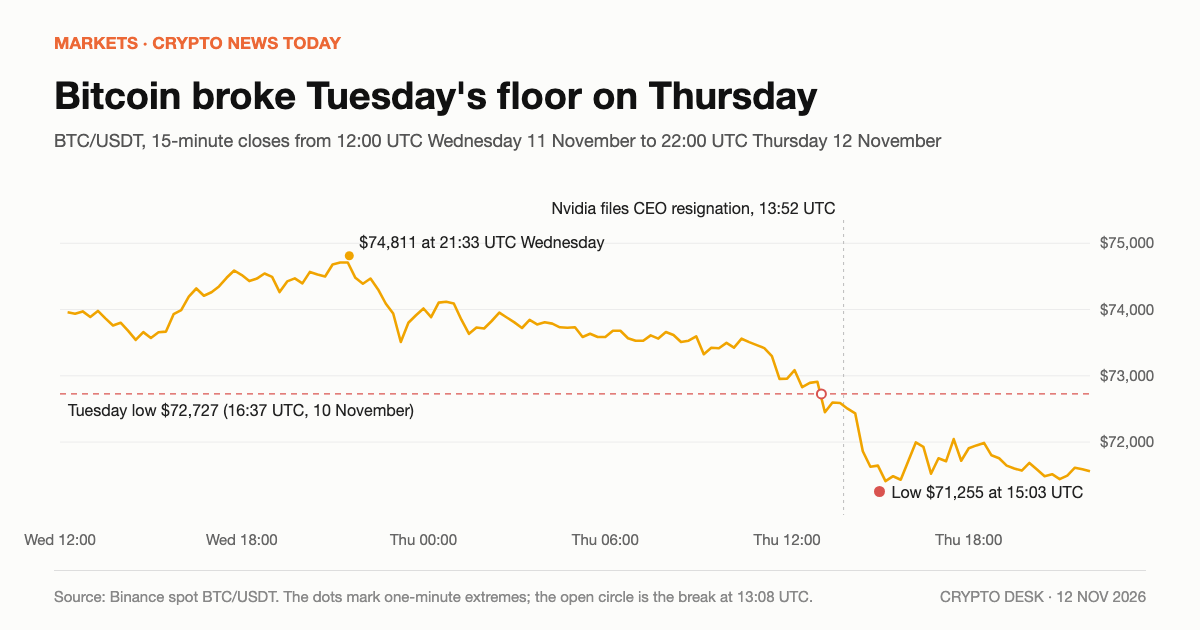
Bitcoin spent Wednesday night going nowhere and Thursday afternoon falling through the floor it had found on Tuesday. On Binance it touched $71,255.02 at 15:03 UTC, a price it had not traded at since 20 August, and ether dipped under $2,000. The drop landed on a crowded US morning. Nvidia announced that Jensen Huang had resigned as chief executive, and Treasury yields jumped on the bond market's first day back after Veterans Day, though most of the yield move came after bitcoin's low. Binance said it had finished replacing the assets lost in its hack, and the Justice Department said it can seize or restrain more than $1.2 billion of the stolen crypto. MSCI confirmed that Strategy leaves its main indexes at the end of the month. Louisiana sued Kalshi and Polymarket along with other prediction-market operators, and Trezor found spy boards inside three of its wallets sold by one reseller.
- Bitcoin price today: Tuesday's floor gave way, and BTC traded at its lowest since 20 August
- Nvidia announced its chief executive's resignation, and bond yields jumped after the Veterans Day break
- Ether went under $2,000, and SOL, XRP and BNB hit three-month lows too
- The bitcoin ETFs lost $300 million on Wednesday, their fifth day of outflows
- MSCI is dropping Strategy from its main indexes at the 30 November close
- Binance says it has replaced everything lost in the hack, but 83 withdrawal routes are still shut
- The US can seize or restrain $1.2 billion of the stolen Binance crypto
- Louisiana sued the prediction markets, and Kalshi asked a federal court to stop the state
- Trezor confirmed spy boards inside three Safe 5 wallets sold by CryptoBilis
- Gemini's revenue fell 19% in the third quarter, and a report says KAST bought its European arm
1. Bitcoin price today: Tuesday's floor gave way, and BTC traded at its lowest since 20 August
The evening before gave no warning. BTCUSDT on Binance peaked at $74,811.45 at 21:33 UTC on Wednesday, eased to $73,480 by 23:14 UTC and then spent the night and the European morning between $73,260 and $74,217. The slide started around 11:15 UTC, when bitcoin went from $73,418 to $72,789 in 37 minutes.
Tuesday's low of $72,727.27, which our Wednesday edition said had not been retested, gave way at 13:08 UTC. Bitcoin was under $72,000 at 14:21 UTC and under $71,500 at 14:54 UTC, and it reached its afternoon low of $71,255.02 at 15:03 UTC, 4.75% below Wednesday evening's high. Coinbase's BTC-USD book went a little lower, to $71,151.01, in the five-minute candle from 15:00 UTC. Until Thursday, Binance's daily candles showed nothing lower since 20 August, when bitcoin fell as far as $68,902.22, and its hourly data last showed a trade under $71,255 in the 13:00 UTC hour of that day.
The bounce was short. Bitcoin got back to $72,223.80 in the 16:00 UTC quarter-hour, then drifted lower again. At 22:11 UTC it stood at $71,522.50, down 4.02% over 24 hours. After this roundup's window closed it slipped a little further, to $71,113.06 at 23:23 UTC, the low of Binance's 12 November daily candle; the live crypto prices board has it from there.
Leveraged longs took most of the damage. Bitcoin.com, citing CoinGlass's 24-hour count at 14:33 UTC, put liquidations above $656 million, more than $555 million of them longs, and said about $226.5 million went around 13:15 UTC, minutes after the break of Tuesday's low. The largest single order was a $31.09 million BTC-USD long on Hyperliquid, in both Bitcoin.com's and PANews's reading of CoinGlass. CryptoSlate's later count, published at 19:20 UTC, was $727 million across 125,731 traders. These totals cover different 24-hour windows, so they can't be added together.
The whole market was worth $2.413 trillion at 22:07 UTC by CoinGecko's count, 59.5% of it in bitcoin. Alternative.me's Fear & Greed Index slipped a point, to 28.
2. Nvidia announced its chief executive's resignation, and bond yields jumped after the Veterans Day break
Nvidia said on Thursday that Jensen Huang had resigned as president, chief executive and board member with immediate effect. Chief financial officer Colette Kress becomes interim CEO and Harvey C. Jones the company's first board chair. The release gives no reason. SEC EDGAR accepted the company's 8-K at 13:52 UTC, and TechCrunch, reading the filing, says the board accepted the resignation on Wednesday.
Bitcoin had broken Tuesday's low about 45 minutes before that filing, so the news can't account for the start of the fall. Its steepest stretch, from $72,500 at 14:00 UTC to $71,255 at 15:03 UTC, came after the filing and around the 14:30 UTC opening of US stocks. FXStreet attributed the crypto drop to the sell-off in AI stocks that followed Huang's exit, while Bitcoin.com listed the leadership change as one possible contributor among others. Nvidia's own shares were already 8.5% lower in premarket trading at 13:45 UTC, seven minutes before the 8-K was accepted, by 24/7 Wall St.'s reading. They closed at $166.19, down 4.34%, after touching $148.80.
Bitcoin barely reacted to the 13:30 UTC jobless claims, which rose by 9,000 to 200,000 against a forecast of 195,000. Existing home sales, out at 15:00 UTC, fell 5.5% in October to an annual rate of 3.75 million, the lowest since August 2010, Reuters reported. There was no producer price report on Thursday. The Bureau of Labor Statistics publishes October's PPI on Friday at 8:30 a.m. ET.
US Treasuries traded for the first time since Tuesday, because the bond market closed for Veterans Day. In its report updated on Thursday afternoon, New York time, CNBC had the 10-year yield up about 13 basis points at 5.125% and the two-year up more than 15 basis points at 4.879%, and said CME's FedWatch tool showed traders fully pricing a rate rise in December, with about a 13% chance of a half point. Earlier in the day CoinDesk, as quoted by Brave New Coin, had put the odds of a quarter-point rise near 90%, so a December rise was already mostly priced and the afternoon only firmed it. Most of the climb in yields came after bitcoin's 15:03 UTC low. Yahoo Finance's live blog had the 10-year around 5.0% at 14:44 UTC, 5.09% at 16:52 UTC and 5.12% at 19:21 UTC, while bitcoin moved sideways. CNBC tied part of the rise to oil, after President Trump said the US does not need a deal with Iran.
Stocks ended a little lower. The S&P 500 lost 0.35% to 7,592.40 and the Nasdaq Composite 0.39% to 25,366.09, after gains of 1.31% and 1.60% on Wednesday. The ICE dollar index rose to 103.19 from 102.91.
3. Ether went under $2,000, and SOL, XRP and BNB hit three-month lows too
Ether broke down in the same hour as bitcoin. ETHUSDT on Binance first traded below $2,000 in the quarter-hour from 13:00 UTC and reached $1,983.82 at 14:28 UTC, its lowest since 19 August, when it fell to $1,906. It had touched $2,103.78 at 17:22 UTC on Wednesday. At 22:11 UTC it was at $2,015.88, down 2.78% over 24 hours. FXStreet put 24-hour ether liquidations at $126.7 million at 21:50 UTC, $103.9 million of them longs.
The other large coins followed. On Binance, SOL's low of $80.46 and XRP's of $1.0164 were their lowest since 19 August, and BNB's $650.01 its lowest since 20 August. BNB lost 4.64% over 24 hours, more than bitcoin did.
The supply of dollar stablecoins kept shrinking. DefiLlama counted $289.03 billion for 12 November when we read it at 22:21 UTC, $443 million less than its figure for 11 November. Tether's USDT stood at $175.64 billion, $2.07 billion lower than a week earlier, and USDC at $69.43 billion, down $709 million in a day. DefiLlama has also revised its history. The same series now gives $289.47 billion for 11 November, about $1.63 billion below the $291.10 billion we printed on Wednesday, and puts the 17 May peak at $312.85 billion instead of $315.54 billion.
4. The bitcoin ETFs lost $300 million on Wednesday, their fifth day of outflows
US stock exchanges stayed open for Veterans Day, and US spot bitcoin ETFs had net outflows of $299.90 million on Wednesday by SoSoValue's count, published by TokenPost. That is about three times Tuesday's $95.0 million. BlackRock's IBIT accounted for $269.73 million of it and Grayscale's GBTC for $39.13 million. Morgan Stanley's MSBT, with $8.96 million in, was the only fund that took money. Farside's table, as FinanceFeeds reported it, gives $299.8 million out and counts nine sessions in a row of redemptions from IBIT since 30 October, about $2.00 billion in all. Decrypt puts the five-day total at $1.44 billion and November's at $1.88 billion so far.
Ether funds lost $144.8 million (SoSoValue data, via FXStreet), roughly $130 million of it from BlackRock's ETHA by Coinomedia's count. Solana funds gave up $5.85 million, with FSOL down $3.77 million and MSOL $2.08 million. XRP funds had no net flow. Grayscale's Zcash fund ZCSH lost $14.61 million, the largest outflow that day among funds for coins other than bitcoin and ether, by TokenPost's tally. Thursday's totals were not out when we last checked.
5. MSCI is dropping Strategy from its main indexes at the 30 November close
MSCI published the final list of companies caught by its new rule for non-operating companies at 22:23 GMT on Wednesday, and the rest of its November index review at 23:32 UTC. The changes take effect at the close on 30 November. Strategy's class A shares leave the MSCI USA Index, which also takes them out of MSCI World and MSCI ACWI. By Unchained's count, Strategy is the only one of the USA index's 24 deletions that does not move down into the small-cap index.
MSCI's file lists six deletions under the new rule: Strategy, Yellow Cake, Metaplanet from the Japan small-cap index, Iceland's Skel Fjarfestingafelag, Agronomics, and Upexi from the USA micro-cap index. Strategy's float-adjusted value in that file, $37.26 billion as of 20 October, is about 93% of the roughly $40 billion being deleted. Nineteen more companies sit on a watchlist, SharpLink, TON Strategy, Solana Company, DeFi Development Corp and Capital B among them, next to several ordinary investment holding companies. Under the rule a company that fails four or more of five financial ratios is ineligible, and a current member goes only if it fails in both of its two most recent annual reporting periods.
Strategy itself has estimated that funds tracking MSCI indexes hold about 13 million of its shares, 3.1% of the basic shares outstanding, and those funds are expected to sell around the 30 November close. MSTR ended Thursday's regular session at $114.41, down 6.5% from $122.35, after a low of $112.32, a steeper fall than bitcoin's. Metaplanet closed at ¥229 in Tokyo, down from ¥231.
6. Binance says it has replaced everything lost in the hack, but 83 withdrawal routes are still shut
At 16:54 UTC Binance said it had finished covering the assets affected by the 29 October security incident, in which it put the loss at about $6.3 billion. It says it committed more than $6.34 billion of its own money and bought the missing tokens on the market and through OTC desks. Part of that came from its SAFU emergency fund and from the share of its futures insurance fund above what its risk rules require. The rest came from its corporate treasury. Binance repeated its pledge to refill SAFU to about $1 billion. Covering the losses means Binance paid for replacement tokens, Bitcoin Magazine notes; it has not got the stolen coins back.
A new proof-of-reserves snapshot, taken at 00:00 UTC on Thursday, covers 198 tokens, against 44 in the previous one on 4 November. Binance says the zero-knowledge proof takes about 40 to 50 hours to generate, so until it is out the 1:1 backing rests on the company's word.
Withdrawals are coming back in stages, and the notice gives no dates. When we read Binance's public withdrawal-status list at 22:14 UTC, 83 coin-network routes were still marked as halted while the exchange refills its hot wallet. Among them were XPL on Plasma and on BNB Chain, ETH on Optimism and Starknet, and USDC on Optimism, Polygon, Avalanche C-Chain and zkSync Era. On Wednesday we cited crypto.news's report of an end-of-week target for INJ, PLASMA, NEAR and LTC. Of those, LTC on its own network was open, probably since about 14:45 UTC on Wednesday, when its record last changed. NEAR and INJ showed wallet maintenance, and INJ's record dates from 12 October, before the hack. HYPE, which reopened earlier this month, now has deposits disabled as well after an update at 01:02 UTC on Thursday.
7. The US can seize or restrain $1.2 billion of the stolen Binance crypto
The Justice Department said on Thursday that a court has authorized it to seize or restrain more than $1.2 billion of the crypto stolen from Binance on or about 29 October. That sum is part of the more than $2.7 billion frozen so far by US government and private-sector efforts, virtual asset service providers among them. The DOJ puts the theft at more than $6 billion and blames North Korean military hackers the FBI calls TraderTraitor, who it says are still laundering the proceeds through bridges, mixers and exchanges. Bloomberg, in a headline summarised by Techmeme, said Tether and Circle did the freezing, which the DOJ release does not say.
In the same release, prosecutors in the Central District of California said they had seized cloud infrastructure behind a scheme called FaceStealer, which the DOJ says stole more than $400 million in crypto over the last 18 months. Targets got video-meeting invites from hijacked accounts and saw replayed clips or deepfakes of people they knew. Then a fake audio fault appeared, and its "fix" installed malware. The FBI seized more than 900 webcam recordings of victims. The $400 million is FaceStealer's own total and is not part of the Binance theft; an FBI agent told The Record it is not clear whether FaceStealer played any part in that breach. North Korea denied the Binance theft in a statement by Kim Yo Jong on 3 November, Decrypt reported at the time.
8. Louisiana sued the prediction markets, and Kalshi asked a federal court to stop the state
Louisiana Attorney General Liz Murrill filed suit in state court on Thursday against several prediction-market operators, arguing that their event contracts, on sports and elections among other things, break the state's gambling laws. She wants an immediate temporary restraining order and an injunction. SportsBettingDime places the case in the 21st Judicial District Court in Tangipahoa Parish. Reports differ on who was sued. The Block names ten defendants: Kalshi, Robinhood, Polymarket, Forecastex, Crypto.com, Coinbase, Novig, Underdog, Gemini and ProphetX. KSLA and Crypto Briefing name five, and SportsBettingDime's list leaves out Coinbase and Gemini.
Kalshi moved the same day. It asked the US District Court for the Western District of Louisiana for a temporary restraining order and a preliminary injunction against any state action over its contracts, in a case it had already brought against state officials on 23 October, and its lawyers said it faces imminent criminal, administrative and forfeiture exposure, SportsBettingDime reported. Robinhood said its contracts are regulated by the CFTC, Coinbase said Congress gave the CFTC exclusive jurisdiction, and the Coalition for Prediction Markets called the suit troubling and unlawful, The Block reported. The Block counts Louisiana as the 11th state to sue at least one prediction market, while Crypto Briefing says at least 12 other states have active enforcement actions. No ruling on either request had been reported by about 22:15 UTC.
Kalshi added a detail to the answer we reported on Wednesday. It told CNBC, in a story first posted at 14:43 UTC that day and updated at 02:43 UTC on Thursday, that the contracts the CFTC flagged are weather contracts. CFTC chairman Michael Selig told CNBC the agency does not comment on investigations. CNBC, which discloses a commercial relationship with Kalshi that includes a minority investment, also reported Representative Ro Khanna's post on X on Tuesday calling for a ban on sports prediction markets. The newest release on the CFTC's press page was still dated 9 November when we checked at about 22:30 UTC on Thursday.
9. Trezor confirmed spy boards inside three Safe 5 wallets sold by CryptoBilis
Trezor said on Thursday that three Safe 5 hardware wallets bought from CryptoBilis, a former reseller in Southeast Asia, contain an extra circuit board fitted between the main board and the screen. Its lab examined the unit reported in October, and the owners of the other two sent photos. The devices were bought between 20 August and 23 September, through CryptoBilis's stores on Tokopedia and Shopee or from the reseller directly.
The board only listens, Trezor says. It copies what the screen shows, recovery words and any passphrase included, encrypts it and sends it out over a mobile network without touching the firmware or the secure element. Firmware 2.13.1, released on 11 November, stops the board capturing anything on an updated device. It can't protect a seed that was already exposed, so Trezor tells these buyers to move their funds to a new seed, and it is replacing devices for anyone who bought from CryptoBilis from March 2026 onward.
So far 48 CryptoBilis buyers have come forward, and their devices are being checked in the lab or from photos. Trezor says it found no implants in other resellers' stock or in its other models, and that nobody has reported lost funds. It has cut its reseller network by about 80%. The board works the same way as the implants found in Ledger devices that CryptoBilis sold, according to Trezor.
10. Gemini's revenue fell 19% in the third quarter, and a report says KAST bought its European arm
Gemini reported after the US close on Thursday. Revenue fell 19% from a year earlier to $40.9 million, and exchange revenue fell 47% to $13.4 million as trading volume dropped to $4.5 billion from $16.4 billion. About $1.2 billion of that volume, or 26%, was trading between outside customers and Gemini's own market maker, the company says, and it credits institutional Zcash trading for part of an 18% rise in spot volume from the second quarter. The net loss narrowed to $58.6 million, or $0.46 a share, from $159.5 million, and the adjusted EBITDA loss was $11.6 million. At 30 September Gemini held $415.2 million of crypto and $194.1 million of cash.
Earlier in the day CoinDesk reported, citing one unnamed person, that KAST, a Singapore company that runs stablecoin accounts, paid less than $10 million for Gemini's UK and European businesses, which Gemini decided in February to wind down. Gemini declined to comment and KAST would say only that it is looking at acquisitions. GEMI closed at $2.62 before the results, down 3.7%, and traded at $2.71 after hours at 22:14 UTC.
Also on Thursday
Initia has gone almost 64 hours without a block
Polkachu's public Initia node still listed block 23,680,323, produced at 06:18:40 UTC on Tuesday, as the latest when it was checked at 22:13 UTC on Thursday: 63 hours and 54 minutes without a new block. Initia's own RPC returned HTTP 502 errors at the same time. We found no restart date or post-mortem from the project since Wednesday afternoon, and its loss figures are unchanged at about $3.27 million taken, of which about $2.16 million is frozen on the halted chain. On Binance spot INIT bounced about 34% overnight, from $0.11046 in the 03:00 UTC hour to $0.14852 in the 04:00 UTC hour, then slid to $0.10799 in the 18:00 UTC hour, its lowest since 9 October. It traded at $0.11284 at 22:25 UTC, 17.9% lower over 24 hours. Binance shows INIT withdrawals as paused, a record that dates from 7 August.
BARD and MAGMA rallied on futures while JCT and IDOL fell apart
Lombard's BARD perpetual sat near $0.087 until 16:00 UTC, jumped to $0.113 within the hour and peaked at $0.1378 in the 18:00 UTC hour. At about 22:20 UTC it was 53.0% higher over 24 hours on $163.2 million of futures turnover, against $10.6 million on spot. Open interest rose from $2.14 million at 16:00 UTC to $7.28 million at 22:00 UTC, and it more than doubled counted in coins as well, while funding at 20:00 UTC was -1.65%, so short sellers kept opening positions against the rally and paid heavily to hold them. Magma Finance's MAGMA lost 17.4% in the 11:00 UTC hour and gained 16.6% in the 13:00 UTC hour; at about 22:20 UTC it was 24.9% higher over 24 hours on $140.5 million of futures turnover. On the 22:11 UTC futures tickers PLAY was up about 40% and DODO about 26% over 24 hours. TokenPost logged DODO's 11.08% hour to 15:47 UTC without giving a reason, and no Binance or Upbit notice covers any of these coins.
Janction's JCT perpetual went the other way. At about 22:20 UTC it was down 52.4% over 24 hours at $0.002419 on $238 million of turnover, after closing lower in 23 of the 33 hourly candles from 14:00 UTC on Wednesday. Its open interest fell about 46% in dollars, from $23.28 million at 14:00 UTC on Wednesday to $12.57 million at 22:00 UTC on Thursday, but rose about 41% counted in coins, so traders added positions as the price fell. A Phemex schedule cited by Interactive Crypto puts a large JCT vesting cliff in early November, but CoinMarketCap's AI page dates it to 10 November and puts its size more than 20 times smaller. MEET48's IDOL ran to $0.040236 in the 03:00 UTC hour, sank to $0.018702 by the 18:00 UTC hour and was 18.6% lower over 24 hours at 22:11 UTC, on $240 million of turnover.
DTCC plans to put tokenized securities on Solana in the second half of 2027
DTCC said it plans to connect its tokenization service to Solana's main network in the second half of 2027, so that eligible assets held at its depository, DTC, can be issued there in tokenized form. The service went live on 28 October on the Canton Network and DTCC's private Besu-based chain, Decrypt and Cointelegraph report. Decrypt says it covers liquid assets such as Russell 1000 stocks and US Treasuries, and that a DTCC fact sheet has Stellar and Circle's Arc due in 2027. Under the SEC's no-action letter from December 2025 the tokens can move only between registered wallets, Cointelegraph notes. DTCC's Brian Steele said tokens on every connected network keep the same ownership rights and investor protections as the securities held the usual way.
BNY will add staking to its crypto custody, on Figment's validators
Figment announced at 13:00 UTC that its validators will power a staking service for eligible clients of BNY Digital Asset Custody, so that asset managers and ETF issuers, among others, can stake assets that stay at the bank. No launch date was given. FinanceFeeds, citing Figment, says Ethereum comes first and Solana later.
New York told licensed crypto firms how they may advertise
New York's Department of Financial Services sent guidance on advertising and marketing to every firm holding a BitLicense or a limited purpose trust charter, in a letter signed by Acting Superintendent Kaitlin Asrow. Claims must be fair and backed by evidence, and performance figures may not leave out time periods. Advertising "no-fee trading" while leaving out spreads or markups is named as misleading. Risks must sit next to benefits, and disclosures can't hide behind a "click for more" link. Paid testimonials must say what was paid and how much, and firms have to watch for impersonation accounts and vet the promoters they hire. The press release sets 10 May 2027 for updated policies, while the letter says they must be ready for the department's review from 12 May 2027.
South Korea plans to let exchanges freeze withdrawals when a hack is only suspected
South Korea's Financial Services Commission said after a meeting in Seoul on Thursday afternoon that it will issue a no-action letter allowing virtual asset service providers to suspend deposits and withdrawals as soon as a hack is suspected. Today they may do so only once a hack is confirmed. The letter itself has not been issued yet. An emergency security guideline requires round-the-clock monitoring, and firms that can't staff it must limit deposits and withdrawals to their operating hours and tell users in advance. Only 5 of 28 providers belong to the Financial Security Institute; the FSC says it will push for more members, taking each firm's size into account. Unchained linked the move to GOPAX, which halted trading and deposits on 6 November after a group emailed claiming a breach. The FSC's own release cites the Binance hack.
a16z and Uniswap are among 18 backers of the challenge to Illinois's crypto tax
The DeFi Education Fund, Andreessen Horowitz, Paradigm and Uniswap led 18 signers of a friend-of-the-court brief, filed on Wednesday and announced on Thursday, in support of the Crypto Council for Innovation and the Blockchain Association, which are suing to block Illinois's Digital Asset Tax Act. Aave Labs, Chainlink Labs, Phantom Technologies and Stand With Crypto are among the others. The tax takes 0.2% of an asset's value whenever a broker exchanges or transfers it for an Illinois customer, and storage counts too, gain or no gain. Its start has been pushed from 1 January to 1 July 2027 while the case runs. The brief argues the law doesn't separate businesses from software that lets people transact on their own, and could turn DEX front ends into tax collectors. Strictly, the filing is a motion for leave to file the brief, Cointelegraph notes.
Thailand drafted a 5 million baht daily cap on stablecoin transfers
Thailand's Securities and Exchange Commission is consulting until 26 November on draft rules for stablecoins at licensed digital asset operators. Each customer could deposit at most 5 million baht of stablecoins a day at each operator, about $148,000 by Cointelegraph's conversion, and withdraw at most the same, with the two caps counted separately; crypto.news adds that amounts would also have to fit the customer's income and financial position. Stablecoins could move only to and from wallets checked as the customer's own, and off-platform broker deals would need a minimum size of 3 million baht. Siam Blockchain lists exemptions, among them transfers between a customer's own accounts at Thai operators that follow the Travel Rule, and says the draft does not ban USDT. The SEC's own release blocked our fetch, so these figures come from Siam Blockchain, crypto.news and Cointelegraph.
Visa will settle in Western Union's USDPT, and SoFi's stablecoin reached Polygon
Anchorage Digital said Visa and eligible partners can now settle VisaNet obligations in USDPT, Western Union's dollar token issued by Anchorage Digital Bank. It is the first Anchorage-issued stablecoin Visa supports. Anchorage did not say which blockchain carries the settlement; USDPT launched on Solana in May, crypto.news notes. Polygon Labs said SoFiUSD, issued by SoFi's national bank, is live on Polygon, its third network after Ethereum and Solana. The token is redeemable one for one but carries no FDIC insurance, Unchained reports.
Tether and Tron started a USDT crime task force with Chainalysis
Tether and Tron announced a Digital Crime Task Force with Chainalysis on Thursday, The Block and crypto.news reported. It will look for illicit USDT activity on Tron and pass intelligence to law enforcement so funds can be frozen before they move. Chainalysis supplies the analytics and Tether the ability to freeze tokens at flagged addresses. The group replaces the T3 Financial Crime Unit, which Tron and Tether ran with TRM Labs from 2024 and which Bloomberg, citing people familiar with the matter, said was wound down in late August over slow responses. T3 said in May that it had frozen more than $450 million across 23 jurisdictions, crypto.news reports.
Figure's revenue rose 84%, and two crypto treasury companies updated their holdings
Figure Technology Solutions, which runs a blockchain-based loan marketplace, said third-quarter net revenue rose 84% to $287 million and adjusted EBITDA 91% to $164 million. Net income was flat at $89.3 million, partly because the year-earlier quarter included a one-time $31 million tax benefit. Its YLDS stablecoin had $504 million in circulation at 30 September, up from $328 million at the end of 2025. The same 8-K discloses a $465 million revolving credit facility signed on 10 November, with JPMorgan Chase as administrative agent.
Bit Digital reported holding about 163,725.9 ETH and ETH equivalents at 30 September and said it sold 1,625 ETH in the quarter without buying any. DeFi Development Corp, one of the names on MSCI's new watchlist, said it held 2,609,829 SOL and SOL equivalents on 9 November. Nakamoto said it had moved the due date on 60 million of the 165 million USDT it owes Kraken from 4 December 2026 to 4 December 2027.
BlackRock's BUIDL can now be swapped for USDC at any hour, and KPMG audited Tether Gold
Securitize and Ethena launched a facility at 14:00 UTC that lets eligible holders swap BlackRock's tokenized money-market fund BUIDL for stablecoins and back at any hour, weekends included. It opens with $50 million, half USDC and half BUIDL, and can draw up to another $50 million within about an hour, for a ceiling of $100 million that isn't always funded. Separately, Tether said KPMG's US firm gave an unqualified opinion on the 2025 financial statements of TG Commodities, the issuer of Tether Gold (XAUT). They show 520,089.350 fine troy ounces of allocated gold at year-end, worth $2.246 billion, against 520,089.300 tokens in issue. Neither the audit report nor the statements have been published, Unchained notes.
Arbitrum's vote on the frozen Binance funds tops 107 million ARB
At 22:13 UTC on Thursday the Snapshot vote on releasing the 8,425.997 ETH and 74,559,805.2 ARB that Arbitrum's Security Council froze on 30 October showed 107,350,213 ARB for, 2,030 against and 779 abstaining, from 676 voters. On Wednesday at 13:44 UTC it had 101,753,319 for, from 558 voters. Binance wrote the release proposal. It is a temperature check with no quorum that closes at 14:30 UTC on 16 November, and the proposal says it will not go on-chain while any court order restrains the assets.
Dates to watch
- Friday 13 November, 13:30 UTC: the US producer price index for October.
- Saturday 14 November: about 86.4 million PIEVERSE at 00:00 UTC (CryptoTicker, not confirmed by Pieverse) and about 29.17 million YZY at 03:00 UTC, as listed in our Wednesday edition.
- Sunday 15 November, 00:00 UTC: about 127 million STRK (PANews).
- Monday 16 November, 14:30 UTC: the Arbitrum Snapshot vote closes.
- 23 November: the OKXICE venue opens. Upbit's window to decide on INIT runs from 23 to 27 November.
- 26 November: comments close on Thailand's draft stablecoin rules.
- 30 November, at the close: MSCI's deletions take effect, Strategy's among them. Trump Media noteholders can also ask for cash repayment that day, up to about $1.0 billion.
- 9 December: the Fed's next rate decision. 10 December: FinCEN's MEXC order takes effect.
- 10 May 2027: New York's deadline for updated advertising policies, by the DFS press release.
- 1 July 2027: Illinois's crypto transaction tax is due to start, unless the court stops it.
How this roundup was put together
For this crypto news today roundup, bitcoin's path through Thursday comes from Binance's one-minute candles, with Coinbase's five-minute candles as a second reading of the 15:03 UTC low; the "lowest since" dates come from Binance's daily and hourly data. It covers the 32 hours from 14:36 UTC on Wednesday to about 22:35 UTC on Thursday, plus one later bitcoin price in section 1. A price without a time is the 22:11 UTC reading. The company stories lean on primary documents: MSCI's own file, Binance's notices and its public withdrawal-status list, and the SEC filings from Nvidia, Gemini and Figure. TokenPost and FXStreet carried SoSoValue's ETF numbers. Farside's bitcoin total, as FinanceFeeds reported it, came within $0.1 million of SoSoValue's. DefiLlama has since revised its stablecoin history, so the $291.10 billion we gave for 11 November in Wednesday's edition now reads $289.47 billion there.
Lombard's BARD turned up on more than one of our own pages. At 22:03 UTC it led the gainers on the crypto market today page at +54.44%, with a market cap of $50.76 million, and at 22:34 UTC it was second on the crypto gainers today list behind Forest Protocol's FOREST, up 95.96%. That list takes any Binance USDT spot pair with at least $250,000 of 24-hour volume, and FOREST cleared it with about $311,000. Two of the newest rows on the crypto whale tracker at 22:34 UTC were sells of a meme token named Jensen Huang. At 22:29 UTC NVDAB, a tokenized Nvidia stock then priced at $166.71, topped the turnover ranking on our crypto volume spike scanner, ahead of ERA and NBISB. Ether would have to trade at $11,767.12, 5.84 times the $2,016.44 the crypto market cap comparison tool used when we read it at about 22:35 UTC, for Ethereum to be worth as much as bitcoin. At 22:11 UTC INIT, IDOL and JCT each had more than $238 million of 24-hour turnover on Binance futures, about three times BNB's $80.5 million on spot; the crypto screener has a Futures filter that narrows its list to coins with a perpetual contract. Binance's listing and delisting notices go out first on its own Telegram announcement feed, which heads our crypto trading signals Telegram channels directory. Market data, not financial advice.
Sources
- Binance spot market data: BTCUSDT one-minute candles from 14:36 UTC on 11 November
- Binance spot market data: BTCUSDT one-minute candles from 07:16 UTC on 12 November
- Binance spot market data: BTCUSDT one-minute candles from 22:11 UTC on 12 November
- Binance spot market data: BTCUSDT daily candles
- Coinbase Exchange: BTC-USD five-minute candles, 14:00 to 16:00 UTC on 12 November
- Binance spot market data: 24-hour tickers
- CryptoSlate: Bitcoin and Ethereum sink to 3-month lows
- Brave New Coin: Bitcoin loses $72K as $550B vanishes from the crypto market
- Bitcoin.com News (CoinGlass data): bitcoin breaks below $72K, $656M liquidated
- PANews (CoinGlass data): 24-hour liquidations
- CoinGecko: global market data
- Alternative.me: Fear & Greed Index
- NVIDIA: NVIDIA announces CEO transition
- NVIDIA via SEC EDGAR: Form 8-K, accepted 08:52:41 ET on 12 November
- TechCrunch: Nvidia's Jensen Huang resigns, CFO Colette Kress named interim CEO
- 24/7 Wall St. via Yahoo Finance: Jensen Huang just resigned from Nvidia
- Yahoo Finance: stock market today live blog, 12 November
- FXStreet: ETH falls below $2,000 as Nvidia's Jensen Huang resigns
- FXStreet: US initial jobless claims rose to 200K
- Reuters via Honolulu Star-Advertiser: US jobless claims rise as home sales hit 16-year low
- US Bureau of Labor Statistics: PPI release schedule
- CNBC: Treasury yields, 12 November
- Yahoo Finance chart data: S&P 500, Nasdaq Composite, dollar index, NVDA, MSTR, GEMI and Metaplanet
- Binance spot market data: ETHUSDT daily candles (also SOLUSDT, XRPUSDT, BNBUSDT)
- Binance spot market data: ETHUSDT 15-minute candles from 14:30 UTC on 11 November
- Binance spot market data: BTCUSDT hourly candles, 20 August
- DefiLlama: stablecoin supply, all chains
- TokenPost (SoSoValue data): bitcoin spot ETF flows, 11 November
- FinanceFeeds (Farside data): IBIT's nine straight sessions of outflows
- Decrypt: bitcoin ETFs bleed $1.4B in five days
- KuCoin News (Coinomedia): bitcoin and ether ETF outflows on 11 November
- TokenPost (SoSoValue data): altcoin spot ETF flows, 11 November
- MSCI: final impact list of the non-operating companies methodology
- MSCI: final list of securities affected by the non-operating screening methodology
- MSCI via StockTitan: November 2026 index review
- Unchained: Strategy to leave MSCI indexes by month-end, Metaplanet also out
- Blockchain Reporter: MSCI deletes Strategy
- 24/7 Wall St.: Strategy is out of the MSCI indexes
- Decrypt: why MSCI is removing Strategy from its indexes
- Binance: coverage of assets impacted in the security incident completed, new proof of reserves
- Binance: Recovery Update #7, 4 November
- Binance: security incident notice, 29 October
- Binance: public network and withdrawal status list
- Bitcoin Magazine: Binance covers $6.34 billion hack
- crypto.news: Binance restores HYPE and APT withdrawals
- US Department of Justice: actions to disrupt North Korea's theft of cryptocurrency
- The Record: DOJ moves on stolen Binance crypto and disrupts FaceStealer
- Decrypt: North Korea stole $400 million through deepfake video calls
- Decrypt: North Korea denies the Binance hack, 3 November
- Techmeme (summarising Bloomberg): Binance theft funds frozen
- The Block: Louisiana sues Kalshi, Robinhood and other prediction markets
- SportsBettingDime: Louisiana attorney general files prediction market lawsuit
- KSLA: Louisiana suing Kalshi, Polymarket and other prediction markets
- Crypto Briefing: Louisiana AG sues Kalshi, Robinhood, Coinbase and Gemini
- CNBC: CFTC investigates if Kalshi improperly self-certified event contracts
- CFTC: press releases
- Trezor: our CryptoBilis investigation
- Trezor: implant reported in a Trezor sold by CryptoBilis, 30 October
- TokenPost: Trezor confirms implants in three Safe 5 devices
- Gemini via SEC EDGAR: third-quarter 2026 results
- Unchained (relaying CoinDesk): KAST buys Gemini's UK and EU arm, report says
- crypto.news: Gemini reportedly sells UK and EU units to KAST
- Polkachu: Initia RPC node status
- Binance spot market data: INITUSDT hourly candles
- CoinCentral: Initia says stolen funds rose to $3.27M
- Binance USD-M futures: 24-hour tickers
- Binance USD-M futures: JCTUSDT hourly candles (also BARD, MAGMA, IDOL)
- Binance USD-M futures: JCTUSDT hourly open interest (also BARDUSDT)
- Binance USD-M futures: BARDUSDT funding rate history
- TokenPost: DODO up 11.08% in an hour
- Interactive Crypto (citing Phemex): Janction's looming token unlocks
- CoinMarketCap AI: Janction
- DTCC: tokenization service to connect with Solana
- Decrypt: DTCC to bring tokenized stocks and Treasuries to Solana in 2027
- Cointelegraph: DTCC plans Solana expansion, but wallet rules limit access
- Figment via StockTitan: Figment collaborates with BNY on staking
- FinanceFeeds: BNY partners with Figment on crypto staking
- NYDFS: industry letter, guidance on advertising and marketing
- NYDFS: press release on virtual currency advertising guidance
- Financial Services Commission (Korea): virtual asset security measures, 12 November
- Unchained: South Korean regulator will shield exchanges that freeze funds
- Blockchain Association: groups unite against Illinois' Digital Asset Tax
- The Block: a16z and DeFi Education Fund push back against Illinois crypto tax
- Cointelegraph: DOJ, business groups and DeFi back challenge to Illinois crypto tax
- Siam Blockchain: Thai SEC draft stablecoin rules
- crypto.news: Thailand proposes daily stablecoin transfer limits
- Cointelegraph: Thailand proposes tighter stablecoin rules
- crypto.news: Visa adds Western Union's USDPT for settlement
- crypto.news: Tron, Tether and Chainalysis task force
- The Block: Tron, Tether and Chainalysis form a new alliance
- Anchorage Digital: Visa stablecoin settlement, starting with USDPT
- Unchained: SoFiUSD goes live on Polygon
- The Block: NYDFS sets advertising standards for crypto firms
- Figure Technology Solutions via SEC EDGAR: third-quarter 2026 results
- Figure Technology Solutions via SEC EDGAR: Form 8-K, credit and guarantee agreement
- Bit Digital: third-quarter 2026 results
- DeFi Development Corp via SEC EDGAR: third-quarter 2026 results
- Nakamoto via SEC EDGAR: amendment to Kraken loan
- Securitize and Ethena: liquidity facility for BlackRock's BUIDL
- Tether: Tether Gold completes a Big Four audit
- Unchained: KPMG signs off on Tether Gold issuer's 2025 books
- Snapshot: Arbitrum vote on releasing the frozen funds
- Unchained: OKXICE tokenized stock venue to open 23 November
- Blockchain Reporter: Bithumb and Upbit flag INIT
- Trump Media via SEC EDGAR: Form 10-Q for the quarter to 30 September 2026
- Federal Register: FinCEN order on MEXC, 10 November 2026
- CryptoTicker: Pieverse unlock on 14 November
- PANews (Token Unlocks data): unlocks for the week of 9 November
- Arbitrum Foundation forum: Security Council emergency action, 30 October
Read next
- Crypto news today, 11 November 2026: bitcoin holds a $971 range on Binance as chip stocks rally, and Initia's chain is still down Bitcoin stayed inside a band of less than $1,000 on Binance from late Tuesday to mid-afternoon on Wednesday, …
- Crypto news today, 10 November 2026: bitcoin falls below Sunday's low after hot CPI, and the MEXC ban gets a start date Bitcoin fell through Sunday's low on Tuesday and touched $72,727 on Binance, its lowest since 20 August, in a…
- Crypto news today, 9 November 2026: bitcoin's lowest since August, Coinbase's charter and eight more stories Bitcoin touched $73,510 on Sunday night, its lowest since August, as $745 million of positions were liquidate…