Spotting a Volume Burst Before Price Moves
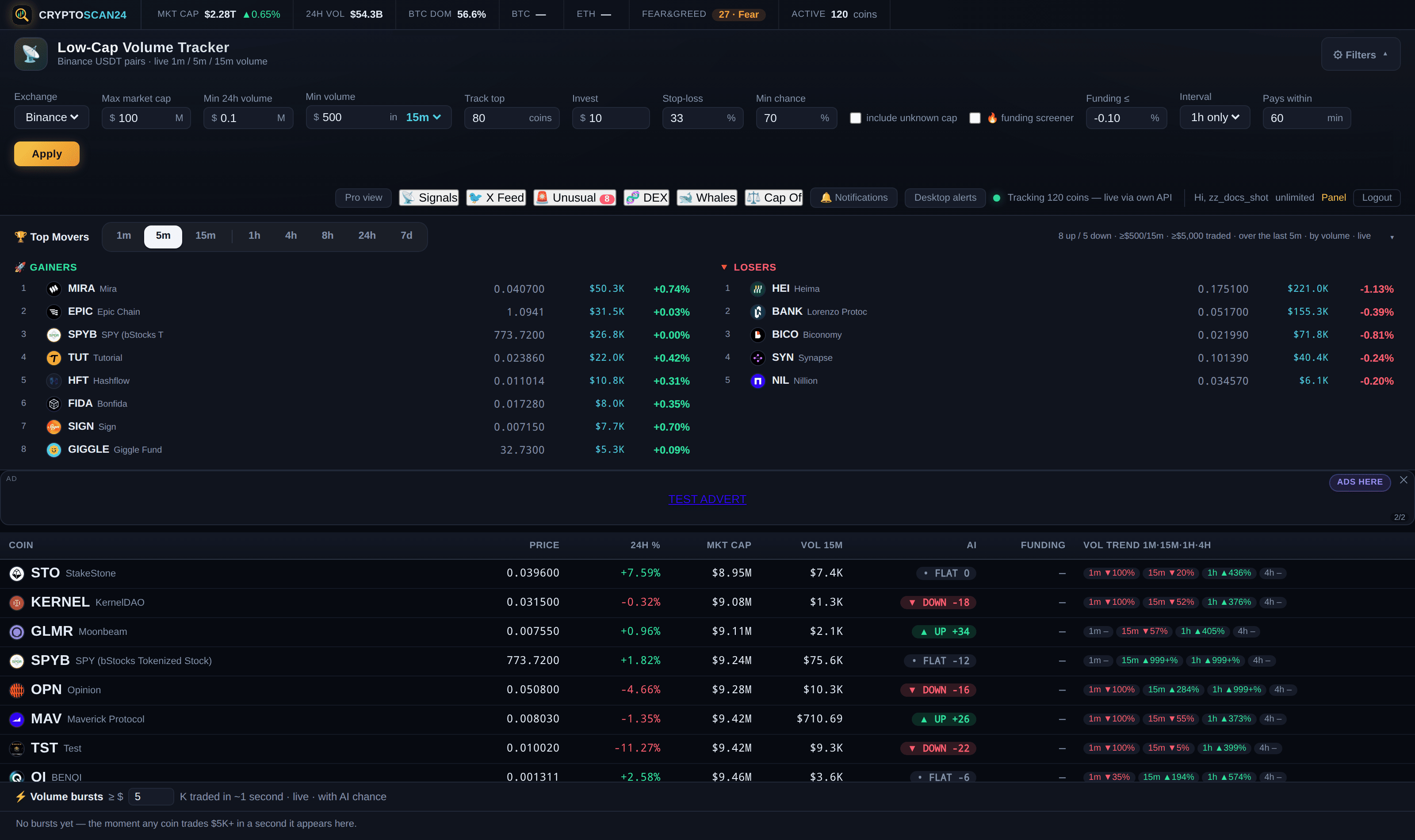
Price tells you what already happened. Volume tells you it is happening. The gap between those two is small — often a minute or two — and it is the only part of a move you can still act on.
A crypto volume burst is a coin trading an unusual amount of money inside about a second. Not unusual for the market: unusual for that coin. A token that normally turns over $200 a minute suddenly clearing $8,000 in one second is telling you something a candle chart will only show you once the candle closes.
Why one second is the right window
Most tools bucket volume into one-minute or five-minute candles. That is fine for reading history and useless for catching entries. By the time a five-minute candle closes green on heavy volume, the move it describes is five minutes old.
Cryptoscan24 measures in one-second slices. A burst is flagged the moment the trades print, scored against that coin's own recent baseline so "unusual" means something specific rather than just "big".

Setting a threshold that suits you
The threshold is yours to set. The default starts at $5,000 traded in a single second, which is a sensible floor for low-cap coins. Raise it if you only want to see size; lower it if you are hunting very early.
- $1K–$5K — very early, noisier, good for micro-caps
- $5K–$25K — the default range, real activity without the chatter
- $25K+ — only serious size, useful on larger pairs
Desktop alerts. You do not have to watch the tab. Bursts can fire a desktop notification, so the board can sit in a background window and still get your attention when something moves.
Bursts alongside unusual activity
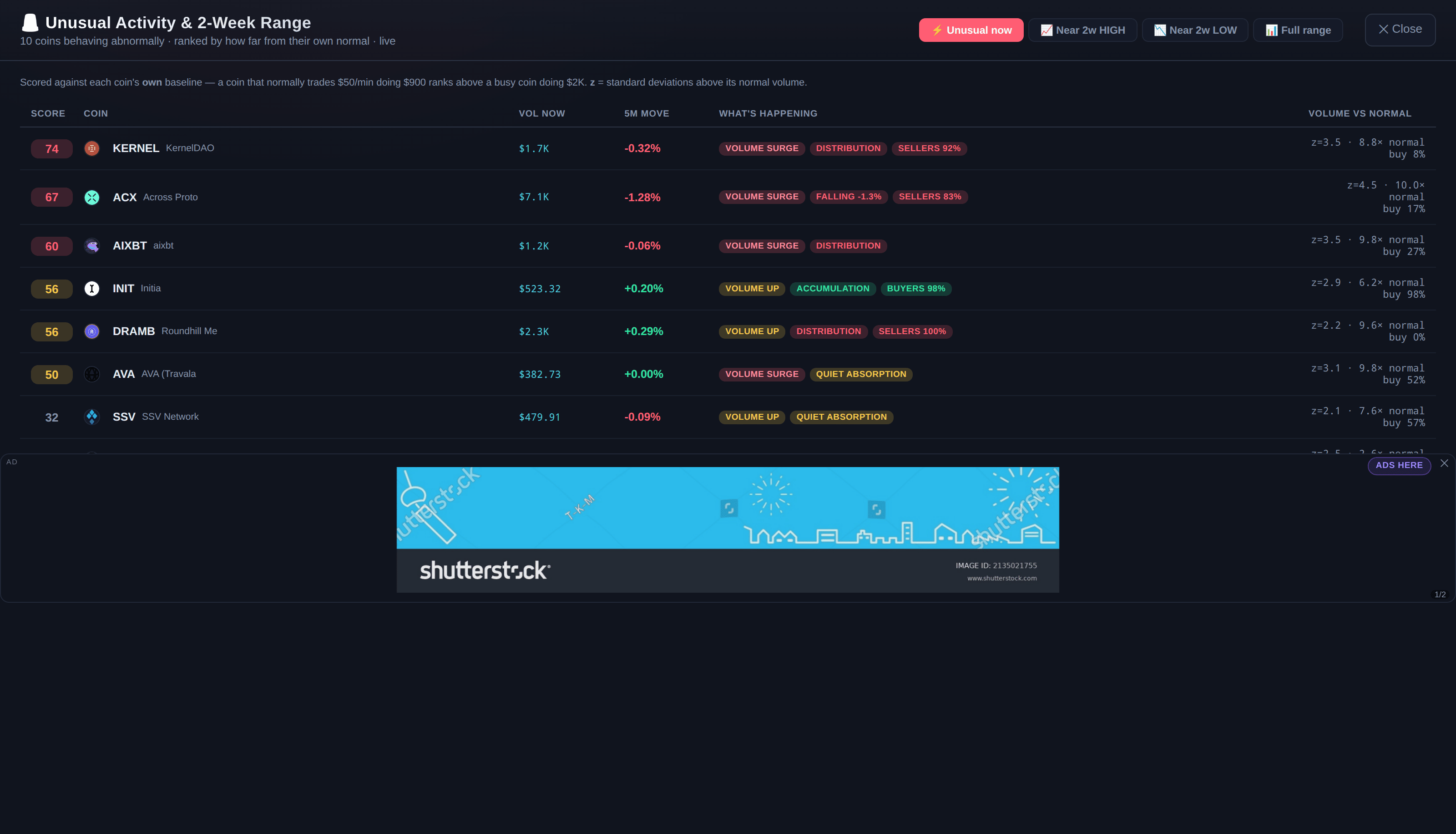
A burst is a single moment. Unusual activity is a pattern: a coin whose volume, spread or trade count has moved well outside its own recent range and stayed there. The two answer different questions, and reading them together is more informative than either alone.
Where the numbers come from
Every figure on the board comes from Cryptoscan24's own indexer, which holds the exchange connections and reads swap events directly from chain. Nothing is re-published from another aggregator, which is why the burst window can be a second instead of however often somebody else's API refreshes.
More from Cryptoscan24
Whale Tracking Across Four ChainsLarge on-chain buys and sells as they settle, read straight from the block, not a third-party feed… Why We Run Our Own Crypto IndexerMost crypto dashboards are a front end over somebody else's API. Cryptoscan24 holds the exchange connecti…Read next
- Catching New Token Launches as They Trade The window on a new token is measured in minutes. Any tool that waits for a listing, an aggregator refresh, o…
- Reading the Live Board: All Pairs, One Screen The board is the product. Everything else on Cryptoscan24 exists to feed it or to explain it. This is a pract…
- Whale Tracking Across Four Chains A whale entry is one of the few genuinely informative events in a thin market. Someone with size took a posit…