A Bitcoin Sidechain Just Lost 95% of Its Reserves. The Federation Multisig Held.
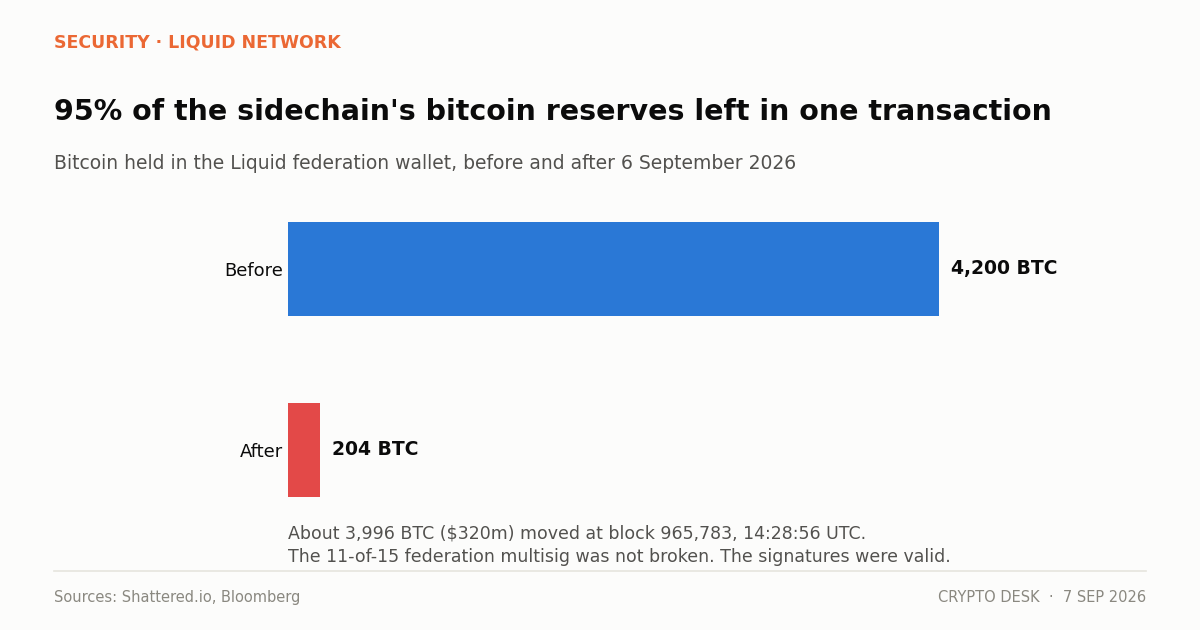
The Liquid Network hack drained roughly 3,996 BTC — about $320 million — from Blockstream's bitcoin sidechain on 6 September, taking with it around 95% of the reserves backing L-BTC.
On this page
- What the Liquid Network hack exposed about the design
- Where the flaw appears to be
- The response, and what is missing from it
- What it means for L-BTC holders
- Where this sits in a very bad year
- The uncomfortable pattern
- What to watch
- The question this raises about federated bridges
At 14:28:56 UTC on Sunday 6 September, at block 965,783, roughly 3,996 BTC left the Liquid Network's reserve wallet. At current prices that is about $320 million. It represents approximately 95% of the roughly 4,200 BTC normally held to back the L-BTC token.
The 11-of-15 multisig that guards those funds was not broken. That is what makes this incident unusual.
What the Liquid Network hack exposed about the design
Liquid is a Bitcoin sidechain operated by Blockstream. Users lock BTC on the main chain and receive L-BTC on Liquid, which settles faster and supports confidential transactions. To get their bitcoin back they peg out, burning L-BTC and unlocking the original coins.
The security model rests on a federation. Fifteen rotating functionaries operate the block-signing infrastructure, and eleven of them must sign before funds move. The broader federation had grown to 87 member organisations by the first quarter of 2026.
The point of that structure is explicit: no single rogue signer, and no single stolen key, should be able to drain the reserves. On the evidence so far, it worked exactly as designed. It just did not matter.
Where the flaw appears to be
The exploit targeted the Peg-out Authorization Key mechanism — the PAK — which governs which addresses are permitted to receive bitcoin withdrawn from the sidechain.
Liquid's own statement is the important detail. It said there is "no evidence that the PAK itself, or the federation's other signing keys, were directly compromised."
Read that carefully. If no key was stolen and no signer went rogue, then the eleven functionaries who signed the transaction were signing something they believed was a legitimate peg-out. The failure sits in the logic that decides what constitutes a valid withdrawal destination, not in the custody of the keys.
That is a considerably worse failure mode than a stolen key. A stolen key is an operational problem with an operational fix: rotate it, improve the hardware security module, tighten access. A logic flaw in the authorisation path means the system approved the theft through its normal process, and every signature on it was genuine.
The response, and what is missing from it
Blockstream paused bridge nodes network-wide and reached out to the attacker through on-chain signed messages. Multiple connected exchanges suspended L-BTC deposits and withdrawals.
The company described the actor as a "purported white hat" — a characterisation it has not independently verified. As of Monday morning no funds had been returned, and the on-chain message claiming white-hat intent came with no proof.
There is also no technical post-mortem. That absence matters more than the funds question in the short term, because every other federated sidechain and bridge using a comparable peg-out authorisation design needs to know whether the flaw is specific to Liquid's implementation or generic to the pattern.
What it means for L-BTC holders
L-BTC is supposed to be backed one-for-one by bitcoin in the federation wallet. That wallet is now missing roughly 95% of its reserves.
Until the funds are returned or a backstop is confirmed, the redemption guarantee is not credible in the ordinary sense. Exchanges suspending deposits and withdrawals is the correct response to that uncertainty, not an overreaction to it.
Whether holders are made whole depends on facts not yet public: whether Blockstream or the federation members will cover the shortfall, whether the actor returns the funds, and whether any insurance arrangement exists. None of those has been stated.
Where this sits in a very bad year
DeFi protocols lost at least $1.3 billion in the first eight months of 2026 across more than thirty exploits above $3 million. A single $320 million incident on 6 September moves that figure toward $1.6 billion in one afternoon.
The larger 2026 incidents provide context:
| Incident | Amount | Date | Method |
|---|---|---|---|
| Liquid Network | ~$320m | 6 Sept | Peg-out authorisation logic |
| KelpDAO | $290m | 18 April | Compromised developer session keys |
| Drift Protocol | $285m | 1 April | Social engineering for admin key |
| Coldcard wallets | $130m | 30 July | Firmware entropy bug |
| Tectonic (Cronos) | $120.4m | 30 Aug | Token price manipulation |
Four of the five largest incidents this year did not involve a smart contract bug. They involved keys, firmware, oracles or authorisation logic — the layer that audits do not cover.
The uncomfortable pattern
For the first time on record, compromised keys and credentials caused more DeFi losses in 2026 than smart contract vulnerabilities did. Liquid is a variation on that theme rather than an exception to it: not a stolen key, but a failure in the same operational layer that key management occupies.
A protocol can pass a flawless code audit and still lose nine figures, because the audit examines the contract and the attacker examines everything else.
Federated bridges concentrate this risk by design. They exist to move value between chains, which means holding a large pool in one place under a governance process. The multisig protects against a corrupt insider. It offers nothing against a flaw in the rules the honest signers are following.
What to watch
A technical post-mortem. The single most important disclosure outstanding. Other federated bridges cannot assess their own exposure without it.
Whether the funds return. The "purported white hat" framing is unverified. White-hat recoveries usually come with rapid, verifiable proof of intent, and that has not appeared.
Whether a backstop is announced. Who covers the shortfall if the funds do not come back determines whether L-BTC survives as a product.
Whether L-BTC trades at a discount. With exchanges suspending transfers, price discovery is limited. When it resumes, the discount to BTC is the market's own estimate of recovery odds.
Other federated sidechains. If the flaw is generic to peg-out authorisation designs instead of specific to Liquid, this is the beginning of the story, not the end.
The question this raises about federated bridges
Every bridge between chains faces the same structural problem: value has to be locked somewhere while a representation of it circulates elsewhere. That pool is the target, and no amount of decentralisation theatre changes the fact that it sits in one place.
Liquid's federation is one of the more carefully designed answers. Fifteen functionaries, eleven signatures, 87 member organisations, rotation. It is considerably more robust than the two-of-three multisigs that lost hundreds of millions in the 2021 and 2022 bridge hacks.
And it still lost 95% of its reserves, because the attack did not target the thing the design protects. The signatures were valid. The threshold was met. The rules said yes.
That is the lesson worth carrying to every other bridge: a threshold signature scheme guarantees that enough parties agreed. It guarantees nothing about whether what they agreed to was correct.
About this report. Amounts, block height, timestamp, federation structure and Blockstream's statements are as reported by Shattered.io and Bloomberg on 6-7 September 2026. Comparative 2026 incident figures are from crypto.news reporting of rekt.news data and CertiK's August report. Recovery status is as of Monday morning and may change.
Not investment or security advice. Incident details are reported as published and remain subject to revision.
Sources
- Liquid Network Hack: $320M Bitcoin Sidechain Exploit — Shattered.io
- Bitcoin Hack Drains $320 Million From Crypto Network — Bloomberg
- DeFi has lost $1.3 billion to hacks in 2026 and the same attack keeps working — crypto.news
- The Largest Hardware Wallet Exploit of 2026: the $116 Million Coldcard Hack — TRM Labs
Read next
- The Liquid Attackers Gave Back 3,400 Bitcoin and Kept $47 Million. Nobody Agreed to That. Liquid Network attackers returned 3,400 BTC of the roughly 4,000 taken, keeping about $47 million they descri…
- Injective Stopped Producing Blocks for Four Hours to Contain a $4.9 Million Exploit, Then Called It an Upgrade Injective's chain stopped for 3 hours 42 minutes on 31 August during a $4.9m exploit. The foundation calls it…
- $215 Million Gone in August, and One Attack Accounted for More Than Half of It CertiK counted $215m in confirmed crypto losses in August 2026, with $144.6m from DeFi. The Tectonic exploit …